
Introduction
The intensification and high-density practices of modern aquaculture have led to chronic oxidative stress, immune suppression, and reduced growth performance in farmed fish, posing significant challenges to industry sustainability. To address these issues, feed additives have gained prominence as a strategy to enhance aquatic animal health and production efficiency. However, concerns persist regarding their safety and efficacy, particularly due to the overuse of antibiotics and synthetic compounds, which contribute to drug residues, pathogen resistance, and environmental contamination. These challenges underscore the demand for sustainable alternatives, driving research toward eco-friendly phytogenic feed additives.
Extensive studies have established that the efficacy of immunostimulants follows a clear dose- and duration-dependent relationship.1 While short-term, high-dose administration can rapidly boost immune competence, sustained low-dose exposure is generally necessary to achieve immunomodulatory effects. Notably, supraphysiological concentrations of some immunostimulants may paradoxically suppress immune responses.2
Growing evidence highlights concerns about immunostimulant-induced fatigue in aquaculture species.3 Intermittent feeding strategies have emerged as a promising approach to counteract this effect. For instance, a 7-day-on/7-day-off peptidoglycan regimen significantly improved growth performance while preventing immune exhaustion in kuruma shrimp (Marsupenaeus japonicus).4 Similarly, a 4-day-on/3-day-off schedule enhanced both growth and immune parameters in Pacific white shrimp (Litopenaeus vannamei).5 In finfish, cyclical β-glucan administration (7-day intervals) demonstrated superior efficacy, boosting weight gain, phenoloxidase activity, and stress resistance compared to continuous feeding protocols.6
Curcumin, a polyphenolic compound derived from Curcuma longa stands out for its broad-spectrum bioactivities, including antioxidant, anti-inflammatory, and immunomodulatory properties. While its benefits in human medicine and livestock are well-established, emerging evidence highlights its potential to improve nutrition and health outcomes in aquatic species. Studies demonstrate that curcumin enhances antioxidant capacity by modulating the Nrf2-Keap1 pathway and reduces inflammation through TLR/NF-κB regulation.7 However, current research on dietary curcumin in fish has primarily examined continuous feeding, with intermittent administration remaining largely unexplored. This pulsed approach could prevent metabolic adaptation to bioactive compounds while lowering production costs, offering a potentially more sustainable aquaculture strategy. Common carp (Cyprinus carpio), a commercially important freshwater species in China, shows increased vulnerability to environmental stressors and pathogens under intensive farming conditions, often leading to growth impairment and immune dysfunction. Systematic evaluation of curcumin’s effects on growth, antioxidant status, and immune function under intermittent feeding regimes is therefore essential for optimizing its use in carp culture.
This study utilized common carp to comprehensively assess how intermittent curcumin supplementation affects growth performance, antioxidant capacity, and immune responses. The results provide both a theoretical basis for optimizing curcumin use in aquafeeds and practical insights for developing sustainable aquaculture health management strategies.
Materials and methods
Experimental diets. The basal diet formulation and proximate composition are presented in Table 1. The control diet contained fish meal, soybean meal, fish oil and soybean oil as protein and lipid sources (32.29% protein, 7.57% fat, 8.17% ash). The experimental diet was identical except for supplementation with 60 mg kg-1 curcumin (Xi’an Feida Bio-Tech Co., Ltd, China). All feed ingredients were ground through a 60-mesh sieve before processing. After sequential addition of supplements, ingredients were homogenized with soybean oil and water to form a dough. This mixture was pelleted using a laboratory extruder, air-dried at room temperature, then crumbled and sieved to obtain uniform 2-mm pellets. All diets were stored at -20℃ until use.
Fish and Experiment design. Juvenile common carp were obtained from the Freshwater Fisheries Research Institute of Shandong Province and acclimated for 15 days while fed the basal diet. Following acclimation, 450 fish (6.35 ± 0.022 g) were randomly allocated to 15 circular fiberglass tanks (300 L water/ tank, 3 tanks/group, 30 fish/tank) across five treatment groups: one control group (Regimen 1, R1) receiving the basal diet, the three intermittent feeding groups were fed a trial diet of 60 mg curcumin kg-1 for one week (Regimen 2, R2), two weeks (Regimen 3, R3), and four weeks (Regimen 4, R4), respectively, followed by feeding with the basal diet for equivalent durations, repeating this cycle for the 8-week experimental duration, and one continuous feeding group (Regimen 5, R5) receiving the trial diet. This was an eight-week experiment. Water flow was maintained at 2 L min-1 with the following parameters: 26±1 ℃, pH 7.4-7.8, dissolved oxygen≥6 mg L-1, and NH-N 0.08-0.09 mg L-1. Fish were hand-fed to satiation three times daily (07:30, 12:00, 16:30 h) under natural photoperiod for 8 weeks.
Sample collection. Following the 8-week feeding trial, fish were fasted for 24 h and anesthetized with 100 mg L-1 MS-222 (tricaine methanesulfonate; Sigma-Aldrich). Total weight and number of fish per tank were recorded for growth analysis. From each tank, three randomly selected fish were sampled for blood collection via caudal venipuncture using heparinized syringes. Immediately after collection, 50 µL of whole blood was aliquoted for respiratory burst assays. The remaining blood was centrifuged (2,000×g, 4 ℃, 10 min) to separate leukocytes and plasma, with plasma stored at -80 ℃ for subsequent analyses.
Growth performance. Individual body weights were recorded at the start (Wi) and end (Wf) of the 8-week experiment. Growth performance was evaluated using the following metrics for each treatment group: weight gain percentage (WG), specific growth rate (SGR), feed conversion ratio (FCR), viscerosomatic index (VSI), and hepatosomatic index (HSI). The calculations were performed as follows:
Weight gain (WG)=100×(Wf -Wi)/Wi
Specific growth rate (SGR, %/d) =100×(Ln Wf-Ln Wi)/t.
Feed conversion ratio (FCR)=Feed consumed (g)/(Wf-Wi)
Viscerosomatic index (VSI, %)=100×viscera weight/body weight.
Hepatosomatic index (HSI, %)=100×hepatopancreas weight/body weight.
where Wf was final body weight (g), Wi was initial body weight (g), t was experimental duration in days.
Blood biochemical measurements. Plasma aspartate aminotransferase (AST) and alanine aminotransferase (ALT) activities were measured colorimetrically using commercial kits (Mindray Bio-Medical, China) with an automated biochemical analyzer (BS-400, Mindray).
White blood cell count (WBC). The white blood cell count (WBC) of obtained blood samples was directly measured using an Auto Hematology Analyzer (BC-5300Vet, Mindray, P.R. China) with a test kit from Shenzhen Mindray Medical International Co. Ltd. (P.R. China).
Respiratory burst activity. Phagocyte respiratory burst activity was assessed via nitroblue tetrazolium (NBT; Sigma-Aldrich) reduction assay following established protocols.4,8 Absorbance was measured at 630 nm using a Multiskan spectrophotometer (Thermo Scientific) with KOH/DMSO as blank. Results were expressed as NBT reduction per 100 μL cell suspension.
Plasma tumor necrosis factor-α (TNF-α) assay. The activity of plasma tumor necrosis factor*-α (TNF-*α) was measured by the double antibody sandwich method using a TNF-α ELISA detection kit (IBL, Germany). Optical density was measured at 450 nm.
Total myeloperoxidase (MPO) assay. Peripheral blood leukocytes were isolated using density gradient centrifugation with modifications from Misra et al.9 Myeloperoxidase activity was determined following established methods.10,11 Briefly, leukocyte suspensions (1×10⁶ cells/well, in triplicate) were incubated with 0.02% CTAB in Hank’s balanced salt solution (Ca²/Mg²-free, phenol red-free) for 20 min. The reaction was initiated by adding 20 mM TMB and 5 mM H2O2, terminated after 2 min with 2 M H2SO4, then centrifuged (600×g, 15 min). Supernatant absorbance was measured at 450 nm using a microplate reader (Bio-Rad).
Plasma antioxidant indicators measurement. The supernatant was collected for analysis. The activities of superoxide dismutase (SOD) was measured using xanthine oxidase method.12 The reactive oxygen species (ROS) and malondialdehyde (MDA) levels were measured using monitoring the oxidation of 2’,7’-dichlorofluorescin by spectrofluorometry,13 and thiobarbituric acid colorimetry,14 respectively.
Challenge test. Gram negative Aeromonas hydrophila was originally isolated from the infected fingerling C. carpio. The seven day LC50 was determined by intraperitoneal injection of 48 fish with graded concentrations of A. hydrophila (10^6; 47; 48; 49^ and 1010 CFU/ml) at 24℃, yielding a day 7 LC50 of 5×10⁶ CFU/ml.
For the challenge test, fish were divided into triplicate groups (10 fish/group) and injected intraperitoneally with 0.5 ml of bacterial suspension (5×10⁶ CFU ml-1 in sterile saline) per 50 g body weight. Fish were fasted during the 4-day observation period, with daily mortality recorded.
Statistical analysis. Data are expressed as mean±SEM. After logarithmic transformation, one-way ANOVA was performed using SPSS 23.0 (IBM). Significant differences among treatments (P < 0.05) were further analyzed by Duncan’s multiple range test to compare curcumin feeding regimens.
Results
Growth. After 8 weeks feeding, dietary curcumin significantly affected common carp growth performance across feeding regimes (Table 2). Initial body weight, FCR and survival rate did not differ among groups (P > 0.05). Compared to controls, final body weight was significantly lower in R2 and R3 (P < 0.05) but higher in R4 (P < 0.05), while R5 showed no difference. WGR was significantly greater in R4 and R5 versus other groups (P < 0.05), with R4 outperforming R5 (P < 0.05). No differences occurred in VSI or CF. However, HSI was significantly reduced in R2 and R4 (P < 0.05), suggesting curcumin may modulate hepatic metabolism.
Blood biochemical measurements and haematological analyses. Dietary curcumin significantly influenced physiological parameters in common carp across feeding regimes (Table 3). Plasma ALT and AST activities were significantly lower in R2 and R4 compared to controls (P < 0.05), but did not differ among treatment groups. TP levels increased significantly in R4 and R5 versus controls (P < 0.05), while AKP activity peaked in R4, exceeding control, R2 and R3 values (P < 0.05) but matching R5. Blood glucose levels remained unaffected by curcumin supplementation across all groups (P > 0.05).
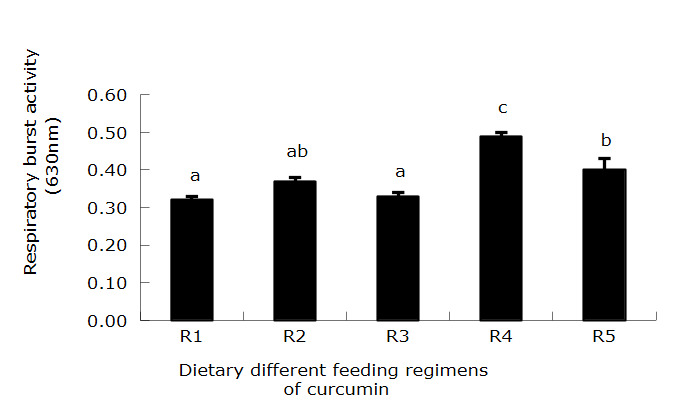
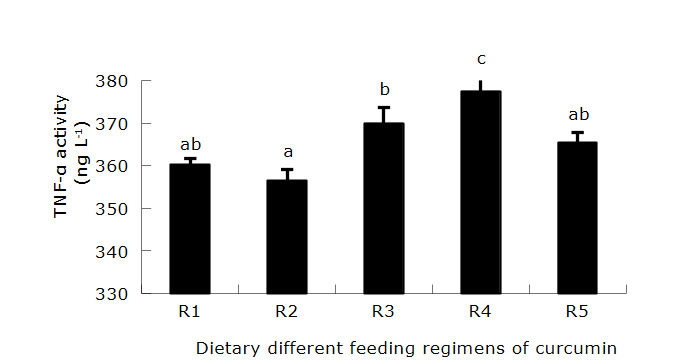
Immune response. Respiratory burst activity peaked in R4, significantly exceeding all other groups (P < 0.05; Fig. 1). R5 showed intermediate activity, higher than R3 and controls (R1) but lower than R4. TNF-α levels followed a similar pattern, with R4 values significantly surpassing R2 and controls (Fig. 2).


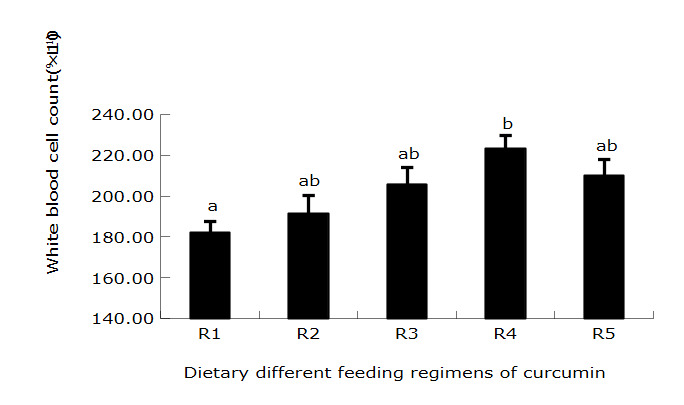
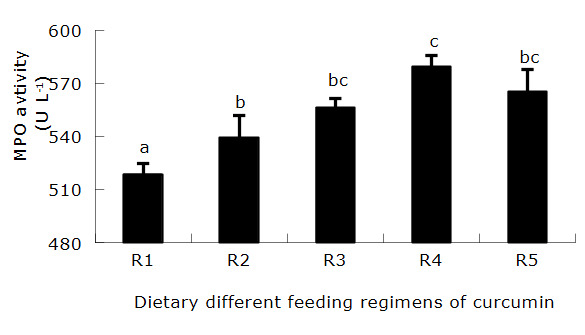
White blood cell (WBC) counts showed a unimodal distribution, peaking at R4 (Fig. 3). Myeloperoxidase (MPO) activity increased significantly in all treatment groups versus controls, with R4 showing the highest levels (P < 0.05; Fig. 4).


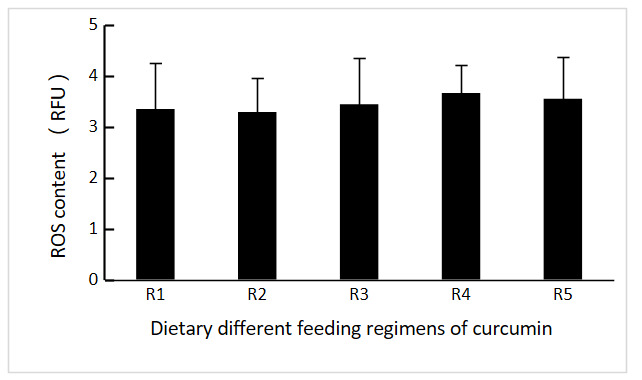
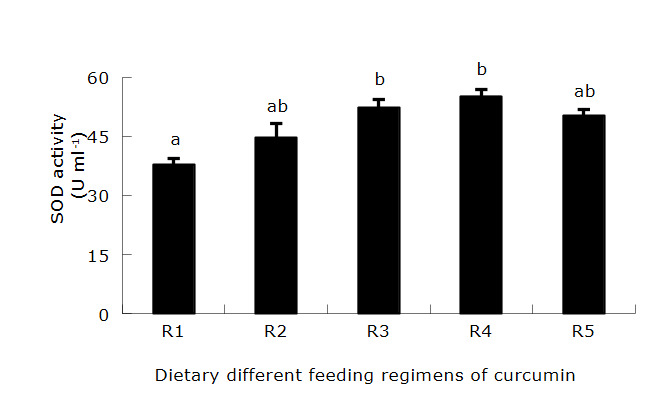
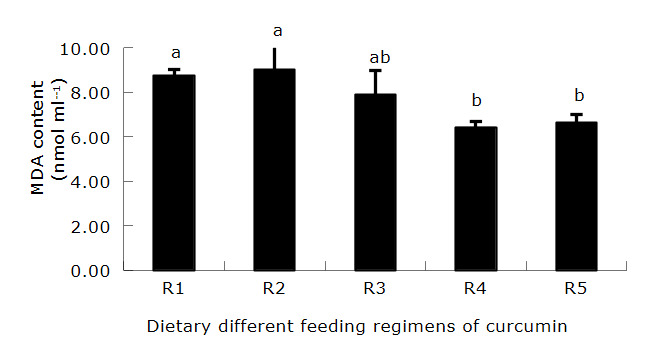
While reactive oxygen species (ROS) remained unaffected (Fig. 5), SOD activity increased in R3-R5 compared to controls (P < 0.05; Fig. 6). Conversely, MDA levels decreased significantly in R4 and R5 (P < 0.05; Fig. 7).


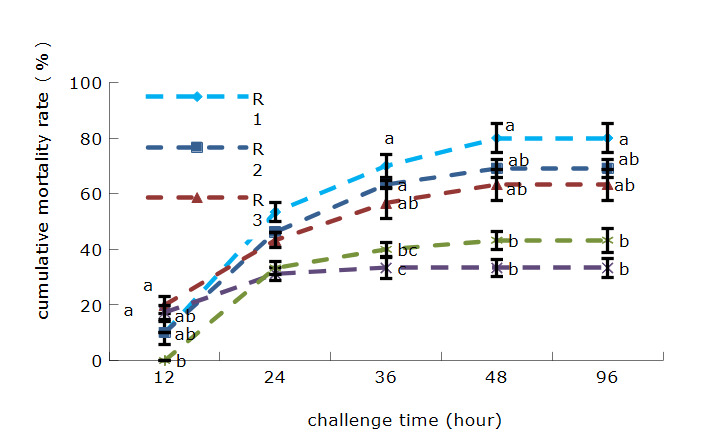
Challenge test. Dietary curcumin significantly affected cumulative mortality in A. hydrophila-challenged common carp during the 4-day observation period (Fig. 8). At 12 h post-infection, R5 showed significantly lower mortality than controls (P < 0.05). By 36 h, both R4 and R5 exhibited reduced mortality versus R2 and controls (P < 0.05), with R4 showing the strongest protection. This protective effect persisted at 48 h in R4 and R5 (P < 0.05 versus controls), indicating time- and regimen-dependent efficacy of curcumin against bacterial infection.

Discussion
Our study establishes that dietary curcumin supplementation enhances growth performance, innate immunity, and disease resistance in common carp (C. carpio), consistent with previous reports (Zhang et al., 2014). While the precise mechanisms underlying growth promotion require further investigation, the immunostimulatory hypothesis,4 whereby immunomodulators improve growth through immune activation and enhanced pathogen resistance provides a compelling framework. Comparative analysis revealed the 4-week pulsed regimen (R4) outperformed both continuous feeding (R5) and controls, suggesting continuous administration may induce immunological fatigue. These findings align with established immunostimulant cycling principles,15 indicating intermittent delivery prevents immunosuppression while optimizing growth. Thus, the R4 regimen represents an optimal curcumin administration strategy for C. carpio aquaculture.
The innate immune system comprises a complex regulatory network where disease resistance emerges from the integrated activity of multiple immune components.11 Since individual immune parameters often show asynchronous responses, we developed a comprehensive evaluation framework to assess curcumin’s immunomodulatory effects in common carp. Using A. hydrophila-a major aquaculture pathogen,12 we conducted challenge tests, a well-established method for evaluating disease resistance.8,14 Key findings revealed: (1) At 12 h post-challenge, continuous feeding (R5) showed significantly lower mortality than controls; (2) By 36 h, intermittent feeding (R4) demonstrated superior protection, with mortality rates 35-40% lower than R1-R3; (3) Temporal patterns suggested continuous administration provides rapid but transient protection, while pulsed feeding offers sustained immunological benefits. These results support Takayuki et al.'s16 immunological fatigue hypothesis and were further elucidated through analyses of multiple immune enzyme activities.
In commercial aquaculture, natural immunostimulants offer potential for enhancing innate immunity and preventing disease outbreaks.17 While probiotics17 and functional carbohydrates18 have been extensively studied, their optimal administration protocols remain unclear. Our study systematically evaluates curcumin feeding regimens to establish the most effective strategy for enhancing innate immunity and A. hydrophila resistance in common carp (C. carpio). Leukocyte populations play crucial roles in defense against microbial challenges.19 TNF-α, a key macrophage-activating factor, enhances phagocytic activity during pathogen clearance. This cytokine boosts respiratory burst intensity, phagocytic efficiency, and nitric oxide production responses conserved across diverse fish species including rainbow trout (Oncorhynchus mykiss), turbot (Scophthalmus maximus), and African catfish (Clarias gariepinus). Our results show that continuous curcumin administration (R5) significantly increased leukocyte counts, TNF-α levels, and respiratory burst activity compared to controls. However, the slightly higher values observed with the 4-week pulse therapy (R4) compared to R5 (though not statistically significant) may indicate, on one hand, a mild degree of immune fatigue during continuous administration. On the other hand, prolonged sustained feeding may lead to adaptive metabolic downregulation in curcumin absorption or signaling pathways, whereas such a downregulated state is recalibrated under pulsed treatment regimens.
Curcumin is well-established as a potent activator of antioxidant defenses, primarily through superoxide dismutase (SOD) induction. This antioxidant response enhances phagocytic activity, as vertebrate immune cells generate microbicidal reactive oxygen species (ROS)-including superoxide anions (O2-), hypochlorous acid (HOCl), hydrogen peroxide (H2O2), and hydroxyl radicals (•OH) - during pathogen clearance. While essential for immunity, excessive ROS production can cause oxidative damage. SOD, the key metalloenzyme in peroxide metabolism, converts O2- to H2O2 and O2, reducing oxidative stress.20 Malondialdehyde (MDA), a cytotoxic lipid peroxidation product generated by •OH attack on membranes, compromises cellular integrity (Freeman and Crapo, 1982). Such antioxidant mechanisms of phytogenic compounds are well-characterized in fish. Our results show that curcumin supplementation significantly improved the oxidative status of common carp. The 4-week intermittent regimen (R4) showed the highest SOD activity, with statistically significant increases over controls and numerically higher (though non-significant) levels compared to other treatment groups (R2, R3, R5). Conversely, R4 exhibited significantly lower MDA concentrations than R1-R3, with marginally reduced levels versus R5. While both continuous (R5) and intermittent (R4) administration enhanced antioxidant responses, the R4 protocol offers distinct advantages, as it avoids the economic inefficiency and potential immunological fatigue risks associated with prolonged continuous feeding. Therefore, the 4-week intermittent regimen represents the optimal balance between antioxidant enhancement and sustainable aquaculture practice.
Neutrophil primary granules contain antimicrobial peptides and cytotoxic compounds released during degranulation.21 These cells play central roles in fish immunity through phagocytosis, chemotaxis, and respiratory burst responses-key biomarkers for health assessment. Myeloperoxidase, a neutrophil-specific enzyme released during respiratory burst, serves as a quantitative marker of antimicrobial activity.22 Our results show that MPO activity paralleled respiratory burst intensity, indicating curcumin’s dual stimulation of neutrophil functions, and the 4-week pulsed regimen (R4) elicited significantly stronger MPO and respiratory burst responses than other protocols. These findings suggest intermittent administration (R4) optimally activates neutrophil immunity, while continuous feeding may induce suboptimal responses through immunological adaptation. The R4 regimen’s superiority aligns with immunostimulant cycling principles, whereas continuous exposure could trigger compensatory immunosuppression-consistent with reported immunomodulator fatigue in teleosts.
AST and ALT serve as reliable biomarkers of hepatic integrity in teleosts, where elevated levels indicate hepatocellular damage . Our results show that intermittent curcumin administration significantly affected these hepatic markers: both R2 (alternate-week) and R4 (4-week interval) groups showed significantly lower AST and ALT activities than controls, with numerically reduced values compared to continuous feeding (R5). No significant differences were observed between R5 and controls. These findings indicate that optimal curcumin supplementation maintains hepatic health without inducing hepatomegaly or metabolic stress, and administration regimen critically determines hepatoprotective efficacy, with R2 and R4 protocols showing superior liver protection and reduced immunostimulant fatigue. These results align with previous observations in grass carp (Ctenopharyngodon idella).
Serum TP concentration plays crucial roles in lipid transport, osmoregulation, and pH homeostasis in fish.23 As a reliable indicator of nonspecific immunity, TP levels correlate with growth performance (Luo et al., 2007). Various nutritional interventions support this relationship: 0.1% oligosaccharides increased TP in rainbow trout (Oncorhynchus mykiss)24; fig polysaccharides enhanced TP and lysozyme activity in crucian carp (Carassius auratus) (Wang et al., 2011), and plant extracts improved both TP and disease resistance in common carp. Our results confirm these associations: continuous feeding (R5; 60 mg/kg curcumin) significantly increased serum albumin, while the 4-week intermittent regimen (R4) showed the highest TP concentrations, weight gain rates, and immune parameters. These findings establish serum TP as an integrative biomarker reflecting both growth enhancement and immune potentiation in teleosts.
AKP is a key metabolic enzyme regulating calcium-phosphorus homeostasis and phosphoryl group transfer, while also serving as an immune competence biomarker.25 Its immunomodulatory function stems from modifying pathogen surfaces to enhance recognition and phagocytosis, which is a critical disease resistance mechanism in fish. Previous studies confirm AKP’s immune role: allicin (0.4-0.8%) and Lycium barbarum polysaccharides (0.066-0.132%) increased serum AKP activity in grass carp (Ctenopharyngodon idella) (Song et al., 2011), while feeding regimes affected AKP levels in tilapia (Oreochromis aureus) (Luo et al., 2007). Our results show the 4-week intermittent regimen (R4) significantly increased AKP activity versus controls, matching continuous feeding (R5) efficacy. This suggests that both methods effectively modulate immune function via AKP and R4, which offers practical advantages, including cost reduction and lower immunological fatigue risk, consistent with immunostimulant cycling principles.
Conclusion
This study demonstrates that a 4-week intermittent curcumin regimen (R4) significantly enhances growth performance, immune function (WBC count, respiratory burst activity, TNF-α levels), antioxidant capacity (SOD activity), and disease resistance in common carp (C. carpio). The R4 protocol not only improved weight gain and pathogen resistance but also offers a cost-effective strategy for aquaculture by reducing additive usage while maintaining efficacy. These findings provide a theoretical foundation for using pulsed curcumin supplementation as an immunoprotectant in sustainable aquaculture practices.
Acknowledgements
This work was supported by Natural Science Foundation of Shandong Province (ZR2022MC003), the Modern Agriculture Industrial Technology System special project-the National Technology System for Conventional Freshwater Fish Industries (CARS-46), the Research and Innovation Talent Fund of Shandong Freshwater Fisheries Research Institute (DSY2024KC02) and Key Research and Development Program of Shandong (2021LZGC029). The authors gratefully acknowledge the scientific research personnel of the Fish Nutrition and Processing and Department, Freshwater Fisheries Research Institute of Shandong Province, Jinan City, PR China for their assistance during the sampling. We are also grateful to the management and staff of the fish farm at the Freshwater Fisheries Research Institute of Shandong Province for their assistance throughout the entire trial period.
Authors’ Contribution
Conceptualization: Yuanyuan Zhang (Equal), Liping Song (Equal). Writing – review & editing: Yuanyuan Zhang (Lead). Writing – original draft: Yuanyuan Zhang (Lead). Investigation: Liping Song (Equal), Guohong Ma (Equal), Shuquan Mao (Equal), Yanhua Zhang (Equal), Bingli Wang (Equal). Formal Analysis: Peng Xu (Equal), Jun Wu (Equal), Shuren Zhu (Equal), Wuxiao Zhang (Equal). Supervision: Hong Lu (Lead). Project administration: Han Ke (Equal).
Competing Interests
The authors declare that they have no known competing financial interests or personal relationships that could have appeared to influence the work reported in this paper.
Ethical Conduct Approval - IACUC
All procedures were carried out in accordance with the guidelines of the Institutional Animal Care and Use Committee at the Freshwater Fisheries Research Institute of Shandong Province.
Informed Consent Statement
All authors and institutions have confirmed this manuscript for publication.
Data Availability Statement
All data generated or used during the study appear in the submitted article.