
Introduction
Information, along with energy and raw materials, is regarded as a fundamental and strategic resource for national economic and social development, and it has become an integral component of modern society. With the continuous advancement of China’s national maritime power strategy, China’s Marine Information Service Industry has achieved certain development; however, a significant gap remains compared to major international maritime powers, such as the United States, Europe, Japan, and South Korea. The Fifth Plenary Session of the 19th Central Committee of the Communist Party of China proposed accelerating the development of modern service industries and advancing digital development. Developing the Marine Information Service Industry is of great significance for accelerating digital development in the marine field and plays a prominent role in advancing the building of a maritime power, ensuring the stability of the national supply chain, driving industrial development, and addressing people’s employment needs. As a fundamental and strategic resource for socioeconomic development, information, alongside energy and raw materials, underpins the operation of modern society. With China’s maritime power strategy advancing in depth, the country’s Marine Information Service Industry (MISI) has made steady progress in recent years, supported by policies such as the national informatization development strategy and local marine economic plans. The State Oceanic Administration’s “14th Five-Year Plan for Marine Informatization Development” further clarifies key tasks such as marine data sharing and intelligent observation, providing a clear policy framework for MISI.1,2 However, compared with established maritime powers including the United States, European Union (EU) member states, Japan, and South Korea, China’s MISI still faces gaps in technological innovation, industrial agglomeration, and institutional mechanisms.
Conceptual Definitions and Classifications
Conceptual Definition of the Information Service Industry
Internationally, definitions of the information service industry vary.
The United Nations Economic and Social Council (ECOSOC) defines the information service industry as the sector that, relying on new information technologies and information processing methods, encompasses the R&D and production of information products and the provision of information services.3
Countries within the European Union (EU) hold relatively consistent views. The Statistical Classification of Economic Activities in the EU (NACE) categorizes the information service industry as encompassing a range of services, including information processing and handling, network services, software products, and system integration services.
The Ministry of Internal Affairs and Communications (MIC) of Japan defines the information service industry as the general term for various industries related to activities such as the production, acquisition, processing, storage, and circulation of information.4
The Analysis No. 22 released by the National Bureau of Statistics of China (NBS) defines the information service industry as a socioeconomic activity in which service providers help information users solve problems through unique strategies and content.
Some local governments have also defined the information service industry. For instance, the Hebei Provincial Government defines it as a modern service industry that utilizes information technology as its primary supporting means, focusing on information transmission services, digital content services, and information technology services as its core content.5
Classification of the Information Service Industry
From a global perspective, the information service industry encompasses a wide range of content, involves multiple industries, and is in a state of constant evolution; therefore, a universally accepted international classification standard has yet to be established.
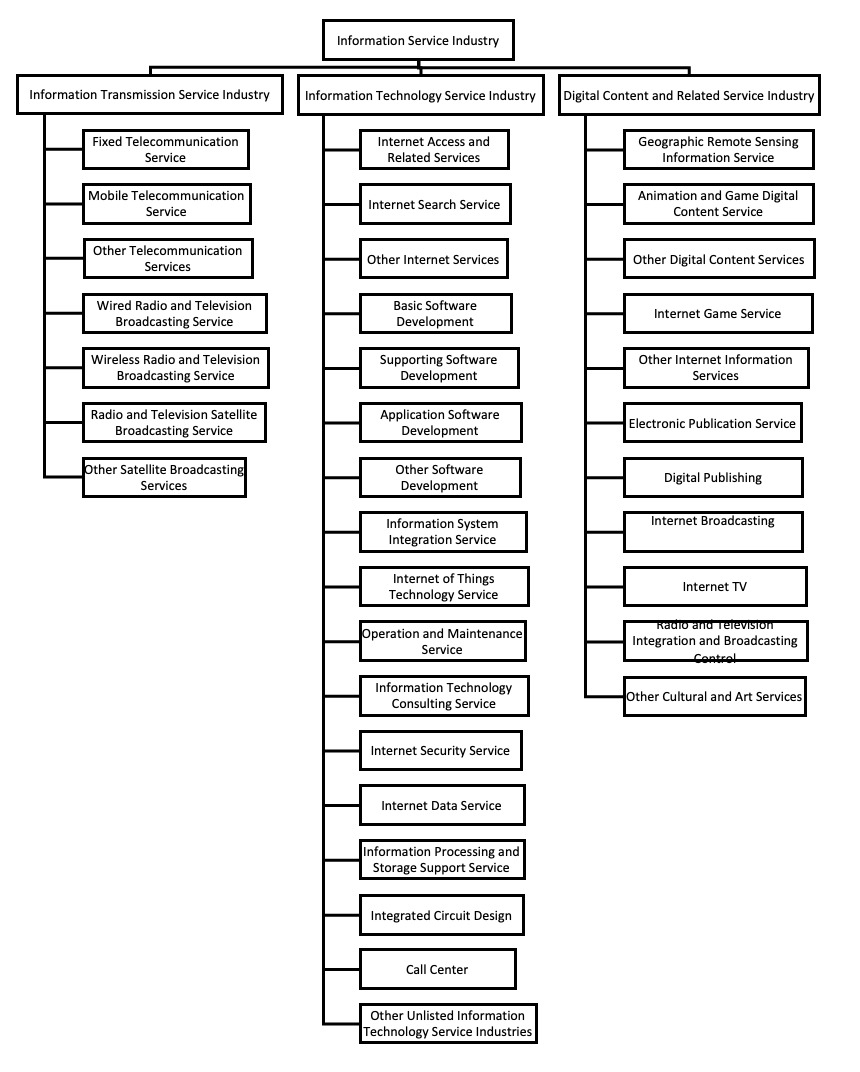
The information industry was first defined and classified as an independent industry in the North American Industry Classification System (NAICS). Subsequently, countries around the world began to follow this example, and the United Nations’ International Standard Industrial Classification of All Economic Activities (ISIC Rev.4) also referenced NAICS’ classification of the information industry.6 NAICS classifies industries starting from Category 42 as service industries, with the information industry categorized under Category 51; China’s information service industry can be regarded as corresponding to Category 51 in NAICS. North America’s classification of the information service industry emphasizes information dissemination and services, primarily consisting of the following entities: entities that produce and distribute information and cultural products; entities that provide methods and means for transmitting and distributing these products; and entities engaged in information services and data processing.7 China currently adopts the Classification of High-Tech Industries (Services) (2018), issued by the National Bureau of Statistics of China (NBS) in 2018. This classification mainly includes information transmission services, IT services (information technology services), and information resource services (digital content industry); for specific classifications, see Figure 1 below.
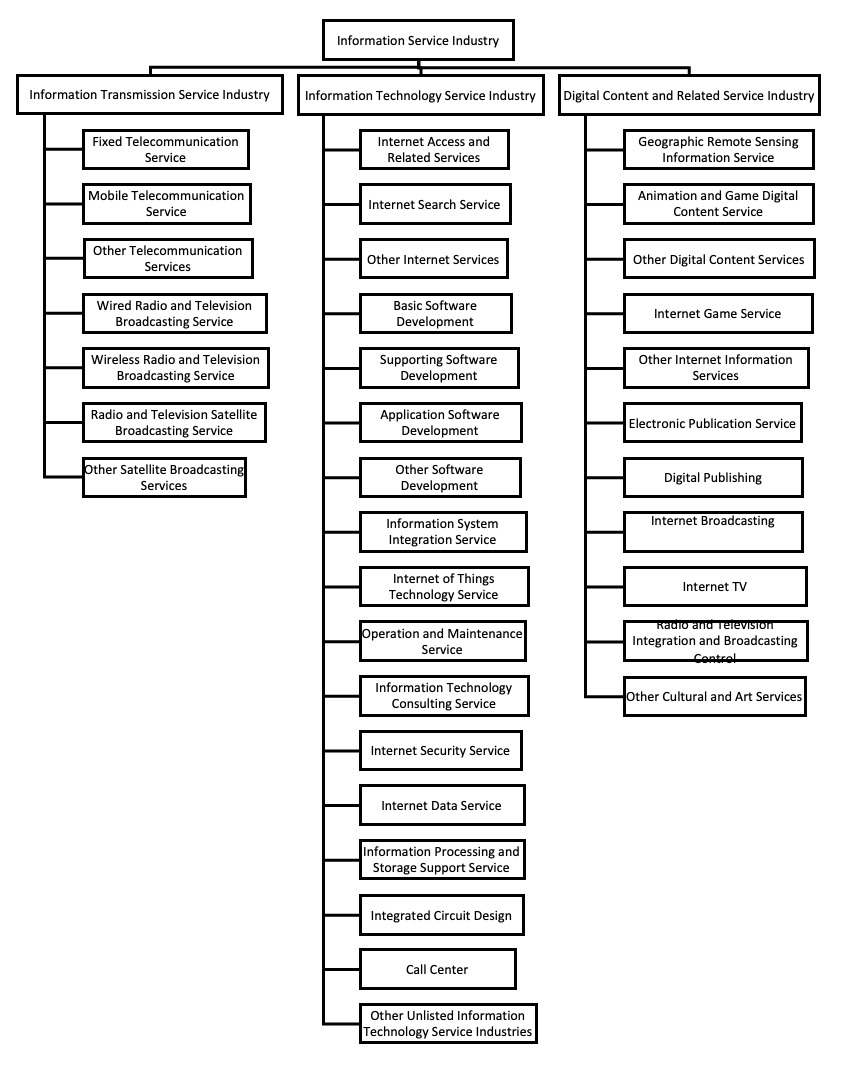
As shown in Figure 1, the three core sectors of China’s information service industry form a mutually supportive system, with information transmission services serving as the channel, IT services providing technical support, and information resource services as the content core—all laying the foundation for the specialized development of MISI. This classification aligns with the global trend of integrating “technology-infrastructure-content” in information service industries, as noted in the OECD’s Information Technology Outlook 2023.2The marine information service industry is an emerging industry built on the foundation of the information service industry. Meanwhile, it possesses characteristics distinct from those of the information service industry. Combining the features of marine science and technology as well as marine industries, this paper defines the marine information service industry as “an industrial activity aimed at meeting the demand for marine information services, supported by modern marine technical equipment, modern information and communication technologies, and engaging in the collection, development, and utilization of marine information resources”.
In terms of extension, it mainly includes the collection, storage, processing, dissemination, and utilization (value-added activities) of marine information. As the industrial division of labor has gradually refined driven by scientific and technological development, the marine information service industry will evolve into an independent industrial sector. Unlike manufacturing industries centered on commodity production, this industry primarily provides services to society in the form of information content and information products by developing and utilizing marine information resources; it is a product of the “servitization of the economy” and the “intellectualization of services”.
Furthermore, the marine information service industry is undergoing a development process from “traditional” to “modern”, from “institutional” to “industrial”, and from “information-focused” to “service-oriented”, gradually becoming a producer service industry. The Marine Information Service Industry (MISI) is an emerging industry built on the foundation of the information service industry. Meanwhile, it possesses characteristics distinct from those of the information service industry. Combining the features of marine science and technology as well as marine industries, this paper defines MISI as “an industrial activity aimed at meeting the demand for marine information services, supported by modern marine technical equipment, modern information and communication technologies, and engaging in the collection, development, and utilization of marine information resources”.
In terms of extension, it mainly includes the collection, storage, processing, dissemination, and utilization (value-added activities) of marine information. As the industrial division of labor has gradually refined, driven by scientific and technological development, MISI will evolve into an independent industrial sector. Unlike manufacturing industries centered on commodity production, this industry primarily provides services to society in the form of information content and information products by developing and utilizing marine information resources; it is a product of the “servicization of the economy” and the “intellectualization of services”.
Furthermore, MISI is undergoing a development process from “traditional” to “modern”, from “institutional” to “industrial”, and from “information-focused” to “service-oriented”, gradually becoming a producer service industry. This evolutionary path is consistent with the development law of marine service industries summarized in Marine Service Industry Development Report 2022.8
Classification of the Marine Information Service Industry
Regarding the marine information service industry, most countries have not established a clear classification for this industry. This paper classifies it from five perspectives: marine information collection, transmission, processing and storage, system development and integration, and sharing and application. It mainly covers the collection of marine environmental information; information transmission via equipment such as marine satellites, underwater communication systems, and submarine optical cables; storage of marine information data; development of marine information platforms and marine software; and application services such as marine meteorological forecasting and marine geographic surveying and mapping.
In recent years, the marine information service industry has gradually formed three core industries based on marine information resources:
First is the marine information equipment manufacturing industry related to the collection, transmission, storage, processing, and utilization of marine information. It covers numerous industries and products such as marine and offshore engineering electronic equipment, marine electronic components and integrated circuits, special marine electronic equipment and instruments, marine communication equipment, marine detection equipment, as well as unmanned, networked, and intelligent equipment.
Second is the marine information engineering and technology industry, formed by various engineering and technical services that must be implemented to acquire marine information and data. It includes marine survey engineering and technical services, marine environmental monitoring engineering and technology, various engineering and technical services for the development and utilization of marine resources, various engineering and technical services adopted in the process of marine science and technology R&D, and various engineering and technical services adopted in the process of marine rights and interests protection—including services such as electronic technology, information technology, communication engineering and technology, and network engineering and technology.
Third is the marine information service industry, which mainly refers to providing various application services of marine information resources directly oriented to user needs. Its scope involves the collection, publication, consultation, intelligence, and decision-making services of information such as marine science and technology information, marine environmental information, marine surveying, mapping, and resource information, marine disaster information, marine economic information, marine policies and regulations, marine military intelligence information, and marine political rights and interests information. Regarding MISI, most countries have not established a clear classification for this industry. This paper classifies it from five perspectives: marine information collection, transmission, processing and storage, system development and integration, and sharing and application. It mainly covers the collection of marine environmental information; information transmission via equipment such as marine satellites, underwater communication systems, and submarine optical cables; storage of marine information data; development of marine information platforms and marine software; and application services such as marine meteorological forecasting and marine geographic surveying and mapping.
Domestic and International Experience Analysis
Through research on the industrial systems of major maritime countries, such as the United States, Canada, and Australia, no detailed classification of the marine information service industry has been found; it is still categorized under the broader scope of the information service industry. Therefore, it is particularly important to study the development experience of the information service industry in foreign countries. Through the research on the industrial systems of major maritime countries such as the United States, Canada, and Australia, no detailed classification of MISI has been found; it is still categorized under the scope of the information service industry. Therefore, it is particularly important to study the development experience of the information service industry in foreign countries.
Domestic and International Experience Analysis of the Information Service Industry
International Experience Analysis
Globally, the developed countries such as the United States, Europe, Japan, and Canada share similarities in their development paths for the information industry, which are mainly reflected in the following six aspects: First, they establish government departments for the overall management of this industry and formulate relevant laws and regulations to arouse the market’s attention to this industry, increase support for small and medium-sized enterprises (SMEs), and facilitate market formation. Second, they develop government procurement systems that favor this industry to drive the growth of industrial demand. Third, the government strengthens the foundation and expands market demand by advancing the construction of basic supporting facilities for this industry. Fourth, they formulate industrial standard systems to achieve the interactive integration of standards, policies, and corporate R&D. Fifth, they build unified regional markets to further promote industrial development. Sixth, they create policy roadmaps for industrial development and set clear goals and tasks for the industry’s future development. Globally, developed countries such as the United States, Europe, Japan, and Canada share similarities in their development paths for the information industry, which are mainly reflected in the following six aspects: First, they establish government departments for the overall management of this industry and formulate relevant laws and regulations to arouse the market’s attention to this industry, increase support for small and medium-sized enterprises (SMEs), and facilitate market formation. Second, they develop government procurement systems that favor this industry to drive the growth of industrial demand. Third, the government strengthens the foundation and expands market demand by advancing the construction of basic supporting facilities for this industry. Fourth, they formulate industrial standard systems to achieve the interactive integration of standards, policies, and corporate R&D. Fifth, they build unified regional markets to further promote industrial development. Sixth, they create policy roadmaps for industrial development and set clear goals and tasks for the industry’s future development.
In summary, major maritime powers share common strategies for developing the information service industry, including centralized management, government procurement support, infrastructure investment, and standardized industrial systems, which provide valuable references for China’s practice.
Domestic Experience Analysis
From the perspective of management institutions, the Ministry of Industry and Information Technology (MIIT) of China, as the competent authority for the country’s software industry, is mainly responsible for researching and formulating national information industry development strategies, policies, and overall plans. The China Software Industry Association (CSIA), together with its local associations and branch associations in various fields, are self-regulatory management organizations for the software and information service industry. Entrusted by MIIT, they are primarily responsible for providing professional guidance, supervision, and inspection for the certification work of local software enterprise certification institutions.
From the perspective of top-level planning and design, China has been strategically planning the development of the information service industry since the Fifth Plenary Session of the 15th Central Committee of the Communist Party of China (CPC). The 16th CPC National Congress established the strategic arrangement of “leveraging informatization to drive industrialization, using industrialization to boost informatization, and taking a new path of industrialization”. In May 2006, the State Council required concentrating efforts on advancing the development of the information service industry and using information to improve resource utilization efficiency.9 Additionally, in the Several Opinions on Accelerating the Development of the Service Industry, the State Council clearly proposed to actively develop the information service industry.
From the perspective of industrial policies, China adopts preferential policies, such as tax reductions and subsidies, for enterprises related to the information service industry to promote industrial development. It also encourages governments at all levels to prioritize purchasing domestic information services. The State Taxation Administration (STA) implements the method of immediate refund of value-added tax (VAT) for eligible information service enterprises,10 and newly established domestic software enterprises enjoy the “two-year exemption and three-year halving” tax policy. In the Key Points for Government Procurement Work in 2015, it is clearly stated that efforts should be made to strengthen informatization and standardization, improve government procurement policies, and support the development of relevant industries.
In terms of talent cultivation, in 2003, the Ministry of Industry and Information Technology (MIIT) issued the Notice on Issuing the Implementation Opinions on National Information Technology Talent Cultivation. The Ministry of Education (MOE) organizes the Computer Technology and Software Professional and Technical Qualification (Level) Examination to serve the software and information service industry. This examination is used for talent selection, replacing evaluation with examinations, and sets examination categories guided by talent demand. At the same time, enterprises actively cooperate with major universities to establish internship bases and carry out targeted training for information technology talents needed by enterprises.
In terms of financial support, the state has established a number of special funds to provide financial assistance to the information service industry, including the Central Financial Special Fund for the Development of the Service Industry and the Central Financial Special Fund for the Development of Strategic Emerging Industries. At the local level, the Ministry of Industry and Information Technology (MIIT) of Zhejiang Province invests over 100 million yuan annually in the information service industry. The Hangzhou municipal government encourages enterprise qualification upgrading and awards 300,000 yuan and 600,000 yuan, respectively, to enterprises that have obtained CMMI Level 4 and CMMI Level 5 certifications.11 The Jinan municipal government directly provides cash rewards to enterprises that pass the ITSS (Information Technology Service Standards) certification for the first time, with a maximum reward of 150,000 yuan12 From the perspective of management institutions, the Ministry of Industry and Information Technology (MIIT) of China, as the competent authority for the country’s software industry, is mainly responsible for researching and formulating national information industry development strategies, policies, and overall plans. The China Software Industry Association (CSIA), in collaboration with its local and branch associations across various fields, serves as a self-regulatory management organization for the software and information service industry. Entrusted by MIIT, they are primarily responsible for providing professional guidance, supervision, and inspection for the certification work of local software enterprise certification institutions.
To summarize, China’s information service industry development relies on a combination of top-level planning, policy incentives, talent cultivation, and financial support, forming a policy-driven development model that has laid a solid foundation for MISI’s growth.
Experience Analysis of the Marine Information Service Industry
International Experience Analysis
In terms of management institutions, at the national level, the United States has established the National Ocean Council (NOC). Within the government, the National Oceanic and Atmospheric Administration (NOAA) serves as the competent authority and oversees the National Ocean Service (NOS) and the National Environmental Satellite, Data, and Information Service (NESDIS), both of which are responsible for providing operational marine information services.
Canada has set up a high-level, dedicated national agency for centralized marine management: the Department of Fisheries and Oceans (DFO). It also has the Interdepartmental Marine Committee at the deputy ministerial level, which is responsible for coordinating work with other marine-related departments.
The United Kingdom has established the Marine Management Organization (MMO) to oversee marine-related affairs, and has a Marine Information Centre under its purview to support marine decision-making.
Japan did not have a centralized agency for overall marine management in the early 2000s; it was not until 2007 that it established the Headquarters for Comprehensive Ocean Policy and appointed a Minister in Charge of Ocean Policy,13 which addressed the issues of duplication of functions and unclear authority among various agencies. Japan also established the Japan Agency for Marine-Earth Science and Technology (JAMSTEC), under which the Value-Added Information Generation Institute (VAIG) operates. VAIG is responsible for conducting research and development based on numerical analysis results to generate advanced and optimized information. In terms of management institutions, at the national level, the United States has established the National Ocean Council (NOC). Within the government, the National Oceanic and Atmospheric Administration (NOAA) serves as the competent authority and oversees the National Ocean Service (NOS) and the National Environmental Satellite, Data, and Information Service (NESDIS), both of which are responsible for providing operational marine information services.
In terms of scientific and technological support, countries have primarily advanced in three areas: first, in space-based technology, the United States has adopted a diversified development approach, launching both dedicated marine satellites and integrated marine environmental observation satellites, and when paired with aerial technologies such as unmanned aerial vehicles (UAVs), these methods form a comprehensive marine satellite observation system capable of real-time monitoring of sea surface height, wind fields, sea surface salinity, seabed topography, sea surface temperature, precipitation, and radar positions at sea; meanwhile, Europe has focused on developing integrated marine observation satellites, including the ERS series and other marine monitoring satellites, and beyond basic marine data, its polar satellites also observe greenhouse gas forcing data, while Japan, for its part, boasts highly mature technologies for satellite-borne oceanographic instruments and remote sensors, with the U.S.-launched OrbView-2 and other satellites adopting Japanese technology.14 Second, in sea-based technology, countries primarily rely on oceanographic research vessels, fixed buoys, and autonomous drifting profilers to collect data—U.S. research vessels can accurately detect seabed topography, shallow/deep multi-beam systems, ocean currents, and seafloor surface geology, while Japanese vessels conduct large-scale seabed topographic and geological surveys, mapping continental shelf bathymetry and generating 3D seabed images; as for buoys, by 2020, the international Argo Program (Autonomous Real-Time Global Ocean Observing Network) had deployed approximately 16,000 profiling floats globally, with 4,000 active units, among which the United States leads with 2,211 active floats, while China contributes 98, reflecting a significant gap.15 Third, in underwater observation, unmanned underwater vehicles (UUVs), subsea observatory networks, and underwater sensor networks are widely used internationally—the U.S.-developed REMUS and Japan’s AE1000 lead the world in endurance and diving depth; for subsea observatory networks, the U.S.-Canada NEPTUNE (North East Pacific Time-series Undersea Networked Experiments) has deployed 20–30 stations at a depth of 3,000 meters, while Europe’s ESONET (European Seafloor Observatory Network) monitors pan-European seabed networks, and notably, the U.S. Navy’s Sea web acoustic network is a leading system for underwater communication and navigation; furthermore, leveraging the vast amounts of marine data acquired, countries such as the United States, Canada, and the EU have established integrated marine service platforms for advanced data analytics, with examples including Canada’s Marine Sensing and Decision System and the Marine initiative led by Ireland and Norway.
Domestic Experience Analysis
Since the proposal of the maritime power strategy, the marine economy has received widespread attention. In recent years, the China Marine Information Service Industry has also continued to develop, relying on marine informatization and Digital Ocean.
In terms of management institutions, the Marine Information Service Industry falls under the category of the information service industry, and its competent authority remains the Ministry of Industry and Information Technology (MIIT). The policies and management measures applicable to the information service industry also cover the Marine Information Service Industry. For the Marine Information Service Industry specifically, the national competent department in charge of marine information-related operations is mainly the Ministry of Natural Resources.
In terms of government planning, since the maritime power strategy was introduced during the 12th Five-Year Plan period, the development of the marine sector has accelerated. The government has formulated plans covering multiple aspects, including marine data acquisition, marine resource accounting, marine informatization, and the development of marine standard systems. Local governments of coastal regions have also formulated corresponding plans for the development of the Marine Information Service Industry.
In terms of scientific and technological support, four marine satellites, from HY-1A to HY-1B, have been serving the marine observation needs. Meanwhile, multiple observation stations have been deployed along the coast, a large number of buoys have been placed in coastal waters, submarine optical cables have been co-built with multiple countries, and breakthroughs have been made in underwater robots. China is developing marine data acquisition capabilities from three dimensions: space-based, shore-based, and underwater, and plans to build a space observation system and a seabed observation system. Additionally, China has established a number of systems and platforms dedicated to marine transaction services, marine supervision, marine data services, and marine forecasting services. Examples include the Ningbo Offshore Radar Supervision System, the Hainan Island Coastal Offshore Radar Integrated Monitoring System, the China Shipping Network, the Global Aquatic Product Trading Center, and the China Marine Economy Information Network.
In terms of talent cultivation, the Norwegian government has identified the marine sector as one of the key areas for future development at the national level, and has made a series of adjustments in education to align with the needs of the marine sector, establishing specialized marine courses and programs to nurture high-level, high-quality marine talents.16 The United States has elevated marine science education to the national policy level through reports such as Ocean Blueprint for the 21st Century and America’s Living Oceans, and is committed to integrating marine science knowledge into the enlightenment education of American youth. The government has incorporated the Marine Culture Guide into primary and secondary school curricula, popularizing marine culture knowledge nationwide; this approach has proven highly effective in nurturing marine talent. Meanwhile, U.S. universities have cultivated a large number of interdisciplinary talents by offering interdisciplinary programs, second degrees, and integrating social sciences, humanities, and natural sciences across various disciplines.
Additionally, the Aberdeen Declaration, signed by EU member states, requires universities and government agencies at all levels to promote marine education. The UK Marine Strategy (2010-2025) mandates stimulating public understanding and research of marine science to raise awareness of marine issues.17 At the same time, European universities have continuously implemented mechanisms for nurturing interdisciplinary talents, designing and rolling out initiatives such as the Erasmus Mobility Programme and Marie Curie Actions, which have facilitated the cultivation of interdisciplinary talents in marine information.
In terms of capital investment, the Japanese government implements large-scale government procurement, enabling domestic information service products to account for over 50% of the market share. When procuring products such as information software and services, the South Korean government prioritizes domestic products. Meanwhile, through the IT Korea Future Strategy, the South Korean government has invested 189.3 trillion won in the electronic information industry.18 As a maritime power, Norway has established the Research Council of Norway as the core organization for the technological advancement of the marine industry. This organization has set up several marine funds for marine technology research and development, and actively promotes the industrialization of scientific research outcomes. In 2019, Norway invested $ 88.67 million in the marine industry to transform the traditional sector, $ 50 million to advance marine science and technology R&D, and $ 27.7 million to enhance education standards.19In summary, major maritime powers adopt diversified capital support models for MISI, including government procurement preferences, special R&D funds, and industrial transformation investments, which effectively stimulate industrial development.
In terms of laws and regulations, as early as the 18th century, the United States enacted the House-keeping Act, which stipulates that the government is obligated to disclose information. Later, it adopted a series of acts concerning privacy and government data disclosure, explicitly requiring the government to make all information that can create value available to the public, while also explicitly specifying the scope of data that is not to be disclosed.20,21
For Japan, it has also used legal means to support the industry: first, it issued the Act on Promotion of Information Technology to guide market attention toward the information service industry; second, it enacted laws related to intellectual property protection to safeguard the rights and interests of information service enterprises; and finally, it introduced laws related to promoting the development of high-tech industries to advance the information service industry further.
The EU has formulated documents such as Public Information in the Information Society, the Open Data Directive, the European Data Strategy, and the Directive on the Reuse of Public Sector Information. From the perspective of government data disclosure, these initiatives have fostered a market environment of open information and laid a solid foundation for further leveraging the value of information.
To sum up, international legal frameworks for MISI focus on three core areas: government information disclosure, intellectual property protection, and industrial development promotion, providing institutional guarantees for the healthy development of the industry.
Since the proposal of the maritime power strategy, the marine economy has received widespread attention. In recent years, China Marine Information Service Industry has also continued to develop, relying on marine informatization and Digital Ocean.
In terms of management institutions, the Marine Information Service Industry falls under the category of the information service industry, and its competent authority remains the Ministry of Industry and Information Technology (MIIT). The policies and management measures applicable to the information service industry also cover the Marine Information Service Industry. For the Marine Information Service Industry specifically, the national competent department in charge of marine information-related operations is mainly the Ministry of Natural Resources.
In terms of government planning, since the maritime power strategy was put forward during the 12th Five-Year Plan period, the development of the marine sector has been put on a fast track. The government has formulated plans covering multiple aspects, including marine data acquisition, marine resource accounting, marine informatization, and the development of marine standard systems. Local governments of coastal regions have also formulated corresponding plans for the development of the Marine Information Service Industry.
In terms of scientific and technological support, four marine satellites, from HY-1A to HY-1B, have been serving marine observation. Meanwhile, multiple observation stations have been deployed along the coast, a large number of buoys have been placed in coastal waters, submarine optical cables have been co-built with multiple countries, and breakthroughs have been made in underwater robots. China is developing marine data acquisition capabilities from three dimensions: space-based, shore-based, and underwater, and plans to build a space observation system and a seabed observation system. Additionally, China has established a number of systems and platforms dedicated to marine transaction services, marine supervision, marine data services, and marine forecasting services. Examples include the Ningbo Offshore Radar Supervision System, the Hainan Island Coastal Offshore Radar Integrated Monitoring System, the China Shipping Network, the Global Aquatic Product Trading Center, and the China Marine Economy Information Network. Since the proposal of the maritime power strategy, the marine economy has received widespread attention. In recent years, China’s MISI has also continued to develop, relying on marine informatization and Digital Ocean.
In terms of management institutions, MISI falls under the category of the information service industry, and its competent authority remains MIIT. The policies and measures applicable to the information service industry also cover MISI. For MISI specifically, the national competent department in charge of marine information-related operations is mainly the Ministry of Natural Resources.
In terms of government planning, since the maritime power strategy was introduced during the 12th Five-Year Plan period, the development of the marine sector has been accelerated. The government has formulated plans covering multiple aspects, including marine data acquisition, marine resource accounting, marine informatization, and the development of marine standard systems. Local governments of coastal regions have also formulated corresponding plans for the development of MISI.
In terms of scientific and technological support, four marine satellites, from HY-1A to HY-1B, have been serving marine observation. Meanwhile, multiple observation stations have been deployed along the coast, a large number of buoys have been placed in coastal waters, submarine optical cables have been co-built with multiple countries, and breakthroughs have been made in underwater robots. China is developing marine data acquisition capabilities from three dimensions: space-based, shore-based, and underwater, and plans to build a space observation system and a seabed observation system. Additionally, China has established a number of systems and platforms dedicated to marine transaction services, marine supervision, marine data services, and marine forecasting services. Examples include the Ningbo Offshore Radar Supervision System, the Hainan Island Coastal Offshore Radar Integrated Monitoring System, the China Shipping Network, the Global Aquatic Product Trading Center, and the China Marine Economy Information Network.
In conclusion, China’s MISI has achieved initial progress in institutional setup, policy planning, and technological infrastructure, but there is still room for improvement in centralized management and technological integration compared with international advanced levels.
Experiences and Insights
By synthesizing the development experiences of the information service industry and MISI at home and abroad, it is not difficult to find that there is much experience worthy of our reference in aspects such as the establishment of management institutions, strategic planning, scientific and technological support, talent cultivation, policy support, opening-up and sharing, and laws and regulations. Specifically:
First, centralized management is the choice of most maritime powers. All countries have organizations for the overall coordination of maritime affairs at the national level and have established departments for comprehensive marine management within their government agencies.
Second, they have clear strategic plans for the marine industry, emphasize the importance of marine informatization, and attract the attention of the market and capital to the Marine Information Service Industry through national plans or relevant policies.
Third, internationally, countries with advanced marine information capabilities all vigorously develop information technology and marine science and technology. They advance marine information technology from the three dimensions of space-based, sea-based, and underwater, actively build marine information infrastructure, integrate various marine data observation and monitoring systems, and have formed a comprehensive integrated network for marine data acquisition—one that achieves full spatiotemporal coverage across the sky, atmosphere, sea surface, and seabed and incorporates multi-disciplinary elements.
Fourth, most maritime powers start with two aspects in talent cultivation: popularizing marine culture among lower grades and nurturing highly educated marine talents. They incorporate marine elements into primary school textbooks, establish market-oriented marine-related majors in universities, and cultivate interdisciplinary talents in marine information through measures such as curriculum design, dual-degree programs, and the popularization of natural sciences across all majors.
Fifth, in the early stage of the development of the (Marine) Information Service Industry, all countries invested substantial funds in technological R&D, infrastructure development, and government procurement of services. They also implemented tax reductions and exemptions for relevant enterprises to promote the industry’s development.
Sixth, with access to massive amounts of observational data, major maritime powers overseas actively establish marine information service platforms, accelerate the opening up and sharing of basic marine data, better tap into the value of data, and serve various industries.
Seventh, the development of the Marine Information Service Industry relies on an advanced information service industry. Maritime powers with strong marine information capabilities—such as the United States, Japan, and Germany—have established a series of laws related to information. They utilize legal means to promote the development of the information and marine industries, curb unfair competition to maintain market order, and protect intellectual property rights. Meanwhile, governments in Europe and the United States also vigorously promote the openness of government information and data, classifying data through legal provisions and utilizing publicly available data to create value.
By conducting a comparative analysis of the experiences in the information service industry and Marine Information Service Industry at home and abroad, and taking into account the current international and domestic situations as well as China’s actual conditions, this paper puts forward relevant suggestions for the further development of China’s Marine Information Service Industry:
First, there is a need for an organizational management body with coordinated management capabilities to effectively advance the implementation of relevant policies and measures in the development of the Marine Information Service Industry.
Second, it is necessary to conduct top-level planning and design for the Marine Information Service Industry, in order to avoid low-level, redundant construction and disordered, unfair competition, which would otherwise lead to resource waste and inefficient development.
Third, strong scientific and technological support is required, especially support for collaborative scientific and technological innovation capabilities. The Marine Information Service Industry encompasses cutting-edge and high-end technologies, including marine science and technology, information technology, and mechanical and electronic engineering. Only through collaboration and synergy can the efficiency and progress of the industry innovative development be enhanced.
Fourth, a large number of human resources specialized in interdisciplinary fields—including marine studies, information technology, and marketing—are needed for support, along with supporting social welfare policies to safeguard human resources.
Fifth, it is essential to foster broad market demand for the Marine Information Service Industry. On the one hand, channels such as government procurement should be used to increase the broad demand for marine information services from marine public welfare undertakings. On the other hand, policies such as fiscal and tax subsidies and the transformation and upgrading of the marine industry should be adopted to stimulate demand for the Marine Information Service Industry from productive marine industries, including the digitalization and servitization of the marine manufacturing industry.
Sixth, efforts should be made to accelerate the promotion of a clustered and networked collaborative development model. The development of the Marine Information Service Industry involves multiple fields and links, such as industrial design, market operation and maintenance, technological R&D, and information service models. Only through division of labor, collaboration, clustering, and networked development can the industry benefit from the division of labor, specialization, and efficient development of modern industries.
Seventh, a multi-dimensional industrial development policy and institutional system that supports the high-quality development of the Marine Information Service Industry is required. This includes systems and laws related to marine information confidentiality, as well as marine information transaction pricing systems, among others.
Authors’ Contribution
Conceptualization: Rong Hua, Yijie Chai Chenzhenzi Liu; Writing - original draft preparation: Rong Hua, Chenzhenzi Liu,Yijie Chai; Writing - review and editing: Rong Hua, Chenzhenzi Liu, Yijie Chai; Supervision: Rong Hua, Yijie Chai, Chenzhenzi Liu.
Competing of Interest – COPE
No competing interests were disclosed.
Ethical Conduct Approval – IACUC
This study did not involve any experimental research on animals or plants.
Informed Consent Statement
All authors and institutions have confirmed this manuscript for publication.
Data Availability Statement
All are available upon reasonable request.