
Introduction
The marine information industry is a crucial component of the digital economy, encompassing the development and utilization of marine resources, marine science and technology, the protection of marine rights and interests, and the protection of the marine ecological environment. It is characterized by broad coverage, a long industrial chain, and a strong driving role in the economy.
In the context of aquaculture and capture fisheries, marine information systems constitute a critical enabling layer for sustainable production, supporting activities such as real-time environmental monitoring, early warning systems for disease, site planning for farming, and adaptive fisheries management. Quantifying the scale and structure of the marine information industry, therefore, provides indirect but essential insight into the technological capacity underpinning aquatic resource sustainability and food security.1–3
To more accurately reflect the development status of the marine information industry, this paper conducts research on the definition of the marine information industry and the composition of its industrial chain, classifies the types of the marine information industry, carries out the identification of marine information enterprises, and establishes an accounting method system for the added value of the marine information industry. On this basis, it tentatively calculates the added value of the marine information industry, enabling accurate evaluation and providing references for promoting its development and advancing high-quality decision-making in the marine economy.
By offering a transparent and replicable value-added accounting framework, this study contributes to the evidence base that regulators, researchers, and industry stakeholders need to evaluate investments in digital infrastructure that increasingly shape the productivity, resilience, and environmental performance of aquaculture and fisheries systems.4,5
Definition and Industrial Chain Composition of the Marine Information Industry
Industry Definition
The marine information industry uses marine information as its primary resource and is supported by information technology, communication technology, media tools, and other relevant means. It involves a series of industrial activities related to production, collection, transmission, processing, refinement, storage, and application of marine information, including hardware manufacturing, software development, and information services.6
Industrial chain composition
The marine information industry chain is mainly composed of a four-tier system of “perception-transmission-processing-application” as well as basic materials and electronic components. The perception system mainly focuses on the construction of core perception systems for air, space, shore, ground, and sea, as well as the production of carrying platforms and supporting engineering equipment. The transmission system primarily involves the production of various wideband and narrowband technical equipment, intelligent routing equipment, and the construction of systems for maritime communication networks. The processing system centers on data aggregation and “brain computing”—namely big data and cloud computing. The application system mainly refers to the branch industrial chains derived from the application of data sources and big data mining results in different fields. Basic materials and electronic components mainly refer to the electrochemical materials and components that support the marine information industry chain.
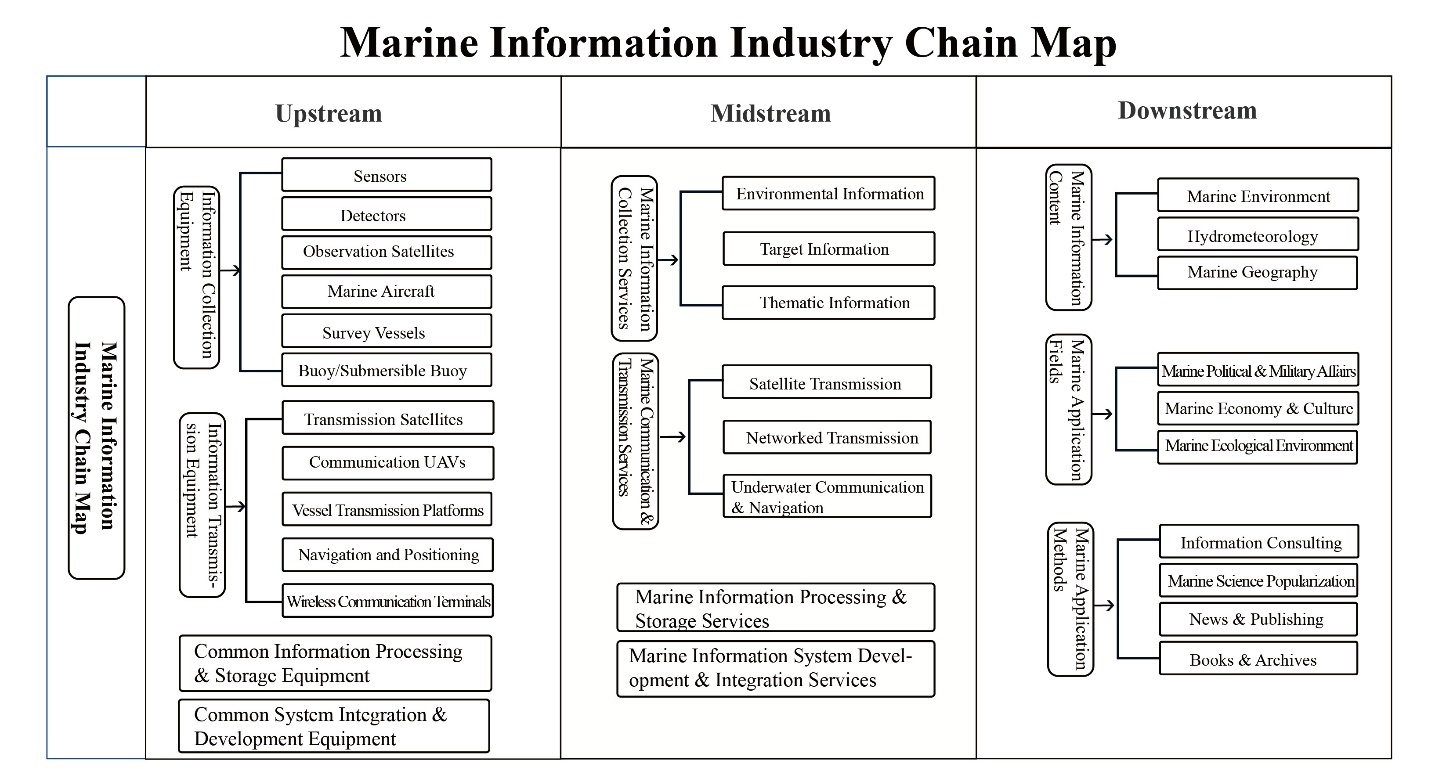
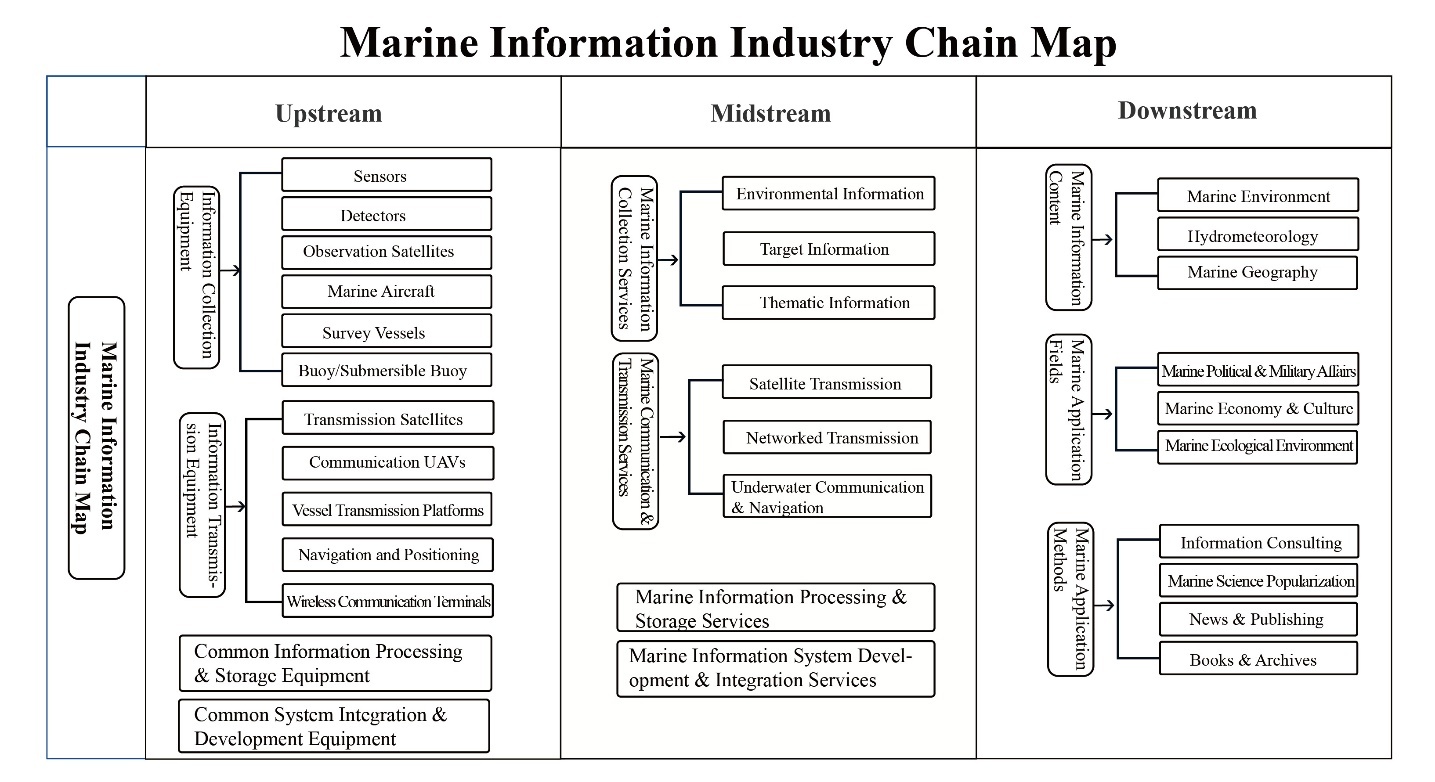
The marine information industry chain consists of three major parts: marine information equipment manufacturing, marine information production, and application services (Figure 1).
The upstream sector provides the equipment foundation for marine information services, mainly referring to the manufacturing of equipment required for marine information collection, transmission, processing and storage, and system development. The midstream sector primarily involves information production services such as marine information collection, transmission, processing and refinement, and system integration and development. The downstream sector mainly refers to the final marine information application services provided to groups including governments, markets, and individuals.7
-
Analysis of the upstream sector Marine information equipment manufacturing is centered on marine sensors and marine detection instrument manufacturing, supplemented by the manufacturing of observation and transmission carrying platforms (such as marine observation and transmission satellites, buoys, ships, waterborne aircraft, and deep submersibles) and radio communication terminals. Representative enterprises include the Institute of Oceanographic Instruments, Shandong Academy of Sciences; China Aerospace Science and Technology Corporation; Zhongxing Instrument (Shenzhen) Co., Ltd.; and CETC Satellite Navigation Operation Service Co., Ltd.
-
Analysis of the midstream sector Marine information collection services acquire information on the natural and social attributes of the ocean through surveying and mapping, remote sensing, and investigation. Marine information transmission services mainly deliver information through space-based, air-based, sea-based, and ground-based communication systems, with the current primary methods being mobile base stations, maritime radio, and communication satellites. Marine information storage and processing services rely on data centers, with a key focus on marine information processing and storage technology. Marine information system development and integration services involve software development and system integration tailored to the characteristics of marine information to better present it. Representative enterprises include Shenzhen Weidu Data Technology Co., Ltd.; Asia-Pacific Satellite Broadband Communications (Shenzhen) Co., Ltd.; CETC (Zhejiang) Marine Communication Technology Co., Ltd.; and Shandong E-Hualu Information Technology Co., Ltd.
-
Analysis of the downstream sector Marine information application services mainly output information to the demand side. By content, they can be divided into services such as marine environment, marine geography, marine hydrology, and marine meteorology. By application field, they include services like marine political information, marine military information, marine economic information, marine cultural information, and marine ecological environment information. By application method, they cover marine consulting, marine science popularization, and marine news and publishing. By application form, they involve marine books and marine archives. This segment has a low degree of marketization and is mainly dominated by public welfare services.8
The described “perception–transmission–processing–application” chain closely parallels the data lifecycle in modern aquaculture and fisheries, where sensor-derived observations (e.g., water quality, biomass, behavior) are transmitted, processed, and translated into operational decisions that directly affect feed efficiency, animal welfare, ecosystem impacts, and harvest outcomes.2,9
Research on Industry Classification and Value-Added Calculation of the Marine Information Industry
Industry Classification
With reference to the line classification method in the National Economic Industry Classification (GB/T 4754-2017) and based on the nature of marine information industry activities mentioned earlier, the marine information industry is divided into two layers: the core layer and the support layer,10 corresponding to 5 industrial categories in total. The core layer of the marine information industry comprises four categories: marine information collection, marine information communication and transmission, marine information storage and analysis, and marine information application and sharing services (Table 1). The support layer includes one category, namely the marine information supporting industry.
-
Marine Information Collection: The manufacturing of marine information collection equipment includes the manufacturing of marine space-based observation equipment, marine air-based observation equipment, marine shore-based observation equipment, and marine sea-based/seabed-based observation equipment. Marine information collection services cover marine environmental information collection, marine target information collection, and marine thematic information collection.
-
Marine Information Communication and Transmission: The manufacturing of marine information communication and transmission equipment includes the manufacturing of marine satellite communication equipment, marine networked communication equipment, and underwater communication equipment. Marine information communication and transmission services include marine satellite transmission services, marine networked transmission services, and underwater communication and navigation services.
-
Marine Information Storage and Analysis: The manufacturing of marine information storage and analysis equipment includes the manufacturing of complete marine computers, marine computer peripheral equipment, and marine information communication equipment. Marine information processing and analysis services cover marine information processing services and marine information system development and integration.
-
Marine Information Application and Sharing Services: Marine information application services refer to marine thematic application information services. Marine information sharing, promotion, and exchange services include marine information sharing services, and marine scientific and technological information promotion and exchange services.
-
Marine Information Supporting Industry: The manufacturing of marine information electronic components includes the manufacturing of specialized equipment for marine semiconductor devices, the manufacturing of marine electronic components and electromechanical assembly equipment, the manufacturing of marine sensitive components and sensors, the manufacturing of marine specialized electronic materials, and the manufacturing of other marine information electronic components and specialized electronic materials. The sales and repair of marine information equipment include the wholesale and leasing of marine information equipment, and the repair of marine information equipment. Marine information management and support cover marine information public management services, marine information research and experimental development, marine information education and training, marine information intellectual property services, and marine information-related financial services.
From an aquaculture and fisheries perspective, the proposed classification clarifies how upstream sensing and communication technologies, midstream data processing services, and downstream application services jointly support core activities such as site selection, production optimization, stock assessment, and ecosystem-based management, thereby reinforcing the practical relevance of marine information industry statistics for aquatic resource governance.1,3
Enterprise Identification (for the Marine Information Industry)
Enterprises serve as the foundation for conducting marine economy statistics. To gain a comprehensive understanding of the development status of the marine information industry and accurately characterize the production and operation conditions of marine information enterprises, it is crucial to carry out the identification and certification of marine information enterprises. This paper examines the application of big data mining technology for enterprise identification, capitalizing on the advantages of big data technology in processing massive amounts of data11 to comprehensively verify the marine-related nature and information attributes of enterprises. By combining online information such as enterprise names, locations, core business scopes, patent information, software copyright information, bidding and tendering information, and recruitment information, and utilizing technologies and algorithms including big data,12 cloud computing, and machine learning, this study realizes the preliminary screening of the preliminary list of marine economy enterprises as well as their identification and certification.
Accurate identification of marine information enterprises is particularly important for aquaculture-dominant coastal regions, where data-service providers, sensor manufacturers, and analytics firms increasingly operate across both marine technology and food-production sectors, blurring traditional industrial boundaries and necessitating refined statistical approaches.3,4
Data Collection and Data Processing
Through multiple channels, such as data sharing and the Internet, a list of the bottom entities in marine economic activity is compiled. The data primarily includes directory information on basic enterprise activity entities, basic industrial and commercial information, patent information, software copyright information, bidding and tendering information, and recruitment information. Data from various data sources are uniformly collected and stored in a database.13 Technical methods, such as format conversion, data association, and multi-source data fusion, are employed to process the data. Enterprise names and unified social credit identifiers are used as associated fields to ensure the uniqueness of enterprise data.
-
Enterprise Identification and Classification Enterprise identification and certification mainly rely on technologies such as text feature matching, and make a comprehensive judgment based on marine industry codes, marine-related regional codes, and marine attribute feature words14 to achieve the goal of fast and accurate identification. Enterprise industry classification mainly involves ranking keywords by the intensity of their marine relevance, and making a comprehensive judgment based on keywords, the corresponding National Economic Industry Classification, and enterprise names, ultimately classifying enterprises into their respective marine-related industries.
-
Quality Control The quality control of enterprise identification is conducted through manual review by industry experts with rich experience. The automatically identified directory is re-verified using information such as enterprise names, keyword features, and geographical locations to ensure comprehensiveness, authenticity, and accuracy of enterprise identification and certification.15
Value-added Calculation
In accordance with the basic theory of national economic accounting, it is assumed that the value-added rate of the marine information industry is equal to that of the corresponding national economic industries. Based on national economic accounting data, methods such as industry stripping, the value-added rate, and input-output analysis are used for calculation.16
-
Industry Stripping Method The industry stripping method refers to a method of calculating the value-added of the marine information industry by using an appropriate stripping coefficient that reflects the components of the marine information industry to strip the value-added of the national economic industries corresponding to the marine information industry. The calculation formula is as follows: Marine information industry value-added = Value-added of the corresponding national economic industry × Stripping coefficient
Among them, the stripping coefficient mainly uses the proportion of the number of marine information industry entities to the number of entities in the corresponding national economic industries. For non-economic census years, the value-added of the corresponding national economic industries shall be estimated using the value-added of the major categories of the corresponding national economic industries and the proportion of the sub-categories of the corresponding national economic industries in the major categories of the corresponding national economic industries during economic census years.
-
Value-Added Rate Method The value-added rate method refers to a method of calculating the value-added of the marine information industry by multiplying the “total output of the marine information industry” by the “value-added rate of the national economic industries corresponding to the marine information industry”. The calculation formula is as follows: Marine information industry value-added = Total output of the marine information industry × Value-added rate of the corresponding national economic industry
Among them, the total output of the marine information industry is mainly estimated using the operating income of corporate entities in the marine information industry.
Input-Output Method
The Input-Output Method refers to a method that applies the input-output principle, utilizes the techno-economic links between industries, calculates the value-added of related marine information industries associated with the core marine information industry, and thereby accounts for the value-added of the marine information industry. The calculation formula is as follows:
Value-added of Related Marine Information Industries = Total Output of the Core Marine Information Industry × Radiation Coefficient × Value-added Rate of the Corresponding National Economic Industries for Related Marine Information Industries
Among them, the Radiation Coefficient is calculated using the direct consumption coefficient from the regional input-output table, and it is a multiplier that reflects the radiation-driven effect of the core marine information industry on related marine information industries.
Value-Added Trial Calculation
(1) Basic Data Overview
There are three main sources of basic data: first, the value-added data of national economic industries corresponding to the marine information industry, including the value-added data of sub-categories of national economic industries in economic census years and the value-added data of major categories of national economic industries in 2021; second, the output value (or operating income data) of the corresponding national economic industries in 2022; third, the national economic input-output table.
(2) Industry-Specific Calculation Methods
Based on industry characteristics and the availability of basic data, the value-added of each marine information industry is calculated using different accounting methods (see Table 2 for details):
For industries where the marine information industry attribute is relatively easy to identify, the corporate entities of the marine information industry are relatively easy to certify, and the operating income of corporate entities is accessible, the Value-Added Rate Method is adopted for calculation, such as marine information communication and transmission, and marine information sharing, promotion, and exchange services.
For industries where the marine information industry attribute is relatively easy to identify, the corporate entities of the marine information industry are relatively easy to certify, but the operating income of corporate entities is unavailable, the Industry Stripping Method is adopted for calculation. This applies to most core-layer industries, such as the manufacturing of marine information-collection equipment and the provision of marine information-collection services.
For industries where the marine information industry attribute is relatively difficult to identify, the corporate entities of the marine information industry are relatively difficult to certify, but those that have a direct association with core-layer industries, the Input-Output Method is adopted for calculation, such as various industries under the category of marine information supporting industry.
(2) Trial Calculation Results
In accordance with the calculation methods for each marine information industry specified in Table 2, the trial calculation of the value-added of the marine information industry in T City in 2022 was conducted. The results show that among the marine information industry in T City in 2022, marine information communication and transmission accounted for the largest share of the industry’s total value-added, reaching 49%; this was followed by marine information storage and analysis, which accounted for 24%; marine information application and sharing services and marine information supporting industry were similar in scale, accounting for 13% and 12% of the total value-added respectively.
Discussion
For journals focused on aquaculture, fisheries, and aquatic sciences, such as the Israeli Journal of Aquaculture – Bamidgeh, the relevance of marine information industry accounting lies in its capacity to contextualize biological and production research within the broader digital and economic systems that enable sustainable aquatic food production, climate adaptation, and responsible resource use. Further conducting in-depth research on marine information industry accounting, establishing a comprehensive theoretical and methodological system, and simultaneously strengthening dynamic monitoring and analysis of the economic operation of the marine information industry are of great significance for fully understanding the functional paths and important roles of marine information in marine economic development, as well as for promoting the high-quality development of the marine economy. Up to now, research results specifically focusing on marine information industry accounting at home and abroad are relatively limited. Based on the previous discussion, future research on marine information industry accounting can be further advanced in the following aspects:
First, regarding the marine attribute characteristics of marine information enterprises. Further improve the marine information industry directory to consolidate the data collection foundation for statistical monitoring of the marine information industry, and strengthen research on data indicators that reflect the intensity of enterprises’ marine attributes.
Second, concerning the supporting means for marine information industry accounting. Explore the use of methods such as questionnaires and big data to enhance supplementary data, and supplement the basic data required for calculating key coefficients in accounting, including the marine-related rate, stripping coefficient, and value-added rate.
Third, focusing on research on the correlation between the marine information industry and other marine industries. Study the input-output relationships between the marine information industry and other marine industries and conduct analysis on the degree of inter-industry correlation.
Authors’ Contribution
Conceptualization: Rong Hua, Yijie Chai, Ruiquan Fu, Linlin Li; Writing - original draft preparation: Rong Hua, Yijie Chai Ruiquan Fu, Linlin Li; Writing - review and editing: Rong Hua, Yijie Chai, Ruiquan Fu, Linlin Li; Supervision: Rong Hua, Yijie Chai, Ruiquan Fu, Linlin Li.
Competing of Interest – COPE
No competing interests were disclosed.
Ethical Conduct Approval – IACUC
This study did not involve any experimental research on animals or plants.
Informed Consent Statement
All authors and institutions have confirmed this manuscript for publication.
Data Availability Statement
All are available upon reasonable request.