
Introduction
Since the 18th CPC National Congress, the strategy of building a maritime power has been accelerated. China has made positive progress in the development of the marine economy, ecological and environmental protection, and safeguarding of maritime rights and interests. However, it still faces numerous challenges and problems. Currently, the global economy remains sluggish, and the “anti-globalization” trend is gaining momentum. Developed Western countries are accelerating the integration of information technology, biotechnology, new energy technology, new material technology, and other technologies in areas such as marine resource development, maritime channel control, and polar and ocean strategic layout.
Domestically, China is still confronted with issues such as insufficient understanding of the ocean, as well as inadequate and unbalanced efforts in maritime governance. In summary, considering both domestic and international situations, the development of the marine information industry is extremely urgent.
The Fifth Plenary Session of the 19th CPC Central Committee put forward initiatives including “promoting the intelligent transformation of traditional industries”, “accelerating the growth of industries such as the new generation of information technology”, “speeding up the digital transformation of the service sector”, “accelerating the construction of 5G mobile communications, big data centers, and other infrastructure”, “establishing basic systems and standards for data resource property rights, transaction and circulation, cross-border transmission, and security protection to promote the development and utilization of data resources”, and “expanding the orderly opening of basic public information data and building a national unified platform for data sharing and opening”. These initiatives have pointed out the direction and provided fundamental guidelines for the development of the marine information industry.
Vigorously developing the marine information industry and deepening the integration of marine and information sectors will help China gain the initiative and leadership in maritime development, enhance its capabilities in the development, utilization, and protection of marine resources, and accelerate the transformation of old and new growth drivers in the marine economy. It holds significant strategic importance for advancing maritime undertakings and building a maritime power.
With the continuous growth of global demand for aquatic food, aquaculture and fisheries have become core components of marine economic development and global food security. The digital and intelligent transformation of aquaculture and fisheries is an inevitable trend to improve production efficiency and achieve sustainable development, and the marine information industry is the core support for this transformation. The construction of marine observation networks, the innovation of information equipment, and the improvement of information service systems can directly provide technical and data support for precision aquaculture, fisheries resource assessment and marine ecological protection, and are of great significance for promoting the high-quality development of marine food production systems.
Definition of the Marine Information Industry
With reference to concepts and classifications related to the information industry,1,2 and integrating practical activities related to marine information, the marine information industry is initially defined as an industry that takes marine information as its resource, is supported by information technology equipment, communication technology, media tools, and other means, and encompasses a series of economic activities related to the production, collection, transmission, processing, refinement, storage, and application of marine information—including all hardware manufacturing, technology software development, and information services associated with these processes. It specifically includes the marine information equipment manufacturing industry and the marine information service industry.
Marine Information Industry Chain
The marine information industry chain mainly comprises three segments: marine information equipment manufacturing as the upstream, marine information services as the midstream, and the marine information needs of governments, enterprises, and individuals as the downstream end (see Figure 1). Among the enterprise demand subjects, aquaculture enterprises, fisheries operation enterprises and aquatic product processing enterprises are the core demanders of marine information services, and their demand for real-time marine environmental monitoring, resource assessment and early warning information directly determines the market orientation of marine information service optimization.
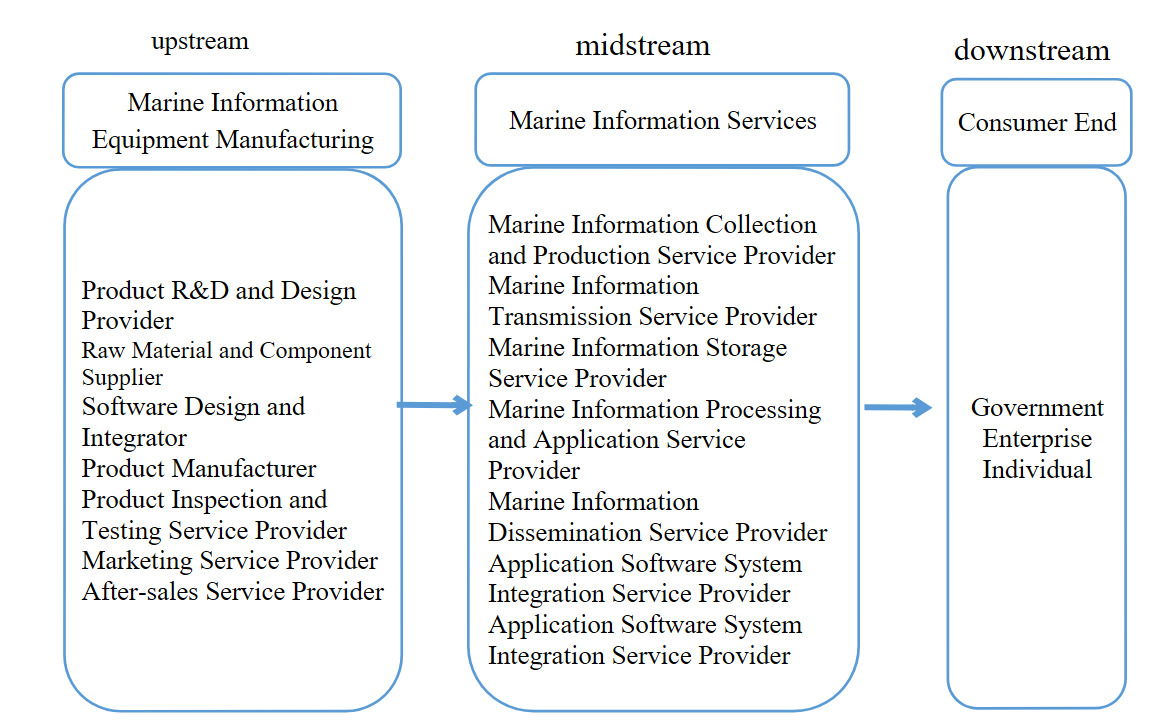
Marine information equipment manufacturing conforms to the industrial process of general equipment manufacturing. Its industrial chain specifically includes basic links such as product R&D and design, supply of raw materials and components, product production, marketing, and after-sales service, and is composed of nodes including information equipment R&D and design institutions, raw material and component suppliers, manufacturers, and marketers.
The marine information service industry chain is composed of nodes such as marine information collection/production service providers, marine information transmission service providers, marine information storage service providers, marine information processing service providers, marine information application service providers, marine information dissemination service providers, relevant marketing and after-sales service providers, and application software system integration service providers.
Role of Marine Information Systems in Aquaculture and Fisheries Development
Modern aquaculture increasingly relies on high-resolution marine information, including real-time data on temperature, salinity, dissolved oxygen, currents, and primary productivity. Marine information systems supported by big data, satellite remote sensing, and in situ monitoring are becoming essential tools for site selection, carrying capacity assessment, disease risk prediction, and adaptive farm management. Therefore, the development of a robust marine information industry has direct implications for the efficiency, sustainability, and resilience of aquaculture production systems.
In capture fisheries, marine information platforms enable improved stock assessment, fishing effort optimization, and ecosystem-based management. Integrated ocean observation systems support early warning of extreme events, harmful algal blooms, and habitat shifts, thereby reducing economic losses and supporting sustainable exploitation of fishery resources. As such, marine information services constitute a critical technological foundation for modern fisheries governance.3
From the perspective of global food security, the integration of marine information technologies with aquaculture and fisheries production systems represents a strategic pathway to increase aquatic food supply while minimizing environmental impacts. Strengthening the marine information industry can thus contribute not only to maritime power strategies but also to sustainable blue food systems, aligning technological development with ecological and societal goals.4
Current Development Status and Problems of the Marine Information Industry
Infrastructure Construction Status
The installation of marine information observation and monitoring equipment, the construction of information networks, as well as marine information big data centers and shared cloud platforms, etc., are the foundations for the development of marine information. China’s marine observation network was planned during the 11th Five-Year Plan period, constructed during the 12th Five-Year Plan period, and developed rapidly during the 13th Five-Year Plan period. Successively, submarine observation systems with the main goal of submarine earthquake and tsunami early warning have been built in Taiwan, Zhejiang, Hainan and other regions. Compared with foreign countries, China’s observation network construction started relatively late, and it is still difficult to achieve independent production in the manufacturing of key technical equipment for submarine observation such as junction boxes and power supplies.5
In terms of the construction of marine information data platforms, the current national-level big data centers mainly include the National Marine Science Data Center and the National Polar Science Data Center; local governments (e.g., Zhejiang, Shandong) and universities have also built big data platforms.6 At present, the marine observation networks built in Taiwan, Zhejiang, Hainan and other regions have initially provided basic environmental data for local mariculture and offshore fisheries, but the lack of high-resolution and real-time data transmission capacity still restricts the development of precision aquaculture and scientific fisheries management.7 However, marine data storage is decentralized, and there are bottlenecks and obstacles in data sharing and aggregation; a big data platform that can comprehensively integrate data from all aspects of the ocean has not been established. In addition, risks such as multi-source and heterogeneous marine data formats, as well as data loss, tampering, and unauthorized access, also cannot be ignored.8
Development Status of Technical Equipment
Marine information technology and equipment are a key driver for the development of the marine information industry. During the 13th Five-Year Plan period, China achieved industrialization of a series of information-based equipment, including unmanned maritime systems, remotely operated/autonomous underwater vehicles (ROVs/AUVs), and deep-sea gliders. Domestic equipment such as the “Shenhai Yongshi” (Deep Sea Warrior) manned submersible was put into service; satellites including the HY-1A/B/C (Ocean-1 A/B/C), HY-2A/B/C (Ocean-2 A/B/C), Gaofen-3, and China-France Ocean Satellite were successfully launched; and more than 10 new scientific research vessels, such as the Kexue, Jiageng, Xuelong 2, and Dongfanghong 3, were launched and put into use. The HY series ocean satellites, Gaofen-3 and China-France Ocean Satellite have realized the remote sensing monitoring of marine aquaculture areas, fishery resource distribution and marine ecological environment, and the “Shenhai Yongshi” manned submersible and deep-sea gliders have provided technical support for the investigation of deep-sea fishery resources and the site selection of deep-sea aquaculture.9
However, compared with foreign countries, China’s marine monitoring equipment industry is still at the mid-to-low-end level, and the self-sufficiency rate in key technologies for marine basic sensors and core instruments remains very low. Although domestic scientific research institutions have made some progress in the development of marine monitoring equipment, the lack of strong supporting conditions has prevented effective upgrading and application of domestic equipment. As a result, high-end foreign imported instruments and core sensors are still used as substitutes.
Development Status of Marine Information Services
The storage, development, and utilization of marine information give rise to the marine information service industry. In recent years, China’s marine information services have gradually shifted from a government-led model to a market-oriented one, and the content of these services has also transitioned from single-type data services (such as marine environmental monitoring and forecasting) to diversified and professional services, including information consulting and market transactions.
However, taken as a whole, the overall development level of China’s marine information service industry remains relatively low at present. In terms of demand for marine information services, in addition to public welfare information services led by the government, the demand for professional marine information services from aquaculture enterprises, fisheries operation enterprises and aquatic product research institutions is growing rapidly, including demand for aquaculture site selection data, fisheries resource assessment reports, marine disaster early warning and other services; however, the demand for personalized marine information services for small and micro aquaculture and fisheries operators has not yet been effectively developed. In terms of the supply of marine information, the proportion of services targeting aquaculture and fisheries is low, and the professional and personalized level of relevant services is insufficient, which cannot meet the actual needs of the digital transformation of aquaculture and fisheries.10
Construction Status of Alliances and Associations
To better promote the development of the marine information industry and integrate the industry-academia-research strengths in the marine information field, relevant alliances have been successively established at the national, local, and social levels. These mainly include the National Marine Information Industry Development Alliance, Marine Monitoring Equipment Industrial Technology Innovation Strategic Alliance, Deep-Sea Marine Engineering Equipment Technology Industry Alliance, China Marine Exploration Alliance, Marine Information Network Alliance of the China Optical Engineering Society, China (Ningbo) Electronic Equipment Industry Alliance, Qingdao Marine Electronic Information Industry Alliance, Qingdao Marine Information Service Industry Alliance, Jiangsu Smart Industry Alliance, and Shaanxi Smart Ocean Military-Civilian Integration Industry Alliance.
However, in terms of aligning with national strategic policies and serving the market, the role played by these alliances and associations has not been ideal. Additionally, there is insufficient interaction among the alliances, and no effective synergy has been formed.
Policy Support Status
Given that the marine information industry features strong technological foresight, a long industrial chain, large early-stage investment, and high added value, it has a relatively high industry threshold. Therefore, a sound policy environment is crucial for the development of the marine information industry. To promote the industry’s development, China’s policies have put forward specific requirements mainly focusing on accelerating infrastructure construction, advancing smart ocean projects, strengthening efforts to tackle key technological challenges in core and key instrumentation and equipment, and encouraging the development of marine information services.
However, the current policy environment for the marine information industry still fails to meet the requirements of “accelerating the building of a maritime power.” At the national level, there is a lack of dedicated top-level design and systematic layout specifically for the marine information industry; within the industry, there are no unified standards and systems regarding equipment manufacturing, data platform construction, data sharing, data security, data property rights, and transactions. Additionally, laws and regulations related to the deployment and protection of infrastructure, the qualification of project implementation entities, and information security also urgently need to be improved.
Relevant Recommendations
To sum up, the following suggestions are put forward:
Strengthen Policy Planning and Guidance
Formulate relevant classification standards for the marine information industry through research, and develop development plans, policies, and other measures to support the development of the marine information industry. Give full play to the role of industry alliances, take national strategies as the guide, and mobilize forces from all sectors of society to serve the growth and expansion of the marine information industry. Formulate special support policies for the development of marine information services for aquaculture and fisheries, and encourage the construction of professional marine information service platforms for the aquaculture and fisheries industry.
Accelerate Infrastructure Construction
Accelerate the full implementation of major projects such as the Smart Ocean Initiative and the National Seafloor Scientific Observation Network, coordinate the deployment of various types of equipment, and build a three-dimensional, real-time information collection and transmission system that integrates land, sea, air, space, and underwater dimensions.
Deepen the application of advanced technologies such as 5G, artificial intelligence (AI), the Internet, and the Internet of Things (IoT) in the marine information field, and construct a national-level comprehensive marine information data platform with international influence and competitiveness. Optimize the layout of marine observation equipment in key aquaculture areas and fisheries operation sea areas, and improve the real-time monitoring capacity of marine environmental factors closely related to aquaculture and fisheries production such as water temperature, salinity, dissolved oxygen and harmful algal blooms.
Enhance Independent Innovation Capabilities of Relevant Instruments and Equipment
Accelerate the full implementation of major projects such as the Smart Ocean Initiative and the National Seafloor Scientific Observation Network, coordinate the deployment of various types of equipment, and build a three-dimensional, real-time information collection and transmission system that integrates land, sea, air, space, and underwater dimensions.
Deepen the application of advanced technologies such as 5G, artificial intelligence (AI), the Internet, and the Internet of Things (IoT) in the marine information field, and construct a national-level comprehensive marine information data platform with international influence and competitiveness.
Accelerate the R&D and industrialization of marine information equipment suitable for aquaculture and fisheries, such as portable marine environmental monitors, aquaculture water quality real-time detection sensors and fisheries resource acoustic survey equipment, and improve the localization rate of core equipment.
Promote Open Sharing of Marine Information Resources
Pool forces from industry, academia, research institutions, application entities, and financial sectors, strengthen efforts in tackling key core technologies for marine instrumentation and equipment such as sensors and buoys, and cultivate marine information equipment manufacturing enterprises with independent intellectual property rights and leading technologies.
Align with (international benchmarks) and formulate and implement national standards or industry standards for marine information equipment manufacturing, and optimize public service platforms for technological R&D, instrument and equipment testing, and transformation of scientific and technological achievements.
Promote and deepen the promotion and application of domestically produced equipment through effective means such as policies.
Establish a special marine data sharing sub-platform for aquaculture and fisheries, integrate marine environmental data, resource data and production data of aquaculture and fisheries, and realize the authorized open sharing of data for relevant enterprises and research institutions.
Further Tap into the Demands for Marine Information Services
Guided by the development needs of aquaculture and fisheries and other key marine industries, deepen the integration of marine information with fishery production, mariculture, aquatic product processing, marine transportation and other fields. Focus on the actual needs of aquaculture and fisheries enterprises, develop personalized and professional marine information services such as precision aquaculture decision-making support, fisheries resource dynamic monitoring and marine disaster early warning, expand the targets and scope of marine information services, and extend the marine information service industry chain for aquaculture and fisheries.
Elevate the research connotation to the level of global marine food security
Strengthening the development of the marine information industry is not only a key measure to implement the maritime power strategy, but also an important path to promote the sustainable development of global aquaculture and fisheries. By improving the marine information service system for aquaculture and fisheries, breaking data barriers, and promoting technological innovation, we can effectively improve the efficiency of aquatic food production, reduce the environmental impact of aquaculture and fisheries activities, and provide strong support for the construction of sustainable blue food systems and the realization of global food security goals.
Authors’ Contribution
Conceptualization: Rong Hua, Yijie Chai; Writing - original draft preparation: Rong Hua, Yijie Chai; Writing - review and editing: Rong Hua, Yijie Chai; Supervision: Rong Hua, Yijie Chai.
Competing of Interest – COPE
No competing interests were disclosed.
Ethical Conduct Approval – IACUC
This study did not involve any experimental research on animals or plants.
Informed Consent Statement
All authors and institutions have confirmed this manuscript for publication.
Data Availability Statement
All are available upon reasonable request.