
1. Introduction
Comprehensively promoting rural revitalization and accelerating agricultural and rural modernization are the core strategic themes of China’s “agriculture, rural areas, and farmers” work in the new era. Fisheries are an important component of the modern agricultural system, and their green and low-carbon transformation is a key lever for achieving high-quality agricultural development and coordinated promotion of marine ecological protection.1 In recent years, the No. 1 central document of the Central Committee has consistently laid out arrangements for the high-quality development of fisheries. The Ministry of Agriculture and Rural Affairs and other departments have successively issued the Several Opinions on Accelerating the Green Development of Aquaculture Industry2 and 14th Five Year Plan for National Fishery Development,3 clearly proposing the development goals of promoting the ecological transformation of aquaculture, strengthening the management of fishery pollution, and building a modern fisheries industry chain, and set up special financial policy tools such as subsidies for green aquaculture, subsidies for ecological restoration of fisheries, and funds for upgrading the modern seed industry, to continue to increase support for the green transformation of fisheries.4 At the same time, China’s green finance system continues to improve, and ESG, as a comprehensive evaluation framework that integrates environmental, social responsibility, and corporate governance, is widely used to quantitatively evaluate companies. The domestic academic community generally uses the Huazheng ESG rating for related research. This database provides continuous, complete data since 2009, and the evaluation indicators align with China’s local regulatory requirements and industry realities. Corresponding assessment items have been developed for pollution control and water ecological conservation issues unique to the fisheries industry, and the scoring rules are better aligned with the operational characteristics of domestic fishery-listed companies. Therefore, this paper uses the Huazheng Score to measure the ESG level of the sample companies. The score ranges from 0 to 100 points; the higher the score, the better the company’s overall performance in environmental control, social responsibility implementation, and internal governance. It should be noted that different third-party rating agencies have distinct indicator compositions and weight allocations, resulting in differences in ESG rating outcomes. For banks and other credit institutions, ESG rating is an important non-financial signal. High-scoring companies have lower potential default risks, such as environmental penalties, business turbulence, and governance chaos, thereby alleviating information asymmetry between banks and companies. Therefore, it has gradually been incorporated into the credit risk control process and has become a key reference for assessing companies’ financing quality. Banking and financial institutions are gradually incorporating ESG performance into the credit approval process,5 providing a new policy path for agricultural companies to solve financing difficulties.
Against the backdrop of sustained policy dividends, the financing constraints faced by fishery companies have not been fundamentally alleviated. Fishery production has both strong environmental sensitivity and high natural risk attributes. The core assets of companies are primarily biological assets, which generally face valuation challenges and have limited collateral effectiveness. At the same time, aquaculture operations are affected by multiple factors, including disease outbreaks, climate fluctuations, market prices, and adjustments to import and export policies, resulting in insufficient profitability and cash flow stability, further increasing the credit risk premium for financial institutions.6 Although forestry, animal husbandry, and agriculture also face common pain points related to restricted biological asset mortgages, fisheries rely on water bodies for production and have distinct industry characteristics in terms of regulatory rules, natural disturbances, and industrial chain structures. It is necessary to conduct research as an independent sub-track. First, the aquaculture tailwater exhibits cross-border flow in the river basin and offshore, making pollution prone to forming cross-regional non-point-source impacts. For aquaculture, China has issued independent tailwater discharge standards, regional management and control rules for mudflats in all waters, and has clearly distinguished the environmental supervision system from the land planting and breeding industry.7 Secondly, the summer fishing ban, the protection of aquatic organisms, and the management of nearshore ecology are exclusive fisheries management systems, and the corresponding financial subsidy policies are also independent of other agricultural categories. Thirdly, fishery production is completely constrained by water environmental conditions. Water ecological disasters such as red tide, abnormal sea temperature rise, and water hypoxia have the characteristic of rapid diffusion across the entire area. A single disaster can easily damage the entire aquaculture population, and the sources of disturbance affecting operating income differ significantly from those in terrestrial farming. Fourthly, the decentralization characteristics at both ends of the industrial chain are prominent. The upstream is mainly composed of small-scale individual farmers, while the downstream production and sales are simultaneously impacted by domestic consumption and cross-border import and export policies. The logic of supply chain fluctuations is different from that of large-scale agricultural and forestry industries. Based on the basic characteristics of differentiated industries mentioned above, this paper selects listed fishery companies as research samples for targeted empirical analysis to address the research gap in ESG and corporate financing in the segmented agricultural sector.
Existing academic research has yielded substantial findings on the economic consequences of ESG and the factors influencing company financing constraints, generally confirming that strong ESG performance can improve company financing conditions. However, existing research samples are mostly concentrated on listed companies across the entire industry, and there is a lack of specialized discussions of subsectors such as fisheries that have both agricultural attributes and strong policy dependence. There is also little literature that combines the characteristics of the fisheries industry to break down the internal transmission path of ESG impact financing constraints from multiple dimensions. The relevant research conclusions are difficult to directly provide targeted empirical support for policy optimization in fisheries.
Based on the policy background and research gaps mentioned above, this paper takes Chinese A-share fishery-listed companies from 2009 to 2025 as research samples, constructs a two-way fixed effects model to empirically test the overall impact of ESG performance on financing constraints of fishery companies, and further refers to the mechanism analysis ideas of Dell8 and Dong and Yu9 to test the two transmission paths of subsidy acquisition and supply chain relationship governance, and conduct robustness tests through various methods. On this basis, this paper also conducts an extended analysis at three levels: ESG dimensions, business attributes of fishery companies, and export dependence, to clarify the differences in ESG financing effects in different scenarios.
This study combines theoretical optimization, empirical supplementation, and practical reference values. On a theoretical level, given the industry characteristics of strict environmental controls, the difficulty of valuing biological assets, and strong policy dependence, this paper explains the distinctive operating mechanism and heterogeneity of ESG impact financing constraints in the fisheries industry. At an empirical level, this paper uses data from listed fisheries companies to conduct tests, filling an empirical gap in existing research, which largely focuses on the industry as a whole. On a practical level, research findings can guide fisheries companies to leverage ESG initiatives to secure policy subsidies and stabilize their supply chains, thereby improving their financing position. They can also provide empirical evidence to help regulatory agencies optimize green subsidies for fisheries and establish industry-specific green finance evaluation systems, thereby promoting the green upgrading of the fisheries industry chain.
2. Literature Review and Hypothesis Proposal
2.1. Economic Consequences of ESG Performance
Previous literature has examined the various practical impacts of ESG on corporate financing, operational performance, investment behavior, and operational risk. Cheng et al. found, using cross-border sample data, that improving company ESG levels can reduce agency conflicts, decrease information asymmetry, and alleviate external funding pressure for companies.10 In the banking credit market, companies with negative ESG records have higher loan pricing, and credit institutions will further increase risk premiums when collateral is insufficient.11 El Ghoul et al. provide evidence, from an equity financing perspective, that sustainable investments in environmental, employee, and product dimensions can lower the cost of equity financing for companies.12 Empirical evidence from China’s A-share market also confirms the differential performance of the above effects, as both equity structure and the nature of property rights can alter the strength of ESG in alleviating financial constraints.13,14
ESG can improve companies’ market valuation and book performance. High-quality ESG practices can enhance the market value of companies. Simply disclosing behavior cannot directly generate profits, but it can mitigate valuation losses stemming from ESG shortcomings.15 Li et al. pointed out that management power amplifies the positive value effect of ESG information disclosure.16 The data show a significant positive correlation between ESG and financial performance, with this effect more pronounced in the eastern region, among state-owned companies, and among heavily polluting companies. ESG also plays a role in the operational decisions of company entities. A good ESG rating can smooth out performance fluctuations, attract market attention, and reduce resource misallocation issues such as overinvestment and underinvestment.17 He’s research18 also demonstrates that ESG can promote companies’ digital upgrading and indirectly enhance innovation output.
Multiple studies on crisis events have confirmed that ESG serves a risk-buffering function. Lins et al. compared the market performance of companies during the financial crisis and found that companies with high ESG targets exhibit greater income stability and smoother debt channels.19 Broadstock et al. drew similar conclusions from pandemic samples, stating that the hedging value of ESG is fully demonstrated only during periods of intense market volatility.20 Recent studies have shown that long-term ESG accumulation can reduce the impact of negative public opinion and violations on a company’s market value.21 Further research has supported this perspective on asset allocation, finding that during periods of market volatility, investment portfolios that focus on environmental and governance dimensions exhibit greater resilience to downturns.22
Existing literature has confirmed that ESG can improve company financing conditions. However, most studies select listed companies across the entire industry, and few conduct segmented tests on highly environmentally sensitive agricultural companies, such as fisheries, nor do they analyze the transmission pathways and characteristics of the fisheries industry. This paper can supplement incremental evidence in this dimension.
2.2. Factors Influencing Company Financing Constraints
Asymmetric information and agency conflicts underlie the formation of financing constraints in companies. When there is friction in the capital market, the cost of internal funds for companies is significantly lower than that of external financing, and the price difference between internal and external financing can lead to varying degrees of funding constraint difficulties.23,24 Existing literature systematically summarizes various influencing factors across three dimensions: internal company characteristics, the external market environment, and industry-related channels, with a focus on identifying and causally decomposing constraint levels.
The operational and governance characteristics of a company are the fundamental variables that determine the strength of financing constraints. The asset size, cash flow stability, and proportion of tangible assets directly determine a company’s ability to mortgage and guarantee. Small-scale, light-asset, and highly volatile companies find it difficult to convey stable debt-repayment signals to financial institutions and face higher credit-access thresholds.25 The equity structure and internal governance arrangements, such as the board of directors, can affect agency costs, and companies with highly concentrated equity and a low proportion of independent directors are more likely to suffer from interest encroachment, thereby exacerbating the information gap between the supply and demand sides of funds.26 In addition, Biddle and Hilary pointed out that transparency of accounting information also plays a key role, and high-quality financial disclosure can reduce the cost of information screening between banks and investors, effectively alleviating external financing pressure.27
Macro-financial development, legal protection, and industrial policies constitute external constraints. The higher the degree of regional financial marketization, the more intense the competition among credit supply entities, and the richer the channels for companies to obtain low-cost funds.28 Improving investor protection laws can constrain major shareholders’ embezzlement and management’s self-interested behavior, and reduce the risk premium required by external investors.29 Recent studies have also shown that industry-level policy support can directly improve the availability of funds for companies. Government subsidies, as a typical policy tool, not only supplement operating cash flow but also signal policy recognition to financial institutions, thereby reducing the difficulty of external financing for companies through a dual path.30–32
Research on industrial chain relationships has further expanded the analytical boundaries of financing constraints. The degree of close cooperation between upstream and downstream can change a company’s ability to obtain commercial credit. A moderately concentrated group of suppliers and customers can help establish long-term stable cooperation, and companies can rely on commercial credit to replace some bank loans.33 In recent years, sustainable finance research has included ESG as a precursor to financing constraints. A company’s environmental, social responsibility, and governance levels can change the risk assessment results of credit institutions. Companies with high ESG scores can obtain longer loan terms and lower financing interest rates.34–36
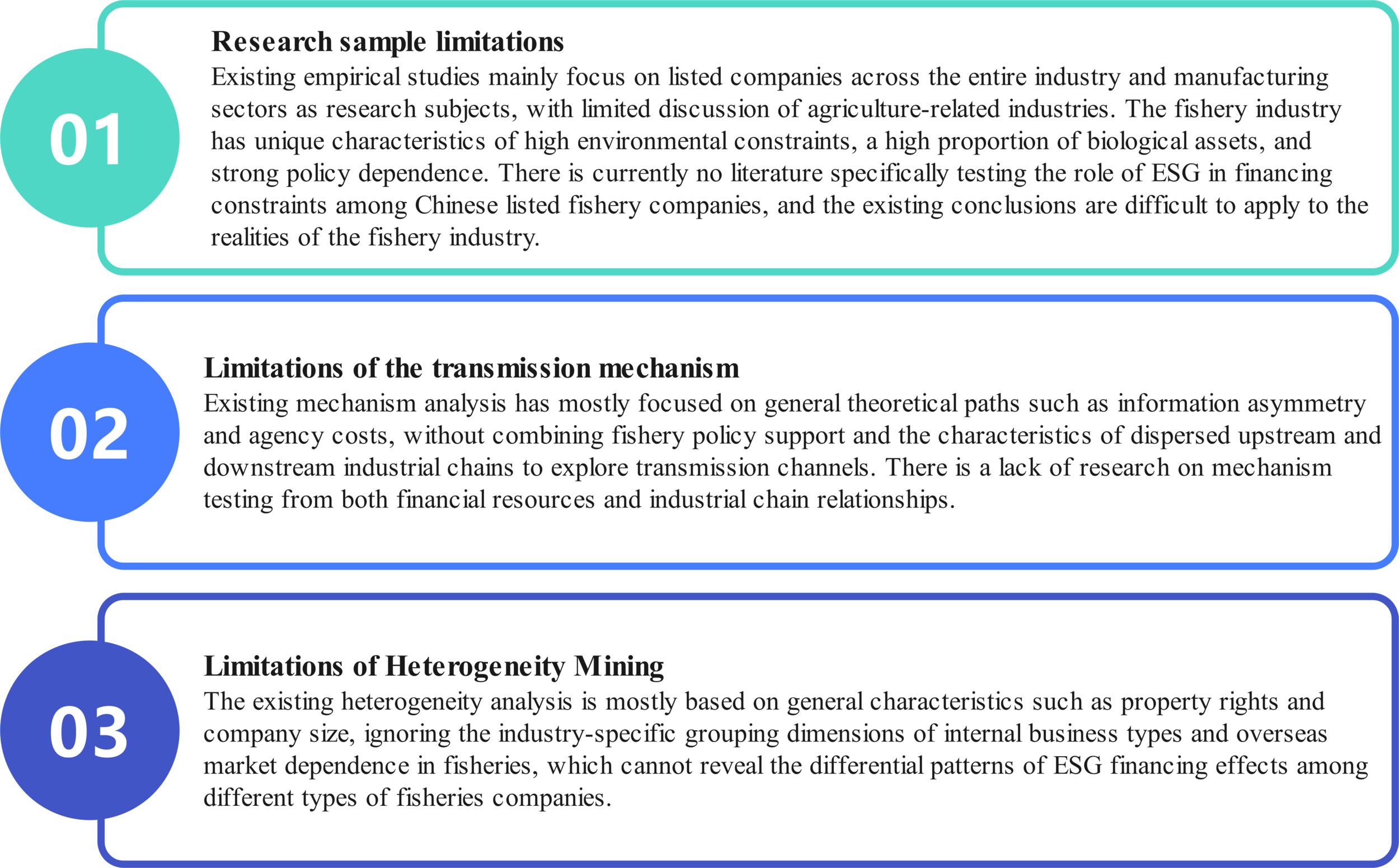
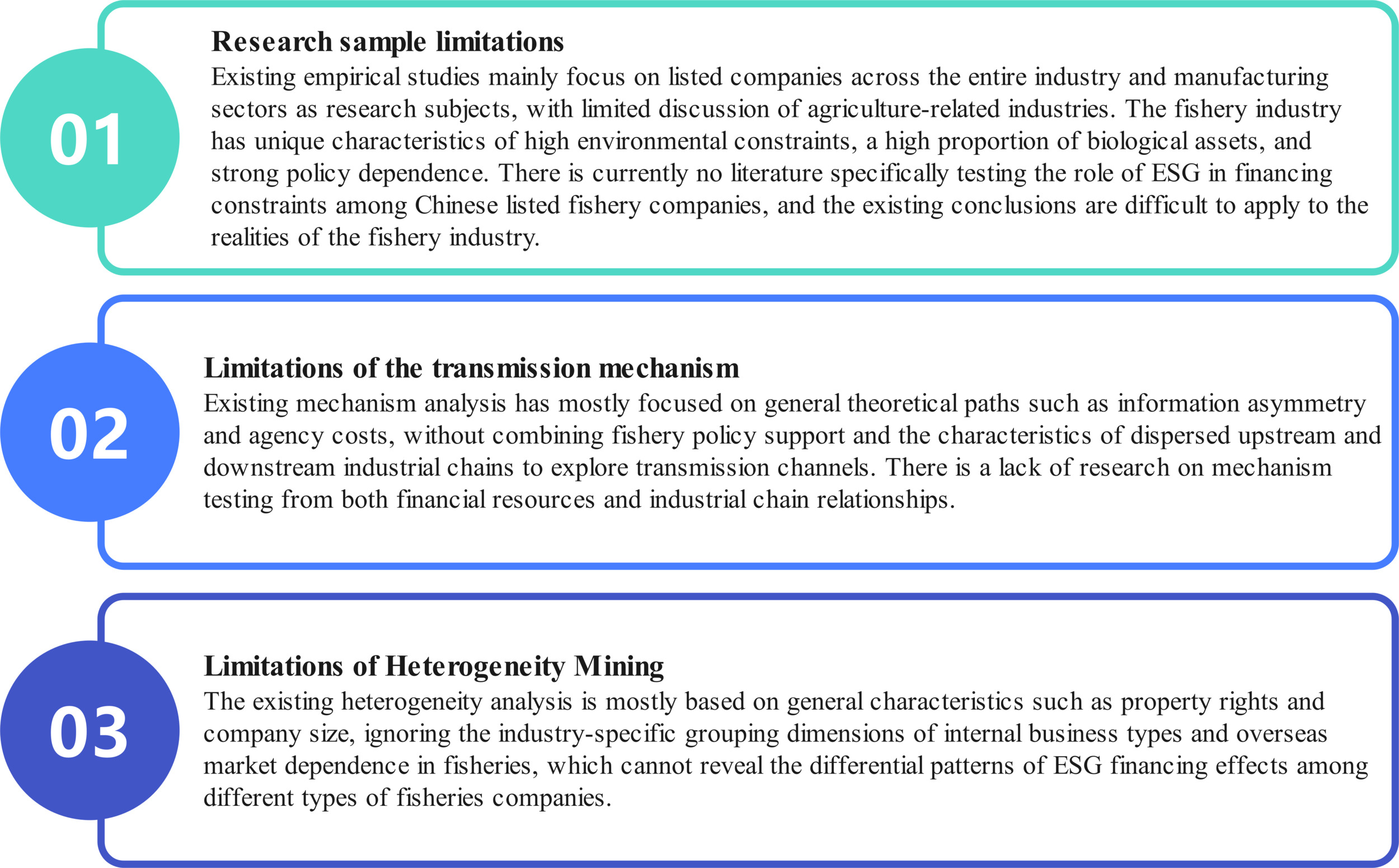
Based on existing research, the logical framework for the role of various factors in financing constraints has been formed. However, when combined with the industrial attributes of the fishery sub-industry, significant adaptation gaps remain in existing research. The core limitations can be summarized into three dimensions, as shown in Figure 1.
2.3. The Impact of ESG Performance on Financing Constraints of Fishery Companies
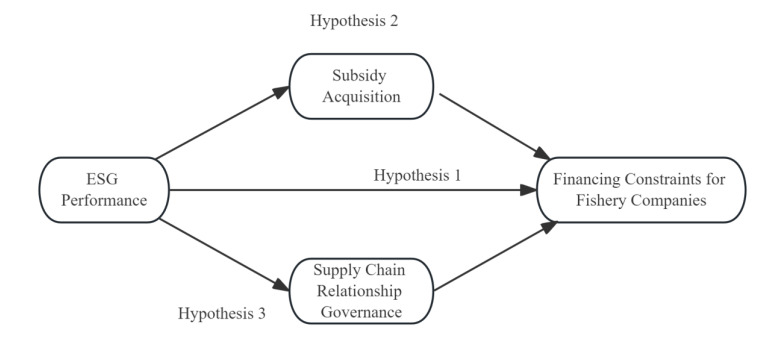
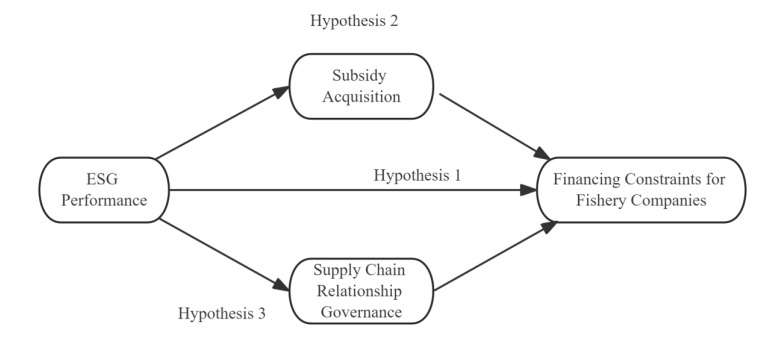
The financing constraints of fishery companies combine the common causes and distinct industry attributes of general companies. The difficulty of valuing biological assets, the strong impact of natural risks on production and operations, and information asymmetry between banks and companies have long constrained the efficiency of industry financing. ESG practices can affect companies’ financing environment through multiple pathways tailored to industry characteristics. The following analysis combines the two transmission pathways of subsidy acquisition and supply chain relationship governance, and proposes corresponding research hypotheses.
2.3.1. Subsidy Acquisition Transmission Pathways and Research Hypotheses
Fisheries is a typical policy-supported agricultural industry, and various government subsidies, such as green breeding subsidies, fisheries ecological restoration subsidies, and rural revitalization industry support funds, are important sources of funding for companies in the industry. Fishery companies with excellent ESG performance demonstrate outstanding compliance in the environmental dimension, aligning more closely with the policy orientation of green fishery development in China. They have obvious advantages in the evaluation of qualifications and the allocation of quotas for special subsidies, and can obtain larger and more sustainable government subsidy support.37
From a functional logic perspective, government subsidies can alleviate financing constraints for companies in two ways: by supplementing funding and by providing signal certification. On the one hand, government subsidies directly inject operational cash flow into companies, filling internal funding gaps and reducing the need for external debt financing. On the other hand, government subsidies have the certification effect of official credit endorsement, which signals to the credit market company compliance and policy recognition. It can effectively reduce information asymmetry between financial institutions and companies, lower risk premium requirements, and help companies obtain lower-cost, longer-term credit funds.30,38 For agricultural companies, the signaling value of policy endorsement is more evident, as it can reduce financial institutions’ concerns about natural risks in agricultural production and increase their willingness to extend credit.
Based on the above transmission logic, ESG performance can be improved by increasing subsidies to enhance the financing environment of fishery companies, and there is a direct overall correlation between the two. Based on this, the following research hypotheses are proposed:
Hypothesis 1. The better the ESG performance, the lower the financing constraints faced by fishery companies
Hypothesis 2. Subsidy acquisition plays a transmission role in alleviating financing constraints for fishery companies through ESG performance
2.3.2. Transmission Path and Research Hypothesis of Supply Chain Relationship Governance
The fisheries industry chain has the structural characteristics of being scattered at the upstream and downstream ends. The upstream supply side is mainly composed of small and medium-sized breeders, with low production standardization and significant risks of disease and quality control issues. The downstream demand side is significantly affected by fluctuations in the consumer market and by adjustments to import and export policies, resulting in weak order stability. The operational risks of the upstream and downstream of the industrial chain are easily transmitted to core companies, exacerbating business fluctuations and financing difficulties. Fishery companies with well-established ESG management systems place greater emphasis on full-chain compliance control and long-term cooperation building and tend to select qualified and stable suppliers to establish deep, long-term partnerships with core customers, optimizing overall supply chain relationships.39,40
A good supply chain relationship can improve the financing conditions of companies in two ways: business stability and financing expansion. Firstly, stable upstream and downstream cooperative relationships can reduce transaction costs, smooth production and operation fluctuations, enhance the predictability of company profits and cash flows, and lower the risk assessment level of financial institutions. Secondly, close supply chain cooperation provides the basic conditions for companies to rely on commercial credit and carry out supply chain finance business, which can expand the financing channels and funding availability of companies.41 The fisheries industry is highly vulnerable, and improving supply chain relationships can effectively hedge against natural risks and market fluctuations, thereby strengthening companies’ financing capabilities.
Based on the above transmission logic, ESG performance can alleviate the financing constraints of fishery companies by optimizing supply chain relationships. Based on this, research hypotheses are proposed:
Hypothesis 3. Supply chain relationship governance serves as a transmission mechanism in alleviating financing constraints for fishery companies through ESG performance.
In summary, ESG performance can not only directly alleviate the financing constraints of fishery companies but also indirectly alleviate them through two channels: subsidy acquisition and supply chain relationship optimization. The overall transmission logic is shown in Figure 2.
3. Research Design
3.1. Samples and Data
This paper uses A-share fishery-listed companies in China from 2009 to 2025 as the research sample. The selection of this time interval is mainly based on two considerations: firstly, in 2009, China’s new and old company accounting standards had completed the transition and connection, and the financial data caliber of listed companies was unified and comparable; Secondly, the traceable data of the Huazheng ESG Index dates back to 2009, which ensures the time series integrity of the core independent variables. In the sample screening process, this paper first defines the industry scope based on the “Guidelines for Industry Classification of Listed Companies (Revised in 2012)” issued by the China Securities Regulatory Commission, selects A-share listed companies in the fishery category under the agriculture, forestry, animal husbandry, and fishery categories, and includes relevant companies whose main business involves aquaculture, marine fishing, aquatic processing, and fishery supporting services to ensure that the sample business attributes are highly compatible with the fishery industry. 14 fishery-listed companies have been preliminarily identified as the research subjects. Given that the fisheries industry is highly segmented and the total sample size of listed companies is limited, excessive exclusion of samples will reduce the effectiveness of statistical testing. This paper excludes only annual observations with missing core variables and subsequently absorbs individual heterogeneity and macro-time shocks using a two-way fixed-effects model to mitigate the influence of outliers on the regression results. In terms of data sources, the core independent variable ESG performance is taken from the Huazheng Index database, while other financial, governance, and supply chain-related data are sourced from the CSMAR database. After the above screening and sorting, a total of 197 non-equilibrium panel observations were obtained from 14 listed fishery companies. Considering that the number of cross-sectional companies in this paper is relatively small, the panel is more inclined towards industry-specific analysis. Therefore, in the robustness testing section, an additional leave-one-out test and a Bootstrap Correction are added to specifically address small-sample estimation bias and to ensure the credibility and effectiveness of the empirical conclusions as much as possible under the existing data conditions. All data processing and analysis in this paper are implemented using R.
3.2. Variable Definition
3.2.1. Dependent Variable
The dependent variable in this paper is financing constraints, measured using the KZ index proposed by Kaplan and Zingales.42 The KZ index comprehensively incorporates multidimensional financial information such as operating cash flow, investment opportunities, capital structure, dividend distribution, and cash holdings, which can comprehensively reflect the external financing premium and financing difficulty faced by companies. It is a commonly used measurement indicator in the study of financing constraints of listed companies. The larger the KZ index, the scarcer the company’s operating cash flow, the stronger the investment demand, the higher the debt pressure, the weaker the cash reserves and dividend-payment ability, and the more severe the external financing constraints the company faces. Conversely, the opposite indicates that the degree of financing constraints faced by the company is relatively light. The specific calculation formula for the KZ index is as follows:
\[\begin{align} K Z_{i t}&=-1.002 \times \frac{C F_{i, t}}{T A_{i, t-1}}+0.283 \times \operatorname{Tobin}_{i, t} \\&\quad+3.139 \times \operatorname{Lev}_{i, t}-39.368 \times \frac{\operatorname{Div}_{i, t}}{T A_{i, t-1}} \\&\quad-1.315 \times \frac{\operatorname{Cash}_{i, t}}{T A_{i, t}} \end{align}\tag{1} \]
In the formula, i represents the individual company, and t represents the observation year; CFi,t is the net cash flow generated from the current operating activities of the company; TAi,t-1 is the total assets of the company at the end of the previous period, which is used to standardize flow indicators to eliminate differences in company size; TobinQi,t is the current TobinQ value of the company, representing the investment opportunities and market valuation level of the company; Levi,t is the current asset liability ratio of a company, reflecting its capital structure and debt burden level; Divi,t is the total amount of cash dividends distributed by the company in the current period; Cashi,t is the balance of cash and cash equivalents at the end of the current period for the company.
At present, the academic community has not yet developed a KZ correction coefficient specifically for calibrating and optimizing Chinese fishery-listed companies, so the original coefficient is used for analysis. Because this paper introduces individual fixed effects in the empirical model, the overall systematic bias from coefficient copying will be absorbed by the fixed effects. Changing only the absolute value of financing constraints will not affect the identification of ESG relative volatility in the marginal effects of financing constraints, nor will it interfere with the core regression results of this paper.
3.2.2. Independent Variable
The core independent variable in this paper is companies’ ESG performance. Refer to previous research,18,22,43 the Huazheng ESG comprehensive score released by the Huazheng Index is used for measurement. This evaluation system has achieved full coverage of all A-share-listed companies, with traceable data dating back to 2009, and can provide continuous and stable evaluation data for research on the fishery sub-industry. The Huazheng ESG indicator system follows a three-dimensional evaluation framework of environment, society, and governance, covering multiple aspects, including company pollution prevention and control, resource utilization, product quality, employee rights and interests, equity structure, and internal control governance. For highly environmentally sensitive industries such as fisheries, the system will assign higher evaluation weights to the environmental dimension, thereby fairly reflecting companies’ ESG practice levels given industry characteristics.
This rating uses a percentage system to report results, with a score range of 0 to 100. The rating takes into account both the quality of the company’s ESG information disclosure and the actual performance. The higher the score, the better the company’s overall ESG performance. Compared with other rating systems, Huazheng’s ESG rating sample offers comprehensive coverage and strong localization adaptability, enabling more accurate measurement of the ESG compliance value of domestic fishery companies. Therefore, this paper selects it as a proxy for the core independent variable.
3.2.3. Mechanism Variables
This paper examines the internal transmission path by which ESG impacts the financing constraints of fishery companies through two channels: subsidy acquisition and supply chain relationship governance. The specific definition and measurement method are as follows:
(1) Subsidy Acquisition
This paper measures subsidy acquisition by the total amount of subsidies received by the company in the current year, in billions of yuan, reflecting the scale of policy funding support obtained by the company in a single accounting year. Obtaining various subsidies is a policy resource channel for fishery companies. Companies with better ESG performance are more aligned with the policy orientation of green fishery development. They are more likely to secure special subsidy funds, thereby alleviating financing constraints by supplementing cash flow and signaling policy endorsement.
(2) Supply Chain Relationship Governance
This paper uses the arithmetic mean of the proportion of the top five suppliers’ procurement amount to the total annual procurement amount and the proportion of the top five customers’ sales amount to the total annual operating income to measure supply chain relationship governance. The calculation formula is shown in equation (2):
\[\scriptsize{ \begin{array}{l} \text { Chain }{i, t}=\dfrac{1}{2} \times\Bigg(\dfrac{\text { Top five suppliers' procurement amount }{i, t}}{\text { Total annual procurement amount }{i, t}} \ \\ \qquad \qquad \qquad \qquad \quad +\dfrac{\text { Top five customers' sales amount }{i, t}}{\text { Total annual revenue }_{i, t}}\Bigg) \end{array} \tag{2}} \]
The concentration of a single supplier or customer can only reflect the structural characteristics of one side of the industrial chain, while fishery companies face dual structural pressures both upstream and downstream. The upstream supply side is mainly composed of dispersed small and medium-sized farmers, with uneven quality and compliance levels and prominent disease risks. The downstream demand side has strong bargaining power with core customers, and order fluctuations are significantly influenced by consumer markets and export policies. The stability of cooperation between upstream and downstream will significantly affect companies’ operational risks and financing capabilities. The comprehensive index, synthesized as the average of the upstream and downstream, more accurately characterizes the degree of cooperation and binding in the company’s overall supply chain.
3.2.4. Control Variables
To control for other potential influencing factors, this paper introduces several company-level control variables, including years since founding, Tobin’s Q value, company size, dual role integration, shareholding ratio of the largest shareholder, proportion of independent directors, and revenue growth rate.44,45 Meanwhile, given that the individual characteristics of companies that do not change over time and common temporal trends may systematically affect the quality of information disclosure, this paper further controls for individual and year fixed effects in the benchmark regression model. The detailed variable definitions are shown in Table 1.
3.3. Model Construction
3.3.1. Benchmark Regression Model
This paper constructs a dual fixed effects model to identify the impact of ESG disclosure on financing constraints, as follows:
\[ \mathrm{KZ}_{\mathrm{i}, \mathrm{t}}=\alpha_0+\alpha_1 \times \mathrm{ESG}_{\mathrm{i}, \mathrm{t}}+\mu_{\mathrm{i}}+\lambda_{\mathrm{t}}+\varepsilon_{\mathrm{i}, \mathrm{t}} \tag{3} \]
Add control variables to model (1) to obtain model (2)
\[\begin{align} K Z_{i, t}&=\beta_0+\beta_1 \times E S G_{i, t}+\sum_{K=2}^K \beta_k \text { Controls }_{k i t} \\&\quad+\mu_i+\lambda_t+\varepsilon_{i, t} \end{align}\tag{4} \]
Among them, KZi,t represents the degree of financing constraint of company i in the t-th year; ESGi,t represents the ESG practice level of company i in year t; Controls are a series of control variables; μi and λt represent individual effects and year effects, respectively; εi,t is the perturbation term. Given the possibility of sequential correlation among observed values for the same company across different years, this paper clusters standard errors at the individual company level in regression analysis to ensure the robustness of statistical inference.
3.3.2. Mechanism Verification Model
Based on a benchmark regression, this paper further analyzes the internal transmission path through which ESG performance affects the degree of financing constraints on fishery companies. Given that the traditional three-step mediation effect model is prone to estimation bias due to endogeneity in mechanism variables, this paper adopts the mainstream two-step analysis paradigm in the field of causal mechanism testing8,9,46,47 to construct a mechanism effect model for testing. Specifically, this paper sets up two regression equations to verify the potential mechanism. The model settings are shown in equations (5) and (6). The first step is the benchmark total-effect test, which assesses whether the overall impact of ESG on the financing constraints of fishery companies is significant. This is a prerequisite for mechanism analysis.
\[\begin{align} K Z_{i, t}&=\beta_0+\beta_1 \times E S G_{i, t}+\sum_{K=2}^K \beta_k \text { Controls }_{k i t} \\&\quad+\mu_i+\lambda_t+\varepsilon_{i, t} \end{align}\tag{5} \]
The second step is to test the effect of mechanism variables. This paper includes subsidy acquisition and supply chain relationship governance as dependent variables in the model to examine the direction and statistical significance of the effects of ESG performance on these two transmission variables. If the regression coefficient on ESG in this step is significant and consistent with existing theories and the consensus in the literature, it can be concluded that the corresponding transmission path is valid.
\[\begin{align} \text { Mechanism }_{i, t}&=\gamma_0+\gamma_1 \times E S G_{i, t} \\&\quad+\sum_{K=2}^K \gamma_k \text { Controls }_{k i t} +\mu_i \\&\quad+\lambda_t+\varepsilon_{i, t} \end{align}\tag{6} \]
Among them, Mechanismi,t is the Mechanism variable, representing the two transmission mechanisms of subsidy acquisition and supply chain relationship governance discussed in this paper. All other variables are consistent with the baseline regression.
4. Result
4.1. Descriptive Statistics and Correlation Analysis
Table 2 presents the descriptive statistics for the main variables, based on 197 sample observations. The mean of the dependent variable KZ is 2.08, with a standard deviation of 1.96, indicating that the sample fishery companies generally have a certain degree of financing constraints, and there are significant differences in the level of constraints between companies. The average performance of the independent variable ESG is 69.10, which is generally above average. Among the controlled variables, there are significant differences in the revenue growth rate and Tobin’s Q values of companies, reflecting a significant gap between the growth ability of fishery companies and their market valuation. The distributions of other variables, such as company size, equity structure, and governance characteristics, fall within a reasonable range, consistent with the overall characteristics of A-share fishery-listed companies.
Table 3 shows the correlation analysis results of the main variables. The results showed that the correlation coefficient between the dependent variable KZ and the core independent variable ESG was -0.411 and was significantly negative at the 1% statistical level, indicating that fishery companies with better ESG performance face weaker financing constraints, consistent with this study’s expectations. Overall, the maximum correlation coefficient between variables is 0.529, which is below the threshold of 0.7 for judging multicollinearity, indicating that the regression model does not have serious multicollinearity issues.
This paper continues to use the variance inflation factor (VIF) for testing, and the results are shown in Table 4. The general criteria for determining VIF are: there is no severe multicollinearity when VIF<5, moderate multicollinearity when VIF ≤ 10, and severe multicollinearity when VIF ≥ 10. According to Table 4, the mean VIF across all variables is 1.42, and the maximum is 1.78, indicating no serious multicollinearity in the regression model of this paper. The variable settings are reasonable, and subsequent regression analysis can be carried out.
4.2. Benchmark Regression Results
Table 5 presents the benchmark regression results for the effect of ESG performance on financing constraints. All models controlled for individual and year fixed effects, and the stability of the results was assessed by gradually adding control variables. Specifically, when column (1) only controls for bidirectional fixed effects, the regression coefficient of ESG is -0.068, which is significantly negative at the 5% statistical level. After gradually incorporating control variables into columns (2) to (8), although the ESG coefficient fluctuated slightly, it remained significant at the 5% level, with a coefficient of -0.069 in column (8). This result indicates that, after controlling for other influencing factors, the better the ESG performance of fishery companies, the lower the degree of financing constraints they face, thereby supporting Hypothesis 1.
4.3. Robustness Test
This paper conducts robustness checks across six dimensions: variable replacement, endogeneity treatment, fixed-effects expansion, special-sample exclusion, sample sensitivity test, and cluster-standard-error correction to verify the reliability of the benchmark regression conclusion. The results of the four conventional robustness tests are summarized in Table 6. Column (1) serves as the baseline regression result as a reference. Column (2) replaces the core explanatory variable from the Huazheng ESG percentage comprehensive rating with the Huazheng ESG rating, assigning values from 1 to 9 in ascending order of 9 levels. The higher the value, the higher the company’s ESG rating and overall performance. The results show that the coefficient on the ESG rating remains significantly negative at the 5% statistical significance level, indicating that the core conclusion is not affected by the measurement method for ESG indicators. Column (3) is regressed using the ESG score from Hexun.com, with the variable ESG_Hexun. The higher the score, the better the company’s ESG performance. The regression coefficient is significantly negative at the 1% level, indicating that the benchmark conclusion is less affected by the measurement divergence of ESG rating agencies. Column (4) adopts a lagged one-period ESG indicator regression to alleviate potential reverse causality problems. The lagged coefficient is still significantly negative at the 5% level, indicating a decrease in sample size, which conforms to the sample loss law of panel lag. Reverse causality has weak interference on the conclusion. Column (5) adds provincial fixed effects on the basis of bidirectional fixed effects, controlling for the interference of regional industrial policies and resource endowments. The ESG coefficient remains significantly negative at the 10% level, and the core conclusion remains stable. Column (6) excludes the COVID-19 samples from 2020-2022 to eliminate the abnormal impact of external shocks, and the ESG coefficient remains significantly negative at the 10% level, indicating that samples from special periods do not drive the conclusion. In summary, the core conclusion that ESG performance alleviates financing constraints for fishery companies under multiple test settings remains consistent, and the research results are highly reliable.
Given that the research sample in this paper comprises only 14 listed fishery companies, the small number of clusters may introduce a downward bias in the robust standard error of traditional clustering, thereby overestimating the significance level. To further verify the reliability of the conclusions in the small-sample scenario, this paper conducted sensitivity testing on a per-sample basis using the leave-one-out method. Individual fishing companies were excluded, and a two-way fixed-effects model was re-fitted. The complete regression results are shown in Table 7. The test results for all companies show that the ESG coefficients in all sub-sample regressions remain negative, with stable values ranging from -0.085 to -0.039 and only small fluctuations. The regression results are significant at the 5% or 10% statistical level, indicating that there is no single-company-dominant problem in the benchmark regression results of this paper, and that the core conclusion has good sample stability.
In terms of cluster standard error correction, this paper conducted 999 bootstrap repeated sampling corrections using companies as hierarchical units, and the correction results are shown in Table 8. The results showed that the ESG benchmark regression coefficient was -0.069, the Bootstrap estimation bias was minimal, the corrected standard error was 0.0237, and the 95% confidence interval was (-0.1167, -0.0221). The overall confidence interval was completely negative and did not include 0, indicating that after correcting for small sample clustering bias, the alleviating effect of ESG on financing constraints of fishery companies still holds significant. In summary, the core conclusion that ESG performance alleviates financing constraints for fisheries companies across multiple test settings remains consistent, and the research results are highly reliable.
4.4. Mechanism Verification
This paper uses a two-step method to test the transmission path. The first step is to verify the benchmark total effect of ESG performance on the financing constraints of fishery companies. The second step is to test the impact of ESG performance on the mechanism variables to determine whether the transmission path is valid. The following text examines the two paths of subsidy acquisition and supply chain relationship governance, and the results are shown in Table 9.
Subsidy acquisition is an important pathway for ESG to alleviate financing constraints for fishery companies. Column (1) reports the results of the benchmark effect test, and the regression coefficient of ESG on the financing constraint KZ index is -0.055, which is significantly negative at the 5% statistical level, verifying the overall mitigating effect of ESG on the financing constraint of fishery companies, consistent with the previous benchmark regression conclusion. Column (2) reports the impact of ESG on subsidy acquisition, and the results show that the regression coefficient of ESG is 0.01, which is significantly positive at the 5% statistical level, indicating that the better the ESG performance of the company, the higher the subsidy scale it can obtain. The inflow of various subsidies can not only directly supplement companies’ internal funds and reduce their dependence on external debt financing, but also signal official credit endorsement to the financial market, lower credit institutions’ risk assessment of companies, and help alleviate companies’ financing constraints.
Supply chain relationship governance is another important mechanism through which ESG can support mitigation financing. Due to the limited availability of supply chain-related data, this section of the test is based on a subsample of 178 valid observations. Column (3) shows the benchmark effect test results for the sub-sample. The regression coefficient of ESG on the KZ index is -0.052, which is significantly negative at the 10% statistical level. This indicates that within this sub-sample range, the benchmark effect of ESG on alleviating financing constraints remains robust. Column (4) reports the impact of ESG on supply chain relationship governance, and the results show that the regression coefficient of ESG is 0.003, which is significantly positive at the 5% statistical level, indicating that the improvement of ESG performance can significantly increase the concentration of upstream and downstream supply chains of companies. Fishery production and operations are strongly affected by the natural environment, disease risks, and market price fluctuations. Stable supply chain cooperation can reduce transaction costs and business fluctuations for companies, improve profitability and cash flow stability, and provide the basic conditions for companies to carry out supply chain finance, thereby improving their financing environment. The two paths play a role from the perspectives of policy resource acquisition and supply chain cooperation governance, jointly constituting the inherent transmission logic of ESG to alleviate the financing constraints of fishery companies.
4.5. Expansion Analysis
The results of ESG dimension analysis are shown in Table 10. This paper breaks down the comprehensive ESG score into three sub-dimensions: environment, society, and governance. Based on the sub-item data of the Huazheng Index, it is sequentially included in the benchmark model for regression testing. The results show that the environmental dimension coefficient is significantly negative at the 5% level, serving as the core driving force for ESG to alleviate financing constraints, while the governance dimension coefficient is significantly negative at the 10% level, which can also slightly improve companies’ current financing situation. The social dimension coefficient is negative but not statistically significant. Due to the scarcity of domestic fishery-listed entities, the overall sample size is relatively small, and the research’s statistical power is limited. The existing data is difficult to identify the marginal effects of weak social dimensions. Therefore, this insignificant result cannot be directly equated with the lack of financing of the slow-release value of social responsibility itself. Based on an analysis of the practical characteristics of the fisheries industry, environmental control directly determines the production and operational qualifications of aquaculture and fishing companies, and ecological governance-related performance is the primary consideration in credit risk control for financial institutions. The level of governance can be improved by optimizing internal information transparency to form auxiliary credit gains.
The results of the heterogeneity analysis for fishery companies are shown in Table 11. The heterogeneity test results divided by business attributes are shown in (1) and (2). The ESG coefficient of aquaculture production companies is -0.053, which is significantly negative at the 1% statistical level. The ESG coefficient of processing and circulation companies is negative, but it did not pass the significance test. The core assets of aquaculture production companies are primarily biological assets, which are difficult to value and strongly affected by uncertainties such as disease and environmental conditions. They generally face problems such as insufficient qualified collateral and high operational risks, and the degree of information asymmetry in the credit market is greater. Good ESG performance can intuitively reflect a company’s ability to comply with environmental regulations in aquaculture and to manage production risks, transmit positive signals of controllable risks to financial institutions, effectively compensate for the shortcomings of insufficient collateral, and therefore have a more prominent effect in easing financing constraints. The asset structure of processing and circulation companies is mainly composed of standardized fixed assets and current assets, with relatively stable cash flow and more mature financing conditions. The marginal credit value brought by ESG performance is relatively limited.
The heterogeneity test results divided by export dependence are shown in columns (3) and (4). Among companies with low export dependence, the ESG coefficient is -0.075, which is significantly negative at the 10% statistical level. Among companies with high export dependence, the ESG coefficient is not significant. Companies with low export dependence mainly focus on the domestic market, and their financing channels rely on domestic bank credit. The problem of information asymmetry between companies and financial institutions is more prominent. ESG performance, as an observable, comprehensive credit signal, can reduce information costs in credit evaluation and help companies obtain more favorable financing terms. Companies with high export dependence can rely on stable overseas customer orders, export credit insurance, and other sources to finance their supply chains. Their own financing channels are more diversified, and overseas cooperation relationships also have a credit-endorsement effect. Therefore, the additional credit enhancement effect of ESG performance has been diluted and has not shown a significant slow-release effect.
5. Discussion
5.1. Benchmark Results and Fishery Scenario Validation
The benchmark regression results show that ESG performance can significantly alleviate the financing constraints of fishery companies, consistent with existing research findings based on industry-wide samples.5,10 Existing literature generally explains the mitigation effect of ESG financing from the perspective of information asymmetry or agency costs, believing that good ESG practices can convey positive signals of compliant operations to the capital market and reduce the risk premium required by external funding providers. However, existing research mostly focuses on industrial and listed companies across industries as samples, with few specialized tests for highly environmentally sensitive industries such as fisheries. Whether the financing effect of ESG can be adapted to sub-industries with a high proportion of biological assets and high natural risks has not yet been supported by empirical evidence.
The test results in this paper confirm that ESG’s signaling function is equally effective in the fisheries industry. Fishery companies generally face the dilemma of valuing biological assets and a shortage of qualified collateral. The information gap between companies and financial institutions is more prominent. ESG, as a comprehensive evaluation system that covers environmental compliance, governance, and social responsibility, can serve as an explicit signal of a company’s stability and long-term development potential, effectively filling the gap left by insufficient hard collateral. This discovery extends the applicability of ESG financing effects to the agricultural sector, indicating that the credit enhancement value of ESG financing is not limited to highly standardized industries but also applies to agricultural sectors with distinctive industrial attributes and more severe information asymmetry. This provides new empirical evidence on industry heterogeneity in the economic consequences of ESG.
5.2. Transmission Mechanism and Economic Explanation
The two transmission paths revealed in this paper reflect the exclusive industrial logic of the fisheries industry’s strong policy dependence and weak industrial chain agglomeration, and explain the deep-channel mechanism by which ESG impacts financing constraints.
From the perspective of subsidy acquisition pathways, existing research has confirmed that ESG performance helps companies obtain more policy resources,37 and government subsidies can alleviate financing constraints through the dual effects of funding supplementation and signal authentication.30 However, this logical chain has not yet been validated in the fisheries industry. The mechanism test results of this article show that fishery companies with better ESG performance receive higher levels of government subsidies, thereby improving their own financing environment. The inherent logic of this result lies in the fact that green transformation is the core policy direction for the current development of China’s fisheries industry. The distribution standards for special support funds, such as green aquaculture subsidies and ecological restoration subsidies, are highly consistent with the dimensions of environmental governance and ecological protection in ESG evaluation. Unlike the market-oriented financing logic of general industries, the ESG value of fishery companies is more evident in policy-resource matching, highlighting the linkage effect between ESG and macro-level industrial policies in the fisheries industry.
From the perspective of the supply chain relationship governance path, existing literature has explored the impact of supply chain concentration on commercial credit and the availability of financing.33,41 In recent years, research has also begun to focus on the driving role of ESG in supply chain finance.39 However, few studies analyze the dispersed upstream breeders and large downstream demand fluctuations in the fisheries industry. This paper found that improving ESG performance can significantly increase the concentration of upstream and downstream supply chains in fishery companies. The reason is that companies with a sound ESG management system are more likely to select qualified, compliant upstream and downstream entities with stable operations to establish long-term cooperation, reduce transaction costs by integrating dispersed industrial chains, and mitigate the impact of natural risks and price fluctuations on their operations. Improving operational stability can reduce the perceived credit risk of financial institutions. At the same time, close supply chain cooperation also creates conditions for companies to obtain commercial credit and engage in supply chain finance. It should be objectively explained that the supply chain concentration index itself has multiple dimensions of interpretation. A higher value not only indicates a relatively stable industrial chain cooperation relationship but also reflects the company’s operational dependence on core partners. Due to the limited duration of the company’s cooperation, formal contract terms, specific trade credit arrangements, and other internal business information that cannot be obtained through public data, it is difficult to use objective data to directly prove the stability of the cooperation relationship. The transmission logic in this paragraph only relies on empirical results and industry characteristics for theoretical deduction. This mechanism indicates that the financing value of ESG in fisheries companies is not only reflected in their internal governance but is also expected to play a corresponding role in mitigating external industry-chain risks.
5.3. Heterogeneity Characteristics and Action Boundaries
The differences in the effects across groups have defined the boundaries within which ESG can play a role in financing mitigation, and these differences are rooted in the regulatory rules of the fisheries industry and in differences in companies’ credit endowments. The environmental dimension has become the primary driver of improvements in financing, mainly due to the strict ecological supervision system in the fisheries industry. The environmental compliance status directly determines companies’ production and operational qualifications and naturally becomes the core indicator for risk assessment by financial institutions. Corporate governance can slightly improve credit by optimizing the quality of internal information disclosure. Due to the limited sample size, statistical testing constraints have prevented the observation of significant financing optimization effects in the social responsibility dimension. This result cannot confirm that social responsibility investment has no actual economic value. Overall, the degree of value manifestation of ESG sub-items closely aligns with the industry’s rigid regulatory focus.
At the business model level, it is difficult to value the biological assets of aquaculture production companies, and there is a shortage of traditional collateral. ESG can effectively fill the credit gap, and the effect on financing improvement is more significant. Processing- and circulation-oriented companies have standardized assets, stable cash flows, better financing terms, and limited marginal ESG gains. High export dependence companies rely on overseas orders and export insurance for natural credit endorsements, while low export dependence companies rely heavily on domestic credit, making the problem of information asymmetry more prominent. The role of ESG signals in enhancing creditworthiness is more prominent. The above differentiation rules can serve as hierarchical references for the ESG layout of fishery companies and for the formulation of industry credit policies by financial institutions.
5.4. Research Limitations and Future Prospects
Due to objective constraints, this paper still has three areas that need further expansion and improvement.
Firstly, the sample range is limited. Due to the limited number of listed fishing companies, this article covers only 197 observations from 14 A-share companies. The relatively small sample size and the focus on listed entities with standardized disclosure make it difficult to fully represent the vast number of small and medium-sized fishing companies. If more data become available in the future, the sample can be expanded to include companies listed on the New Third Board and large-scale fishing entities to enhance the generalizability of the conclusions.
Secondly, there are limitations in the mechanism analysis. The two-step method can verify the existence of transmission pathways, but it cannot accurately quantify the relative effects of the two mechanisms. Moreover, this paper examined only two core pathways and did not address other potential channels. There is ambiguity in interpreting the concentration index of the supply chain, and microdata such as contracts and cooperation duration are not available. The relevant inferences are only theoretical analysis. In the future, we can enrich the transmission channels and deepen the inspection of the supply chain mechanism by combining research data.
The third issue is the insufficient adaptability of variable measurement. This paper calculates the KZ index using a fixed coefficient calibrated by U.S.-listed companies. At present, the academic community has not yet developed a correction coefficient that is suitable for the characteristics of China’s fisheries industry. The high proportion of biological assets and large fluctuations in cash flows in the industry will reduce the index’s fit. This paper relies on individual fixed effects to offset the overall systematic bias, combined with multiple robust tests to ensure the reliability of empirical conclusions. However, subsequent research can rely on segmented industry-level financial data to estimate fishery-specific measurement coefficients and optimize the accuracy of measuring financing constraints.
6. Conclusions and Policy Recommendation
6.1. Conclusions
This paper uses Chinese A-share fishery-listed companies from 2009 to 2025 as research samples, constructs a two-way fixed-effects model and a mechanism framework, and systematically examines the impact of ESG performance on the financing constraints of fishery companies, the internal transmission pathways, and heterogeneity characteristics. The main research conclusions are as follows:
Firstly, ESG performance can significantly alleviate the financing constraints of fishery companies. After controlling for variables such as company size and governance characteristics, as well as individual and yearly fixed effects, there is a significant negative correlation between the ESG comprehensive score and the level of company financing constraints. Multiple robustness tests support this conclusion, indicating that good ESG practices are an effective path for fishery companies to improve their financing environment.
Secondly, obtaining government subsidies and managing supply chain relationships are two core transmission paths. Improving ESG performance can significantly increase the subsidy scale obtained by fishery companies and reduce financing difficulties through internal fund supplementation and official credit certification. At the same time, improving ESG performance can strengthen concentration in upstream and downstream supply chains, improve financing conditions by stabilizing business expectations, and expand commercial credit and supply chain financing channels. Two paths, one from the perspective of policy resources and the other from the perspective of industrial chain governance, constitute the internal mechanism for ESG to alleviate the financing constraints of fishery companies.
Thirdly, the financing mitigation effect of ESG exhibits significant heterogeneity. In terms of dimensional heterogeneity, the environmental dimension is the primary driver of ESG’s financing role, while the governance dimension plays a supporting role. The financing credit enhancement effect of the social dimension has not yet materialized, reflecting the fisheries industry’s strong environmental regulatory environment. In terms of company heterogeneity, ESG financing effects are more prominent for breeding production companies and those with lower export dependence. Companies with higher levels of information asymmetry and weaker collateral foundations have stronger ESG signal supplementation and credit value enhancement.
6.2. Policy Recommendation
Based on the above empirical conclusions, this paper summarizes policy implications from three levels: government regulatory agencies, financial institutions, and fishery companies. The core measures are summarized in Table 12.
The government can play a guiding role through two methods: fiscal subsidies and industry standards. ESG performance of companies can be included in the assessment criteria for fisheries-related special subsidies, using differentiated subsidies to encourage companies to actively implement green practices such as ecological breeding and pollution control. At the same time, it is possible to gradually improve ESG disclosure standards in the fisheries industry, unify them, and alleviate information asymmetry in the capital market. Attempt to leverage industry leaders to drive the overall ESG level of the entire industry chain and improve the external financing environment of the entire fisheries sector.
Financial institutions can optimize the existing green credit evaluation framework by tailoring it to the characteristics of the fisheries industry and appropriately increasing the weight of environmental performance in credit evaluation. Relying on the ESG credit qualifications of leading companies to develop supply chain finance, attempting to improve the financing situation of small and medium-sized fishing entities in the industrial chain.
Companies can prioritize investing in ESG initiatives related to environmental control and internal governance, and rely on compliant ecological operations and maintenance practices to serve the credit-signal role of ESG. At the same time, maintain relatively stable upstream and downstream cooperation relationships, smooth out cash flow fluctuations, leverage its own ESG advantages and supply chain synergies, and alleviate the financing constraints it faces.
Acknowledgments
The authors gratefully thank the editor and anonymous reviewers for their review. This study did not receive external funding.
Authors’ contribution
Conceptualization: Litao Wang (Lead). Methodology: Litao Wang (Equal), Danni Yin (Equal). Software: Litao Wang (Lead). Validation: Litao Wang (Equal), Danni Yin (Equal). Resources: Litao Wang (Lead). Data curation: Litao Wang (Lead). Writing – original draft: Litao Wang (Equal), Danni Yin (Equal). Writing – review & editing: Litao Wang (Equal), Danni Yin (Equal). Visualization: Litao Wang (Lead). Project administration: Litao Wang (Equal), Danni Yin (Equal).
Competing of Interest
The authors declare no conflicts of interest.
Ethical Conduct Approval – IACUC
Not applicable (no clinical/experimental trial registration required for this financial economics research)
Informed Consent Statement
All authors and institutions have confirmed this manuscript for publication
Data Availability Statement
All data used in this study are publicly available and details are provided in the paper. Further inquiries can be directed to the corresponding author.