
1. Introduction
Mandarin fish (Siniperca chuatsi) is a commercially important freshwater species widely cultured in China.1 Its annual aquaculture production has exceeded 400,000 tonnes, highlighting its substantial economic importance to the Chinese freshwater aquaculture industry.2 Advances in formulated-feed domestication and intensive aquaculture have increased the demand for high-quality broodstock and juveniles.3,4 However, the use of a limited number of broodstock or unequal parental contributions during hatchery propagation may reduce effective population size and allelic diversity, thereby altering the genetic composition of cultured stocks.5 Interregional transfers of broodstock and juveniles may further introduce non-local or admixed genetic backgrounds, weakening the correspondence between hatchery location and genetic provenance.6 Genetic characterization of wild and cultured germplasm is therefore important for informed broodstock management and the long-term maintenance of genetic diversity.7
Previous studies have investigated the genetic diversity and population structure of S. chuatsi using RAPD, microsatellite, and mitochondrial markers. Fang et al.8 reported pronounced genetic differences between wild and cultured populations based on RAPD markers. Subsequent microsatellite-based studies revealed varying levels of genetic diversity and differentiation among natural, cultured, and stocked populations.9,10 Using both mitochondrial cytochrome b sequences and microsatellite loci, Tian et al.11 examined five populations from the middle reach of the Yangtze River and found high genetic diversity but generally limited population differentiation. Nevertheless, the maternal haplotype composition and genetic relationships of the four populations examined in the present study remain unknown. This information is particularly relevant because the geographic location of a cultured stock may not accurately reflect its broodstock origin or translocation history.
The mitochondrial control region, commonly referred to as the D-loop, is one of the most variable regions of the mitochondrial genome. Together with the predominantly maternal inheritance of mitochondrial DNA, this high variability makes D-loop sequences useful for characterizing haplotype diversity and maternal genetic relationships in fish populations.12,13 In the present study, D-loop sequences were analyzed in four S. chuatsi populations, one wild-origin population from Huzhou, Zhejiang Province, and three cultured populations from Chizhou, Anhui Province, Wuhan, Hubei Province, and Jiangmen, Guangdong Province. Given the widespread interregional movement of broodstock and juveniles in mandarin fish aquaculture, we expected common maternal haplotypes to be shared among geographically separated cultured populations. However, founder effects, unequal parental contributions, and the use of locally sourced broodstock were also expected to generate or retain low-frequency population-specific haplotypes. We therefore quantified haplotype and nucleotide diversity, evaluated genetic differentiation and the distribution of variation within and among populations, and visualized relationships among haplotypes to test whether the observed maternal haplotype patterns were predominantly shared or population-specific. The results provide baseline information for maternal lineage identification, broodstock management, and the conservation and utilization of S. chuatsi germplasm.
2. MATERIALS AND METHODS
2.1. Samples collection and DNA isolation
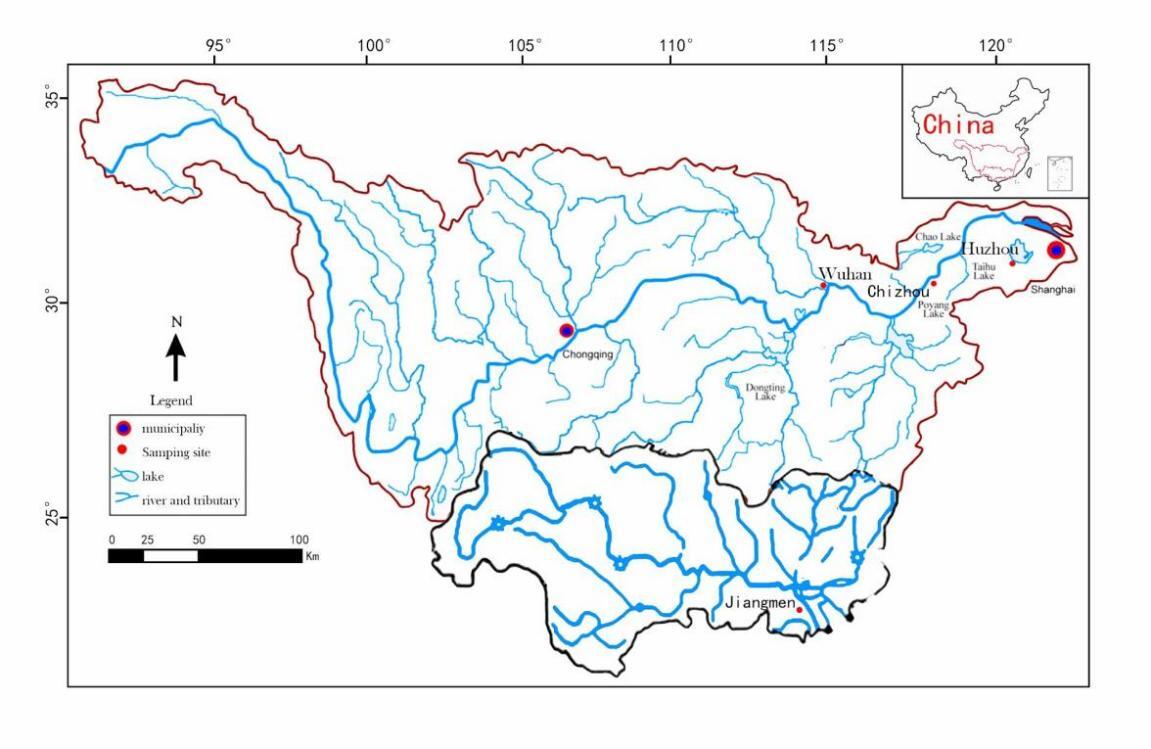
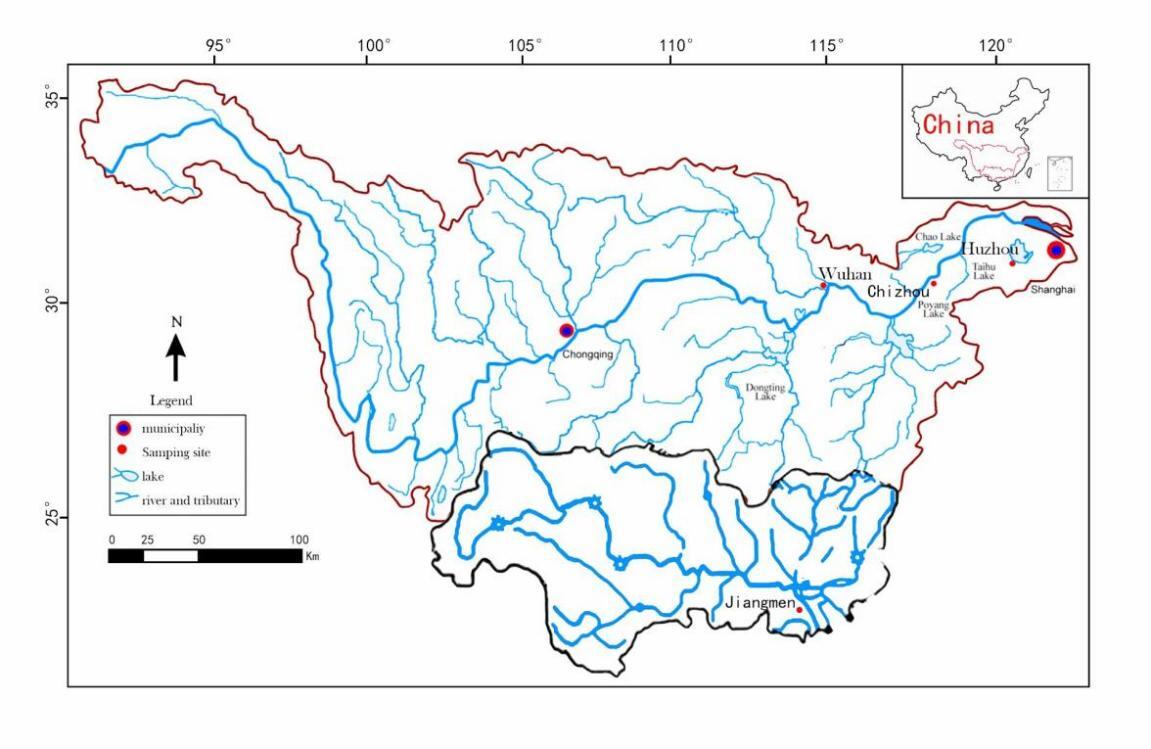
A total of 120 individuals were sampled from four S. chuatsi populations, comprising one wild-origin population from Huzhou, Zhejiang Province (ZJHZ), and three cultured populations from Chizhou, Anhui Province (AHCZ), Wuhan, Hubei Province (HBWH), and Jiangmen, Guangdong Province (GDJM) (Figure 1). Thirty individuals were initially collected from each population. Because the sampling design included only one wild-origin population and three cultured populations, it was not intended to provide a replicated comparison between wild and cultured S. chuatsi. Instead, the study focused on characterizing and comparing the maternal genetic composition of the four sampled populations. ZJHZ was therefore treated solely as a wild-origin population from Huzhou and not as a reference or baseline representative of wild S. chuatsi across the species’ geographic range. Fish were anesthetized in accordance with the approved animal-use protocol, after which muscle tissues were excised, immediately frozen in liquid nitrogen, and stored at −20 °C until DNA extraction. Genomic DNA was extracted using a TIANamp Genomic DNA Kit (Tiangen, China) following the manufacturer’s protocol. DNA integrity was evaluated using 1.5% agarose gel electrophoresis, and DNA concentration and purity were measured using a NanoDrop ND2000 spectrophotometer.
2.2. Amplification and sequencing of the mitochondrial D-loop region
An approximately 1-kb fragment encompassing the mitochondrial D-loop region was amplified using primers newly designed for this study based on the complete mitochondrial genome sequence of S. chuatsi deposited in GenBank under accession number NC_015822.1. The primer-binding sites were selected in relatively conserved regions flanking the mitochondrial control region to enable amplification and sequencing of the variable D-loop region used for haplotype analysis. The primers were designated Sc-Dloop-F and Sc-Dloop-R according to their amplification directions relative to the reference sequence (Table 1). Each 50-μL PCR reaction contained 25 μL of 2× Es-Taq MasterMix (Dye), 2 μL of genomic DNA, 1 μL of each primer (2.5 μM), and 21 μL of ddH₂O. Cycling conditions were 94 °C for 5 min; 30 cycles of 94 °C for 30 s, 54 °C for 30 s, and 72 °C for 1 min; followed by a final extension at 72 °C for 10 min. Amplicons were examined by agarose gel electrophoresis, purified, and sequenced by Sangon Biotech (Shanghai, China). Two samples, one from AHCZ and one from HBWH, failed to yield usable PCR amplicons and were therefore excluded from sequencing and subsequent analyses. The final dataset comprised 118 individuals, including 30 from GDJM, 29 from AHCZ, 30 from ZJHZ, and 29 from HBWH. Thus, the exclusions were distributed across two populations and did not disproportionately affect any single population. Sequence chromatograms from the remaining samples were manually inspected before downstream analysis.
2.3. Mitochondrial DNA statistical analysis
Raw chromatograms were manually checked and edited using SeqMan 5.01. Sequences were aligned to the S. chuatsi mitochondrial reference sequence NC015822.1, trimmed to a common high-quality region, and aligned using ClustalW in MEGA 5.05. DnaSP 5.10.01 was used to calculate the number of polymorphic sites, number of haplotypes (H), haplotype diversity (Hd), nucleotide diversity (π), mean number of nucleotide differences (K), and neutrality test (Tajima’s D).
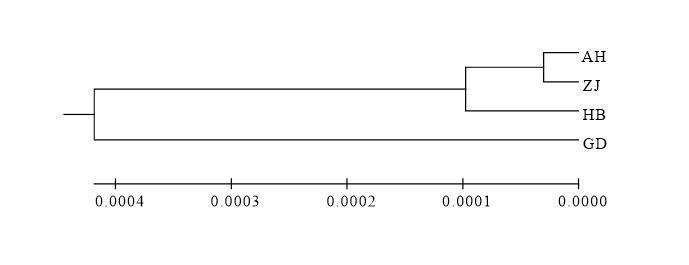
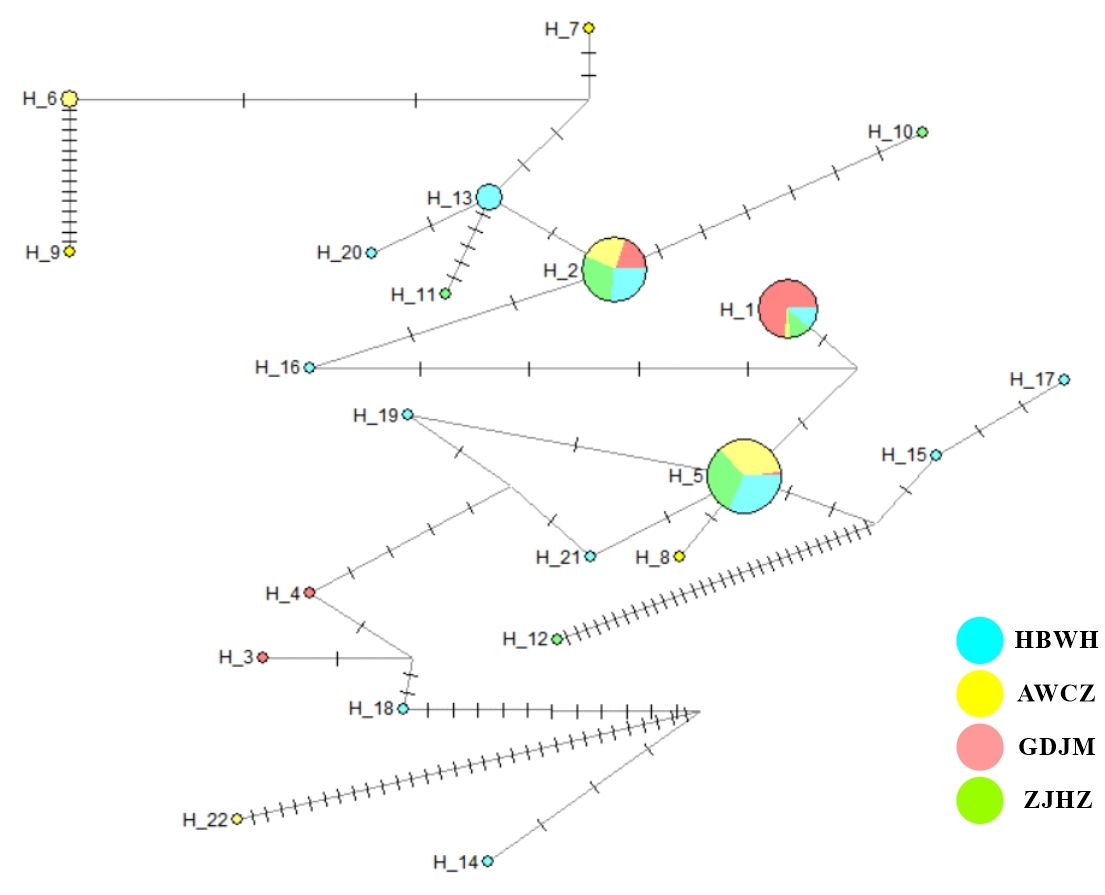
Genetic differentiation among the four populations was evaluated using pairwise FST estimates in Arlequin v3.5.1.2. Statistical significance was assessed using permutation tests, for which the Arlequin output reported 110 permutations for the pairwise FST comparisons. Analysis of molecular variance (AMOVA) was performed using the same software to partition mitochondrial variation into among-population and within-population components, and the significance of the among-population component was evaluated using 1,023 permutations. Statistical significance was defined as P < 0.05. Pairwise genetic distances among the four populations were also estimated for population clustering. An unweighted pair-group method with arithmetic mean (UPGMA) dendrogram based on the pairwise genetic-distance matrix was constructed using MEGA 5.05. A median-joining haplotype network was generated using PopART 1.7 to visualize the distribution and relationships among D-loop haplotypes across populations.
3. Results
3.1. Maternal Genetic diversity parameters of four S. chuatsi populations
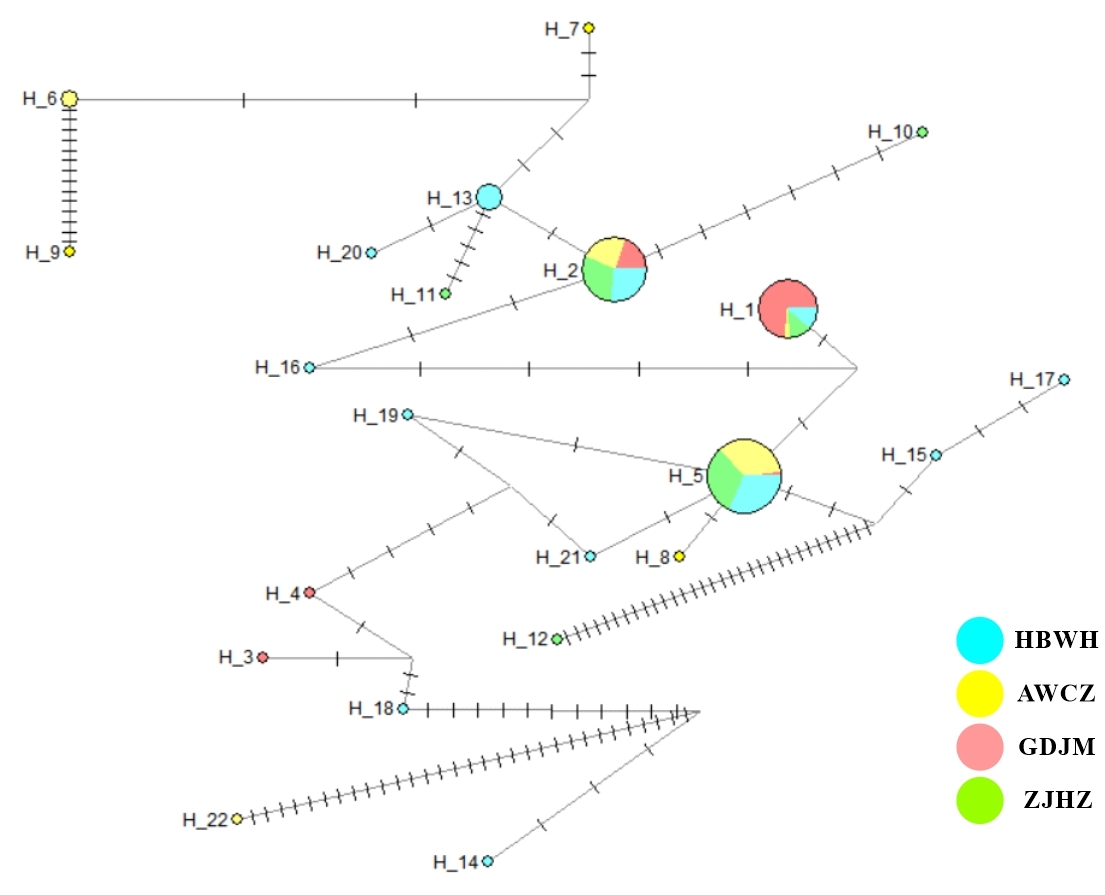
The four sampled populations were geographically distributed across Zhejiang, Anhui, Hubei, and Guangdong provinces, as shown in Figure 1. Of the 120 initially sampled individuals, 118 yielded usable PCR amplicons and high-quality D-loop sequences. One individual from AHCZ and one from HBWH were excluded because of PCR amplification failure. The final dataset therefore comprised 30 sequences from GDJM, 29 from AHCZ, 30 from ZJHZ, and 29 from HBWH. The aligned sequences showed an A+T bias. A total of 22 haplotypes (Hap1-Hap22) were identified (Table 2). Hap1, Hap2, and Hap5 were shared among all four populations and together accounted for 94 of the 118 individuals (79.7%). The remaining 19 haplotypes were population-specific and mostly occurred at low frequencies. Thus, most individuals carried widely shared maternal haplotypes, while the populations also retained multiple low-frequency, population-specific haplotypes.
Haplotype diversity ranged from 0.543 in GDJM to 0.805 in HBWH, nucleotide diversity ranged from 0.00604 in GDJM to 0.01095 in AHCZ, and the mean number of nucleotide differences ranged from 4.80920 to 8.07389 (Table 3). Overall, the four populations showed moderate-to-high mitochondrial haplotype diversity and comparatively low mitochondrial nucleotide diversity. Tajima’s D was negative in AHCZ, ZJHZ, and HBWH but positive in GDJM (Table 3). These statistics are reported descriptively and were not used to infer demographic expansion, selection, founder effects, or genetic drift because significance tests and independent genomic evidence would be required for such interpretations.
3.2. Population genetic distance and genetic differentiation index
Pairwise FST estimates ranged from −0.00633 to 0.11882 (Table 4). Significant differentiation was detected between GDJM and AHCZ (FST = 0.11372, P < 0.01), between GDJM and ZJHZ (F~ST ~= 0.09589, P < 0.01), and between GDJM and HBWH (F~ST ~= 0.11882, P < 0.01). The comparison between ZJHZ and HBWH was marginally significant (FST = 0.03405, P = 0.04505), although the magnitude of differentiation was low. In contrast, differentiation was not significant between AHCZ and ZJHZ (FST = −0.00633, P = 0.55856) or between AHCZ and HBWH (F~ST ~= 0.01302, P = 0.21622). The negative *F~ST ~*estimate between AHCZ and ZJHZ was interpreted as no detectable biological differentiation. Pairwise sequence distances were small, indicating limited overall mitochondrial sequence divergence.
AMOVA attributed 5.83% of the total mitochondrial variation to differences among populations and 94.17% to variation within populations (Table 5). The among-population variance component was statistically significant (FST = 0.05831, P = 0.00196), indicating weak but detectable maternal genetic structuring among the four sampled populations. Nevertheless, most mitochondrial sequence variation occurred within populations.
3.3. Haplotype phylogenetic tree and haplotype network
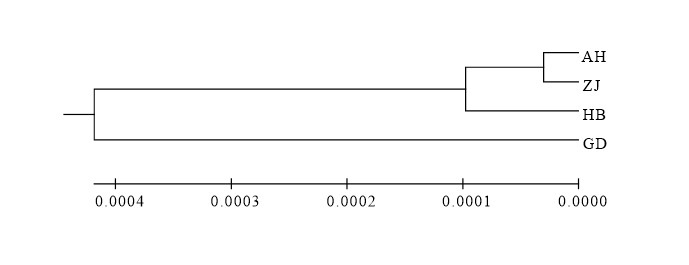
The UPGMA dendrogram based on pairwise mitochondrial sequence distances grouped AHCZ, ZJHZ, and HBWH into one cluster, whereas GDJM formed a separate branch (Figure 2). The median-joining network was dominated by Hap1, Hap2, and Hap5, which were shared among all four populations (Figure 3). In the network, blue, yellow, red, and green sectors represent HBWH, AHCZ, GDJM, and ZJHZ, respectively, and circle size is proportional to haplotype frequency. Multiple low-frequency population-specific haplotypes occurred around these common lineages. The network did not show clear geographic clustering, suggesting that the distribution of maternal haplotypes was not strictly associated with sampling location.
4. Discussion
Hatchery propagation may reduce genetic diversity when only a limited number of breeders contribute disproportionately to subsequent generations, although its effects vary among cultured fishes.14,15 In the present dataset, the wild-origin ZJHZ population from Huzhou had a haplotype diversity of 0.690 and a nucleotide diversity of 0.00853. Among the three cultured populations, haplotype diversity ranged from 0.543 to 0.805 and nucleotide diversity ranged from 0.00604 to 0.01095. These values describe variation among the four sampled populations but do not constitute a replicated test of differences between wild and cultured S. chuatsi. Differences in maternal diversity among the four sampled populations may reflect variation in the origins and reproductive contributions of female founders, because high variance in female reproductive success can reduce mitochondrial haplotype diversity in hatchery offspring.16 The diversity estimates observed here were broadly comparable to those reported by Lin et al.,17 although direct comparison is constrained by their use of concatenated D-loop and cox1 sequences.
The broad sharing of mitochondrial haplotypes across geographically separated populations may reflect shared ancestry, human-mediated translocation of broodstock or juveniles, or a combination of both.18,19 Similar genetic affinities among geographically distant cultured populations have been attributed to artificial propagation and stock translocation in other fishes.20,21 Conversely, the low-frequency population-specific haplotypes may represent rare maternal lineages, founder effects, or incompletely sampled variation rather than deeply divergent lineages. Without detailed broodstock records and broader geographic sampling, the relative contributions of historical ancestry and recent translocation cannot be distinguished conclusively.
The weak but statistically supported maternal structuring observed among the sampled populations was driven primarily by the differentiation of GDJM from the other three populations. Together with its separate position in the UPGMA dendrogram, this result identifies GDJM as maternally differentiated within the present dataset but does not establish the underlying mechanism. Differences in maternal founder composition, subsequent genetic drift, undocumented broodstock translocation, or a combination of these processes represent non-exclusive hypotheses that cannot be distinguished using the present single-locus data. Previous studies have reported generally weak differentiation among some S. chuatsi populations, potentially reflecting shared origins and exchanges of cultured germplasm.11,17 A microsatellite study also found that a cultured Jiangmen stock was comparatively distinct from other sampled stocks.9 However, this cross-marker similarity should not be interpreted as evidence of temporal continuity or a shared demographic mechanism because the studies differed in sampling time, stock source, and marker type. Genome-wide nuclear markers, documented broodstock pedigrees, and temporal sampling will be required to determine whether the maternal differentiation of GDJM reflects founder composition, genetic drift, stock translocation, or other population-specific processes.
From a maternal-lineage management perspective, hatchery location should not be treated as a reliable indicator of maternal provenance when selecting female broodstock.22 Management practices should document the origins of female broodstock, maintain sufficient numbers of unrelated females, balance female contributions to subsequent generations, and avoid unrecorded transfers among hatcheries. The low-frequency population-specific haplotypes identified here may be useful for monitoring maternal lineages, although their population specificity requires validation using larger samples and additional locations. These recommendations apply specifically to the management of maternal lineages and should complement, rather than replace, assessments of biparental genetic diversity based on nuclear markers and pedigree information.
Several limitations should be considered when interpreting these findings. First, the inclusion of only one wild-origin population from Huzhou precluded a replicated assessment of genetic differences associated with culture status. Population identity, geographic origin, broodstock history, and culture status were therefore partially confounded in the present sampling design. Second, mitochondrial D-loop sequences are maternally inherited and represent a single non-recombining locus; consequently, they provide information only on maternal genetic diversity and cannot resolve biparental admixture, paternal contributions, male-mediated gene flow, or genome-wide differentiation. Third, the absence of detailed broodstock and translocation records prevents the determination of the relative contributions of shared ancestry and recent human-mediated stock movement. Future studies should include multiple geographically representative wild-origin and cultured populations from comparable regions and integrate genome-wide nuclear markers, broodstock pedigrees, and temporal sampling.
Conclusion
Mitochondrial D-loop analysis revealed a broadly shared maternal genetic background, with weak but statistically significant structuring among the four sampled S. chuatsi populations, primarily involving differentiation in GDJM. Because the study included only one wild-origin population from Huzhou and examined a single maternally inherited locus, the findings are limited to maternal genetic variation in the sampled populations and cannot be used to evaluate paternal contributions or genome-wide diversity. The results support improved documentation of female broodstock origins, balanced female contributions, and mitochondrial monitoring of maternal lineages. Broader geographic sampling combined with genome-wide nuclear markers and pedigree information will be necessary for a comprehensive assessment of broodstock genetic structure and stock provenance.
ACKNOWLEDGMENTS
This study was supported by the Key Research and Development Project of Huzhou (Grant No. 2024ZD2046) and the Zhejiang Province Special Fund for Agro-Scientific Research (No. 2026CZZX02).
AUTHORS CONTRIBUTION - CRediT
Methodology: Yuefei Yao (Equal), Chao Zhu (Equal). Writing – original draft: Yuefei Yao (Equal), Meili Chi (Equal). Supervision: Fei Li (Lead). Formal Analysis: Wenping Jiang (Equal), Shun Cheng (Equal). Investigation: Wenping Jiang (Equal), Shun Cheng (Equal). Resources: Shili Liu (Equal), Junzhi Luo (Equal). Conceptualization: Jianbo Zheng (Equal), Haiqi Zhang (Equal). Funding acquisition: Jianbo Zheng (Equal). Writing – review & editing: Haiqi Zhang (Lead).
COMPETING OF INTEREST – COPE
No competing interests were disclosed.
ETHICAL CONDUCT APPROVAL – IACUC
All experiments in this study were conducted in accordance with the guidelines for scientific purposes and approved by the Animal Ethics Committee of Zhejiang Institute of Freshwater Fisheries.
INFORMED CONSENT STATEMENT
All authors and institutions have confirmed this manuscript for publication.
DATA AVAILABILITY STATEMENT
The representative mitochondrial D-loop sequences of the 22 haplotypes identified in this study, together with the corresponding variable-site matrix, are publicly available in Zenodo at https://doi.org/10.5281/zenodo.22886642.