
1. Introduction
Aquaculture has become a central component of the global aquatic-food system. In 2022, farmed aquatic animals exceeded capture fisheries in direct human-food production, while aquatic plants continued to contribute a substantial additional volume.1 This transition has strengthened food supply and created livelihood opportunities, but it has also shifted a growing share of environmental pressure from capture fisheries to managed production systems. The central sustainability question is consequently not whether aquaculture should expand, but which species, technologies, locations, and governance arrangements can increase production without exceeding ecological limits.
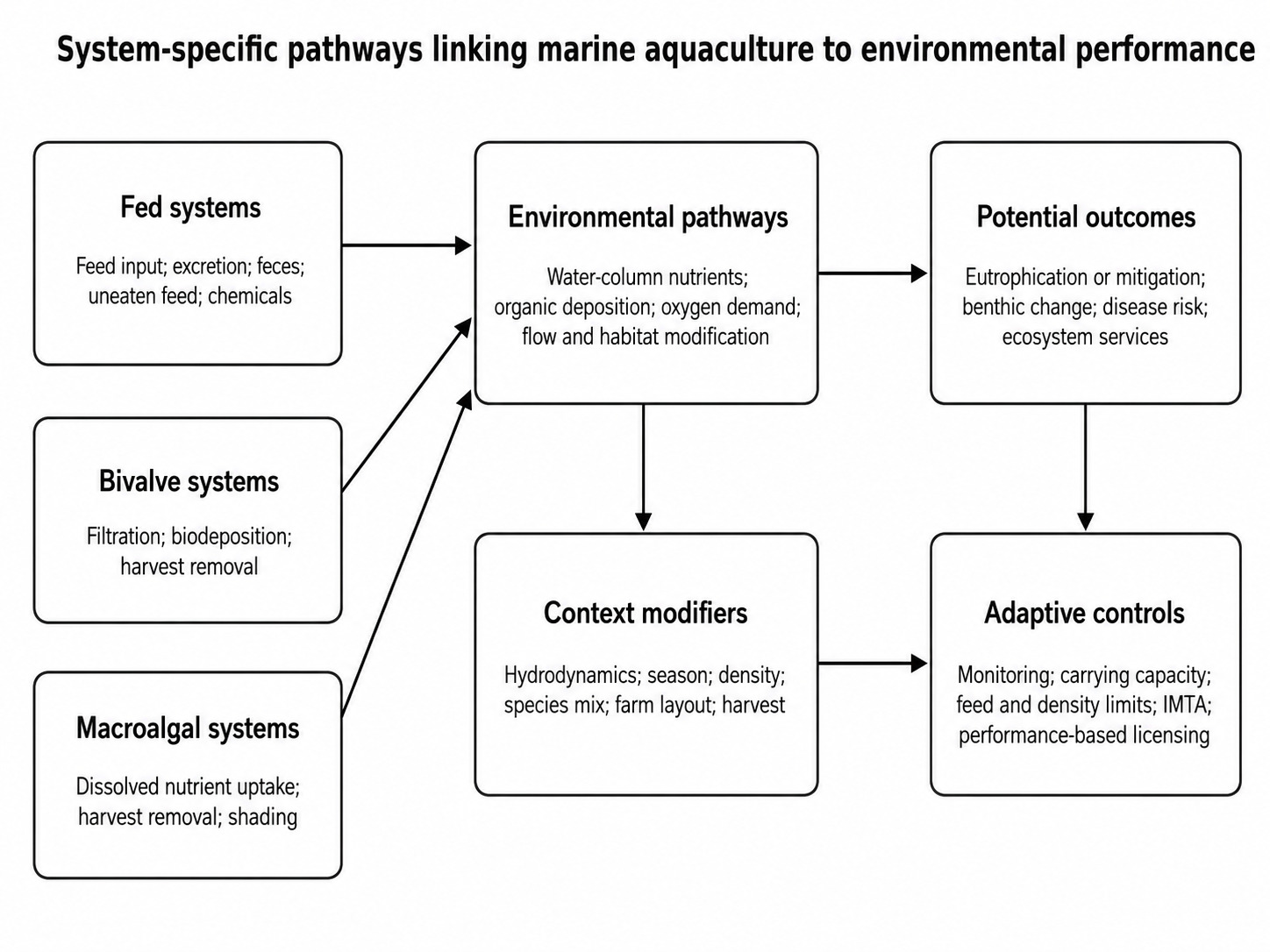
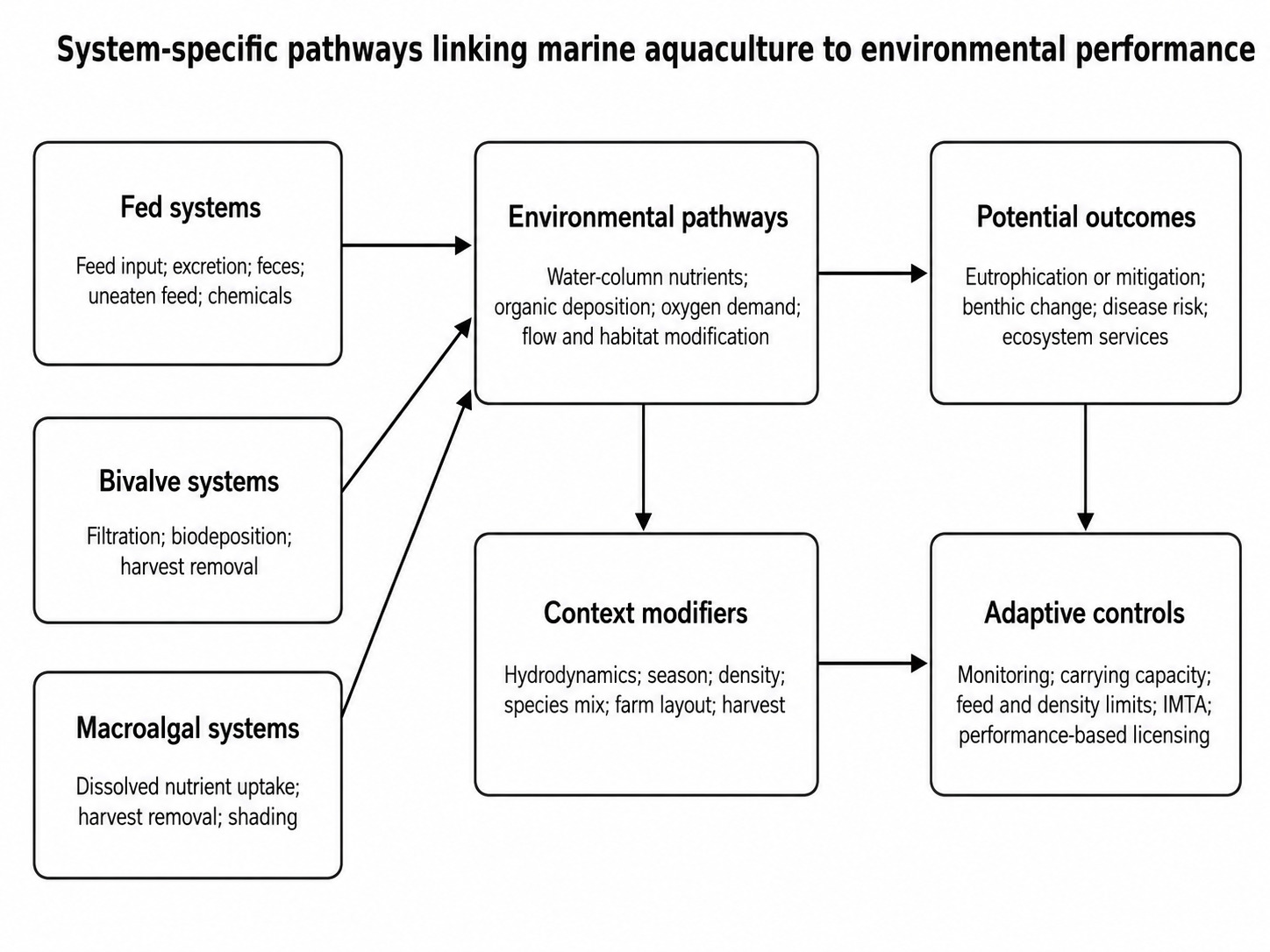
China is the world’s largest aquaculture producer and contains one of the most diverse mariculture portfolios. Coastal production includes net-pen finfish, shrimp and crab ponds, oysters, scallops, mussels, clams, kelp, laver, Gracilaria, sea cucumber, and multi-species systems. This diversity prevents a single environmental judgment from being applied to the whole sector. Fed animals import nutrients through formulated feed or forage fish and export a fraction through harvest; the remainder may enter the water column or sediment. Filter-feeding bivalves remove suspended particles but transfer some material to the seabed as feces and pseudofeces. Macroalgae assimilate dissolved nutrients and carbon during growth, yet their wider effects depend on harvest, decomposition, farm density, and changes to light and water movement. IMTA attempts to couple these contrasting functions within a shared production area.2–4
Earlier debates frequently treated aquaculture as either a substitute for depleted wild fisheries or a new source of environmental degradation.3 The accumulated evidence now supports a more conditional interpretation. Environmental performance is shaped by trophic mode, feed dependence, stocking intensity, farm geometry, water residence time, seasonal temperature, oxygen availability, sediment assimilation, disease management, and regulatory enforcement. For example, nutrient-retentive systems such as Sansha Bay can experience elevated nutrient concentrations even where extractive species are present, whereas more strongly flushed or differently configured farming areas may show a smaller local footprint. Conversely, extractive systems can deliver nutrient-removal and habitat-related services only when stocking density, food supply, hydrodynamic renewal, sediment assimilative capacity, and harvest are compatible with ecological carrying capacity.5–12
The Chinese case is especially important because national nutrient balances and local environmental observations can appear contradictory. Sector-wide accounting may indicate substantial nutrient removal through the harvest of shellfish and seaweed, while bay-scale studies still identify eutrophication, altered nitrogen-to-phosphorus ratios, and sediment stress near intensive farms.9,10 This is not necessarily a conflict in the evidence. National balances aggregate dissimilar provinces, species, and hydrodynamic settings, whereas ecological effects arise at specific spatial and temporal scales. A credible review must therefore distinguish gross nutrient input, harvest removal, net balance, local concentration, residence time, deposition, and ecological response.
This article has three objectives. First, it critically synthesizes environmental pathways associated with major coastal marine aquaculture systems in China. Second, it evaluates the benefits, boundary conditions, and limitations of bivalve culture, macroalgal cultivation, and IMTA as mitigation strategies. Third, it translates the evidence into operational indicators for monitoring, ecological carrying capacity, and adaptive governance. The primary scope is coastal marine aquaculture; freshwater aquaculture, land-based recirculating aquaculture systems, and dedicated offshore/deep-water production are outside the core review and are mentioned only when they clarify how environmental pressure may be displaced or redistributed. The intended contribution is a system-specific framework that links farming type, environmental mechanisms, monitoring evidence, and management responses.
2. Materials and Methods
2.1. Review design and analytical scope
A critical structured narrative review was selected because the purpose was to compare mechanisms, boundary conditions, and management implications across heterogeneous aquaculture systems rather than to calculate a pooled effect size. Here, ‘critical structured narrative review’ denotes a narrative synthesis guided by an explicit search framework, predefined analytical questions, and transparent evidence-prioritization criteria. It differs from a systematic review in that it does not claim exhaustive retrieval, protocol registration, duplicate independent screening, formal risk-of-bias scoring, or PRISMA-compliant study selection. This distinction is important because marine-aquaculture studies use diverse units, spatial scales, species, exposure periods, and ecological endpoints that are not readily reducible to one summary effect.
The evidence base was updated for the present revision through July 2026 using targeted searches for peer-reviewed studies and authoritative technical sources. The core literature emphasized publications from January 2000 to July 2026, while earlier foundational standards or conceptual sources were retained when necessary. Search concepts combined geography (China, Chinese coast, Bohai Sea, Yellow Sea, East China Sea, South China Sea, Sanggou Bay, Sansha Bay), production systems (mariculture, cage culture, shrimp, shellfish, bivalve, seaweed, macroalgae, IMTA), environmental pathways (nitrogen, phosphorus, organic enrichment, eutrophication, sediment, benthos, hydrodynamics, disease, chemicals), and governance tools (monitoring, carrying capacity, zoning, licensing, nutrient accounting). Because a retrospective, database-by-database search log was not available for the original narrative review, the revised manuscript does not claim a fully reproducible systematic search history. Instead, priority was given to studies that (i) quantified a material or biological pathway, (ii) reported farm- or bay-scale environmental observations, (iii) clarified boundary conditions or cumulative effects, (iv) provided evidence from representative Chinese mariculture bays, or (v) translated ecological evidence into operational monitoring or management. Targeted update verification for this revision included direct publisher sources for the representative bay studies and official Ministry of Ecology and Environment sources for current Chinese environmental standards. Studies focused exclusively on freshwater, land-based RAS, or offshore/deep-water systems were excluded from the core synthesis.
Studies were interpreted through five questions: (1) What material or biological pathway connects the farm to the surrounding ecosystem? (2) At what scale is the effect measured? (3) Which contextual variables amplify or attenuate the effect? (4) Does the study assess gross input, harvest removal, local concentration, ecological response, or cumulative impact? and (5) What management action follows from the evidence? This framework was used to avoid treating nutrient removal, improved water clarity, or carbon uptake as automatically equivalent to net ecosystem benefit.
2.2. Evidence organization
The evidence was grouped into fed systems, suspended bivalves, macroalgae, IMTA, disease and chemical pathways, and monitoring/carrying-capacity governance. Table 1 summarizes the defining inputs, potential services, principal risks, and minimum indicators for each system. The synthesis deliberately separates farm-scale performance from bay-scale cumulative effects. A technically efficient farm can still contribute to ecological deterioration when many farms operate in a restricted water body, and a nationally favorable nutrient balance can coexist with local hotspots.
The review also distinguishes production carrying capacity from ecological and social carrying capacity. Production carrying capacity concerns the biomass that can be maintained without unacceptable loss of farm performance. Ecological carrying capacity concerns the magnitude of production compatible with agreed limits on ecosystem structure and function. Social carrying capacity concerns conflict, public acceptance, navigation, landscape, and distributional effects.13 These categories should not be merged because a farm may remain profitable after ecological thresholds have been crossed, or may remain ecologically acceptable while generating severe spatial conflict.
3. Critical Evidence Synthesis
3.1. Scale expansion, structural change, and environmental accounting
China’s mariculture development has moved from production expansion toward an explicit policy emphasis on green and high-quality development. Nevertheless, environmental accounting remains complicated by differences among species and production modes. Zhang et al.5 estimated that Chinese aquaculture released substantial nitrogen and phosphorus and documented low nutrient-use efficiency in several systems. Luo et al.6 reconstructed the long-term nitrogen budget and showed that increasing inputs were accompanied by emissions, sediment accumulation, and export to coastal waters. These studies establish that harvest tonnage alone is an inadequate sustainability metric.
A later mariculture-specific assessment separated fed and extractive components and reported that harvest of shellfish and algae could outweigh estimated nutrient release in several coastal regions, although net release persisted in some southern provinces.9 This result should not be read as proof that intensive mariculture is environmentally benign. A net mass balance does not identify the timing, location, chemical form, residence time, or ecological effect of nutrients. Removal at harvest may occur months after dissolved nutrients or organic particles have affected a semi-enclosed bay. Moreover, shellfish harvest removes assimilated nutrients while biodeposition may still intensify sediment oxygen demand beneath farms.
The appropriate interpretation is therefore hierarchical. Farm-level nutrient-use efficiency describes the conversion of inputs into harvest. Bay-level budgets describe cumulative loads and removals. Water-quality indicators describe concentration and stoichiometry. Biological indicators describe ecological response. Sustainable governance requires all four levels, because improvement in one metric does not guarantee improvement in the others.
3.2. Fed systems: nutrient release, organic deposition, and benthic response
Fed marine systems are the clearest pathway by which exogenous nutrients enter coastal waters. Nitrogen and phosphorus not retained in cultured biomass are released as dissolved excretion, feces, uneaten feed, mortalities, and pond discharge. The fraction reaching the seabed depends on feed properties, animal behavior, cage design, current velocity, depth, and resuspension. Organic enrichment can increase microbial respiration, reduce sediment redox potential, generate sulfide, and alter benthic community composition.5–8,14
The effect is rarely linear across space. Strong currents may reduce deposition immediately beneath cages but enlarge the area receiving diluted particles. Conversely, weak flushing can concentrate dissolved nutrients and increase oxygen demand. Moving cages offshore may therefore redistribute rather than eliminate environmental pressure. Offshore development also introduces energy, containment, animal-welfare, and emergency-response requirements. Environmental assessment should evaluate total footprint and cumulative loading rather than rely on distance from shore as a proxy for sustainability.
Feed management remains the most direct control. Precision feeding, high-digestibility diets, stable pellets, observation-based ration adjustment, and strain-specific nutritional formulations can reduce waste at source. However, feed-conversion ratio alone is insufficient. A farm with an efficient FCR may still generate excessive cumulative load when stocking density and total feed input are high. Regulators should therefore pair efficiency targets with absolute input or waste-load limits at the permitted site.
3.3. Water-column change, eutrophication, and nutrient stoichiometry
Eutrophication is governed not only by total nutrient quantity but also by nutrient ratios, residence time, temperature, light, and community composition. A representative case is Sansha Bay, where winter 2021 monitoring at 25 stations reported nitrate concentrations of 8.4–44.9 μM (mean 31.3 ± 10.5 μM) and phosphate concentrations of 0.46–3.61 μM (mean 2.26 ± 0.84 μM). Approximately 81% of observations exceeded the study’s eutrophication thresholds, while the mean nitrate-to-phosphate ratio was 14.3 ± 2.2, below the canonical Redfield ratio.10 These measurements demonstrate why a simple statement that a bay is ‘semi-enclosed’ is insufficient: the management-relevant evidence lies in measured nutrient concentrations, stoichiometry, hydrodynamic exchange, biological uptake, and sedimentary processing. Monitoring programs that report only total nitrogen or total phosphorus can, therefore, miss ecologically important shifts.
The practical monitoring unit should be the water body that integrates multiple farms. Farm compliance sampling is necessary, but cannot reveal cumulative effects when dozens of operators share the same bay. Bay-scale stations should include reference locations, seasonal coverage, and event-triggered sampling during heat waves, low-oxygen episodes, disease outbreaks, and bloom conditions. Core variables should include temperature, salinity, dissolved oxygen, ammonium, nitrate plus nitrite, phosphate, chlorophyll-a, turbidity, and, where feasible, phytoplankton composition and flow.
Thresholds must be linked to action. Monitoring without pre-defined management responses becomes descriptive rather than adaptive. A tiered system can require intensified sampling when early-warning thresholds are exceeded, temporary feed reduction or density adjustment under sustained deterioration, and production-cap review when ecological status fails to recover. This logic is consistent with the shift toward locally specified aquaculture-pollution control standards under China’s HJ 1217-2023 framework, which emphasizes translating environmental objectives into implementable control requirements.15
3.4. Suspended bivalves: ecosystem services with density-dependent trade-offs
Bivalve aquaculture is often presented as a low-input or restorative form of seafood production. Filter-feeding oysters, mussels, scallops, and clams can remove phytoplankton and suspended particles, improve water clarity under some conditions, and export nitrogen and phosphorus when biomass is harvested. Reviews identify additional potential services, including habitat provision and shoreline or sediment-related functions.16–19 These benefits are real but context dependent.
Filtration redistributes material rather than simply making it disappear. Feces and pseudofeces increase vertical particle flux and may enrich sediments beneath dense farms. If biodeposition exceeds sediment assimilation and oxygen supply, benthic conditions deteriorate. High filtration pressure may also reduce food availability for cultured and wild suspension feeders. Accordingly, positive ecosystem-service outcomes are most plausible where phytoplankton or seston supply is sufficient, water renewal prevents chronic food depletion, farm density remains below ecological carrying capacity, sediments can assimilate biodeposits without persistent hypoxia or sulfide accumulation, and harvested biomass actually exports assimilated nutrients from the management area. The sign and magnitude of the net effect therefore depend on clearance rate, stocking density, residence time, primary production, sediment type, temperature, and harvest regime.
Sanggou Bay provides a contrasting empirical example. A MOM-system assessment of 66 sediment samples from 10 stations found benthic fauna in all samples, sediment redox potential remaining above +50 mV, and overall benthic conditions classified as low-impact condition 1 or 2, although impacts were greater in summer and autumn than in winter and spring.20 More recent monthly monitoring also documented seasonal oxygen stress, with the lowest reported dissolved-oxygen concentration reaching 5.56 mg L−1 in September and lower oxygen generally occurring from June to September.21 These observations do not imply that intensive suspended culture is universally benign; rather, they show that environmental performance is conditional on season, temperature, hydrodynamics, culture composition, and loading. Nutrient-credit or ecosystem-service payment schemes should therefore require measured harvest removal together with evidence that local water-column and sediment thresholds remain within acceptable ranges.
3.5. Macroalgal culture: nutrient bioextraction and limits of environmental claims
Large-scale seaweed aquaculture is a prominent component of Chinese mariculture. Xiao et al.11 estimated substantial annual removal of nitrogen and phosphorus from coastal waters through seaweed harvest. This function makes macroalgae attractive as a component of nutrient-management strategies and as an extractive compartment in IMTA. Artificial upwelling and other engineering interventions have also been explored to increase nutrient delivery and biomass production.12
Bioextraction must nevertheless be demonstrated as a mass balance. Nutrient uptake during growth becomes removal from the local water body only when biomass is harvested before substantial detachment or decomposition, and when the harvested material is managed so that nutrients are not rapidly returned to the same receiving environment. The strongest nutrient-service claims, therefore, require adequate dissolved-nutrient supply, hydrodynamic exchange, farm densities that do not cause excessive shading or flow obstruction, harvest timing matched to peak nutrient content, and accounting for storm loss, crop detachment, and post-harvest waste. Dense farms may alter current speed, light penetration, plankton dynamics, and habitat structure; at very large scale, nutrient competition can constrain both farm yield and surrounding primary production.
Carbon claims require even greater caution. Photosynthetic uptake transfers dissolved inorganic carbon into seaweed biomass, but this is not equivalent to durable carbon dioxide removal (CDR). After harvest, carbon may be rapidly returned to the atmosphere through respiration, consumption, decomposition, short-lived products, or fuel use; only the fraction stored for an appropriate permanence period or transferred to a durable sink can contribute to net removal. A defensible lifecycle assessment must therefore define the accounting boundary and include cultivation materials, vessels, energy, drying, transport, processing, product lifetime, end-of-life fate, remineralization, and any counterfactual displacement of more carbon-intensive products. Recent global analyses show strong spatial variation and substantial economic and biophysical limits to gigaton-scale seaweed carbon removal.13,19,22 Seaweed cultivation can still provide valuable products and nutrient services, but CDR or carbon-credit claims should use transparent lifecycle boundaries, conservative permanence assumptions, and explicit treatment of uncertainty.
3.6. IMTA: mechanism, performance conditions, and implementation barriers
IMTA couples fed species with organisms that use particulate or dissolved waste streams. The conceptual objective is to convert a portion of otherwise lost nutrients into harvestable biomass while diversifying revenue. Foundational work emphasizes ecological engineering rather than simple co-location: species must be connected by actual waste pathways, and spatial design must match particle settling and dissolved-nutrient transport.23–25
Sanggou Bay is an internationally important example because multiple trophic groups are cultivated at a commercial scale. Studies have described system structure and quantified nutrient sources and exports.26,27 The evidence supports the potential for integrated systems to improve material use, but also shows that performance is embedded in bay hydrodynamics and seasonal production cycles. A bivalve or seaweed crop placed too far from a feed source, harvested at the wrong time, or limited by another nutrient may recover only a small share of the waste.
Implementation barriers are ecological, economic, and institutional. Additional species create food-safety, disease, labor, processing, and market requirements. Benefits may be unevenly distributed when one operator bears the cost of extractive production while another generates the waste. Licensing systems commonly regulate species or leases separately, which can obstruct integrated design. IMTA policy should therefore support coordinated permits, shared monitoring, nutrient-recovery accounting, and markets for all components rather than merely encouraging mixed-species farming in principle.21
3.7. Disease, pharmaceuticals, escapes, and biological interactions
Environmental performance extends beyond nutrients. High density and repeated stocking can increase pathogen transmission and amplify losses during thermal or oxygen stress. Therapeutants, disinfectants, and pesticides may enter surrounding waters when use is poorly controlled. Escapees can interact with wild populations through competition, predation, disease transmission, or genetic introgression. Non-native species add further risk when biosecurity and containment are weak.14
Disease management should prioritize prevention: certified seed, quarantine, vaccination where available, fallowing, density control, mortality surveillance, and rapid diagnostics. Chemical use should be recorded in standardized digital logs and linked to withdrawal periods and environmental monitoring. Public reporting need not disclose commercially sensitive details, but regulators require sufficient information to identify cumulative use and resistance risk.
Climate change strengthens the case for integrated surveillance. Higher temperatures can alter metabolism, oxygen demand, pathogen dynamics, and host microbiomes, while extreme rainfall changes salinity and contaminant transport. Farm plans should include climate-sensitive thresholds and contingency procedures rather than rely exclusively on historical averages.
3.8. Ecological carrying capacity and adaptive monitoring
Carrying capacity provides the bridge between site suitability and cumulative management. For bivalves, hierarchical frameworks distinguish physical, production, ecological, and social capacity.13 The same logic applies more broadly. Physical suitability asks whether infrastructure and species can persist. Production capacity asks how much biomass can be grown efficiently. Ecological capacity asks how much production can occur without unacceptable ecosystem change. Social capacity asks how much development can occur without unacceptable conflict or loss of public values. Conceptual pathways linking marine aquaculture systems to environmental performance and adaptive controls are illustrated in Figure 1.
In practice, carrying capacity should be treated as an adaptive estimate rather than a permanent number. Nutrient inputs, hydrodynamics, temperature, farm layout, wild populations, and background land-based pollution all change. Models should be calibrated with field observations and revised when monitoring shows systematic bias. The result should inform total allowable feed, biomass, lease area, or harvest by management unit.
A minimum program combines farm records with water and sediment indicators. Farm records include species, stocked biomass, mortality, feed, therapeutants, and harvest. Water indicators include oxygen, nutrients, chlorophyll-a, temperature, salinity, and turbidity. Sediment indicators include organic matter, redox, sulfide, and benthic community condition where deposition is expected. Remote sensing and automated sensors can improve coverage, but calibration, maintenance, quality assurance, and response protocols determine whether digital monitoring is useful. Table 2 summarizes the evidence matrix for major environmental pathways and management responses.
3.9. Spatial governance, cumulative effects, and distributional trade-offs
Co-management can contribute local ecological knowledge, rapid reporting, and social legitimacy, but it should complement rather than replace public regulation. Farmers and fishers often observe changes in currents, water color, mortalities, blooms, and species distribution before formal monitoring detects them. Structured reporting channels can integrate these observations with sensor and laboratory data. Final decisions on allowable production and environmental thresholds should nevertheless be transparent, scientifically justified, and subject to independent oversight, particularly where powerful operators may influence local institutions.
Distributional equity also affects environmental compliance. Small family farms may lack capital for continuous oxygen sensors, sediment surveys, certified seed, redesigned gear, or independent environmental auditing, whereas larger firms can spread these fixed costs across greater production volumes and may have easier access to credit and premium markets. A uniform capital-intensive standard can therefore induce small operators to exit or transfer leases to larger firms even when total bay-scale biomass and nutrient loading do not decline; consolidation alone is not an ecological outcome. Transition policy should combine enforceable minimum standards with shared bay-scale monitoring platforms, cooperative sampling and treatment services, extension support, and time-limited finance for verified improvements. Financial assistance should be conditional on transparent reporting and measurable reductions in environmental pressure so that public support does not subsidize continued overstocking or merely shift production to larger operators.
Cumulative assessment is especially important where many individually compliant farms operate close together. Permit-by-permit review may underestimate total feed load, filtration pressure, shading, biodeposition, or physical obstruction. A bay-scale management unit should map all leases and major non-aquaculture nutrient sources, identify sensitive habitats and circulation pathways, and evaluate alternative farm configurations before authorizing further expansion. Strategic zoning can separate incompatible uses, preserve flushing corridors, and concentrate monitoring where modeled exposure is greatest. However, zoning must remain revisable because production technologies, markets, and climate conditions change.
Marine aquaculture occupies shared coastal space. Rafts, longlines, cages, access routes, service vessels, processing infrastructure, conservation areas, capture-fishing grounds, tourism, and shipping may overlap within the same bay. An environmental assessment that focuses only on farm emissions can therefore miss important sustainability effects. Farm structures can modify navigation and landscape values, restrict access to traditional fishing areas, or create habitat that attracts wildlife and alters local fishing patterns. These outcomes are not uniformly negative or positive; they depend on spatial design, tenure arrangements, enforcement, and how costs and benefits are distributed among users.
4. Discussion
4.1. From sector labels to environmental functions
The principal conclusion of this review is that environmental regulation should not classify mariculture as a single activity. Fed systems, bivalves, macroalgae, and IMTA have different material pathways and therefore require different indicators. A uniform permit based solely on area or species cannot account for feed-derived waste, harvest-based nutrient removal, biodeposition, or trophic coupling. Functional classification provides a stronger basis for licensing and reporting.
For fed systems, the core management variables are total feed, nutrient retention, density, mortality, chemical use, and depositional footprint. For bivalves, management must balance harvest removal and filtration benefits against food depletion and biodeposition. For macroalgae, the critical variables are harvested biomass, tissue nutrient content, farm density, light and flow modification, and product fate. For IMTA, managers require a whole-system mass balance and evidence that extractive components are connected to the waste plume.
4.2. Reconciling national balances with local ecological risk
The apparent contrast between national net-removal estimates and local eutrophication is resolved by scale. Nutrient budgets are not interchangeable with ecological status. A harvested tonne of nitrogen may offset annual inputs in accounting terms, yet still fail to prevent a seasonal oxygen event in a poorly flushed bay. Management should therefore report gross input, harvest export, net balance, local concentrations, sediment condition, and biological response as separate metrics.
This distinction also clarifies the role of shellfish and seaweed. Their ecosystem services should be recognized, but crediting schemes must avoid double-counting and leakage. Here, double counting means assigning the same nutrient-removal or carbon benefit more than once across a farm, bay-level program, product claim, or offset scheme; leakage means displacing an environmental burden outside the accounting boundary rather than actually preventing it. A nutrient credit should therefore correspond to measured nutrient mass in harvested biomass, be reconciled with farm-related biodeposition and other local effects, and be verified within a defined management area. Carbon claims require an even more conservative standard because net benefit depends on lifecycle emissions, permanence, and the counterfactual fate of products.
4.3. Boundary conditions, accounting integrity, and governance safeguards
Environmental safeguards should be embedded within the economic and governance mechanisms that shape farm behavior. Governance integration can require common bay-level standards; livelihood programs can finance verified transitions to lower waste loads; digital infrastructure can provide traceable farm records and early warning; and co-management can improve local observation and compliance while retaining scientific thresholds and public regulatory accountability. The key principle is that enabling investments should be conditional on measurable environmental performance rather than treated as evidence of sustainability in themselves.
Performance-based incentives are preferable to technology labels. A farm should not receive a sustainability benefit merely because it is digital, relocated, or multi-trophic. Eligibility should depend on measurable outcomes such as lower nutrient loss per unit harvest, compliance with sediment thresholds, verified nutrient removal, reduced chemical use, and transparent reporting. This approach reduces the risk that nominal innovation is subsidized without a corresponding improvement in bay-scale ecological condition.
4.4. Operational policy roadmap
A staged roadmap is appropriate. In the short term, authorities can standardize farm records, minimum water and sediment indicators, and feed or biomass reporting. In the medium term, bay-level nutrient budgets and carrying-capacity models can be linked to licenses, production caps, fallowing, and farm-layout revision. In the longer term, adaptive permits can be updated from monitoring evidence, while verified ecosystem services from shellfish and seaweed can be incorporated into nutrient-management or incentive schemes. The trigger values in Table 3 are screening examples rather than universal ecological limits: they should be calibrated to the designated water-quality class, species sensitivity, seasonal baseline, hydrodynamics, and local reference stations. For example, China’s current GB 3097-1997 Class II seawater objectives specify dissolved oxygen above 5 mg L−1, inorganic nitrogen at or below 0.30 mg N L−1, and active phosphate at or below 0.030 mg P L−1; HJ 1300-2023 provides the current national framework for integrated assessment of seawater and marine-sediment quality.28,29 The roadmap should be implemented first in intensively farmed bays with recurrent nutrient enrichment, oxygen stress, bloom events, disease episodes, or sediment deterioration.
4.5. Limitations and research priorities
This review has several limitations. It is a critical structured narrative review rather than a systematic review with a registered protocol, complete search log, duplicate independent screening, and formal risk-of-bias assessment. The literature is heterogeneous, encompassing different species, locations, sampling designs, and measurement scales. Although the search framework, time window, evidence-prioritization criteria, and scope boundaries are now stated explicitly, the synthesis remains interpretive and may not capture every relevant Chinese-language or local monitoring report. Quantitative values should therefore be interpreted in their original spatial and seasonal contexts rather than transferred directly among bays.
Future research should develop a transparent China mariculture evidence database that links farm inputs, cultured biomass, hydrodynamics, water quality, sediment conditions, biodiversity, disease, and socioeconomic performance. Repeated bay-scale studies are needed to distinguish farm effects from land-based pollution and climate variability. Comparative evaluations should test whether performance-based permits, nutrient credits, or coordinated IMTA licensing produce measurable improvement rather than only procedural compliance.
5. Conclusions
Marine aquaculture in China cannot be classified as uniformly harmful or uniformly beneficial. Environmental performance depends on trophic function, external inputs, density, farm layout, hydrodynamics, season, harvest, and governance. Fed systems require strict control of total feed and waste loads. Bivalve and seaweed systems can provide nutrient-removal and other ecosystem services, but these benefits are conditional on harvest and carrying capacity. IMTA can improve recovery and diversify production, but only when trophic coupling and commercial operation are demonstrated. The most important management shift is from production- or area-based permission to evidence-based adaptive licensing. Minimum farm records, bay-scale nutrient budgets, water and sediment thresholds, and ecological carrying-capacity assessment should determine allowable feed, biomass, and farm layout. Monitoring must be linked to pre-defined responses rather than treated as a reporting exercise.
Sustainable transition also requires attention to distributional effects. Uniform compliance requirements can unintentionally accelerate consolidation if small operators face fixed monitoring and technology costs that larger firms can more easily absorb. Shared monitoring infrastructure, cooperative services, and performance-linked transition finance can reduce this risk while preserving enforceable ecological standards. The central policy test is therefore not whether a technology is labelled ‘green’, but whether cumulative environmental performance improves at the scale of the receiving bay.
Acknowledgments
The authors thank colleagues and practitioners whose technical discussions helped refine the review framework and its management implications. This work was supported by the National Science and Technology Council of Taiwan (Grant NSTC 114-2121-M-366-001).
Author Contributions
Conceptualization: Xin-Ruo Wang (Equal), Ta-Jen Chu (Equal), Yu-Ming Lu (Equal), Chun-han Shih (Equal). Methodology: Xin-Ruo Wang (Equal), Ta-Jen Chu (Equal), Yu-Ming Lu (Equal), Chun-han Shih (Equal). Investigation: Xin-Ruo Wang (Equal), Ta-Jen Chu (Equal), Chun-han Shih (Equal). Data curation: Xin-Ruo Wang (Equal), Ta-Jen Chu (Equal), Chun-han Shih (Equal). Formal Analysis: Xin-Ruo Wang (Equal), Ta-Jen Chu (Equal), Chun-han Shih (Equal). Writing – review & editing: Xin-Ruo Wang (Equal), Ta-Jen Chu (Equal), Yu-Ming Lu (Equal), Chun-han Shih (Equal). Visualization: Ta-Jen Chu (Equal), Chun-han Shih (Equal). Writing – original draft: Ta-Jen Chu (Equal), Chun-han Shih (Equal).
Ethical conduct approval – IACUC
Not applicable
Data Availability
No new primary dataset was generated or analyzed in the revised manuscript. All evidence is derived from the published sources and publicly available technical standards cited in the article. The secondary AHP analysis included in the original submission has been removed; therefore, no questionnaire-derived result is used to support the conclusions of this revised review.
Competing Interests
The authors declare no competing financial interests or personal relationships that could have influenced the work reported in this paper.
Declaration of Generative AI and AI-Assisted Technologies
During preparation of the revised manuscript, the authors used OpenAI ChatGPT for language editing and editorial assistance. All AI-assisted text was critically reviewed, verified against the cited sources, and revised by the authors, who take full responsibility for the content.