
1. Introduction
As one of the most powerful biosurfactants, surfactin is the natural secondary metabolite of several strains of the genus Bacillus. Its structure features a cyclic heptapeptide headgroup with the sequence Glu-Leu-d-Leu-Val-Asp-d-Leu-Leu, which is connected by a lactone bond to a C13–15 β-hydroxy fatty acid.1,2 This unique cyclic structure not only confers resistance to proteolytic digestion by pepsin and trypsin, but also endows surfactin with potent biosurfactant activity through its amphiphilic nature, which arises from the polar amino acid head and hydrophobic hydrocarbon chain.3–5
In recent years, surfactin has been demonstrated to possess a broad spectrum of biological activities, including antibacterial, antiviral, antifungal, antimycoplasmal, and hemolytic effects.1,6 Moreover, surfactin possesses emulsifying properties that facilitate the dispersion and digestion of dietary lipids, thereby improving nutrient utilization.6,7 Those biological activities are highly relevant to health care and biotechnology applications. Surfactin has gained increasing interest as an antimicrobial peptide or emulsifier in aquafeeds, and its positive effects on growth and intestinal health have been demonstrated across a broad range of fish species, from American eel (Anguilla rostrata),7 orange-spotted grouper (Epinephelus coioides),8 marbled eel (Anguilla marmaorata),9 tilapia (Oreochromis niloticus),10 rainbow trout (Oncorhynchus mykiss),11 zebrafish (Danio rerio),12 and largemouth bass (Micropterus salmoides).13
All the aforesaid studies were conducted under laboratory conditions; the application of surfactin in the diet of aquatic animals has not been explored under practical culture conditions. On aquaculture farms, fish of different body sizes are frequently reared during the same cultivation period. Owing to ontogenetic differences in digestion, microbiota, and feed intake, fish in different body sizes may respond unequally to feed additives or diets.14,15 It is necessary to evaluate the effects of dietary surfactin supplementation in fish with different body sizes to explore its potential for precise application.
Eels (Anguilla spp.) are globally valuable commercial species predominantly produced in China, with the American eel standing out for its exceptional market potential.16 Intensive culture of eels in cement tanks is the conventional practice under practical farming conditions.17 However, some factors, including high levels of ammonia N or nitrite in the water environment, excessive dietary histamine, and some biological diseases, may compromise intestinal function in eels, further leading to growth retardation and even mortality.18–20 Therefore, protecting intestinal health is of great practical significance for sustaining the normal growth of eels. Based on previous findings under laboratory conditions,7 this study aimed to evaluate the effects of dietary supplementation with 100 mg/kg surfactin on the growth performance and intestinal health of American eels of two body sizes cultured in cement tanks, thereby bridging the gap between laboratory research and practical aquaculture.
2. Materials and methods
2.1. Experimental diets
The basal diet was the commercial powder feed (Fuyuan Fishery Development Co., Ltd., Fujian, China) containing 48.32% crude protein, 4.37% lipids, 11.87% ash, and 5.42% moisture, supplemented with 5% fish oil. All experimental diets were formulated to be iso-nitrogenous and iso-lipidic after the addition of fish oil and surfactin to eliminate nutritional interference. The Control-W20 group was fed the basal diet, while the Surfactin-W20 and Surfactin-W40 groups were fed the basal diet supplemented with 100 mg/kg surfactin (the content of surfactin product was 98%, which was measured by HPLC method). The Batch No. of surfactin product was ZKDY-H:2018061808, and it was produced by Bacillus subtilis fermentation in Anhui Zhongke Diyuan Technology Development Co., Ltd, Hefei, China. Surfactin was incorporated into the basal diet via stepwise mixing to ensure homogeneous distribution and to maintain its stability in the final experimental diets.
2.2. Experimental fish and feeding trial
The trial was carried out at Fuyuan Fishery Development Co., Ltd. (Fujian, China). All juvenile American eels were cultured in cement tanks (17m×15m and 0.7m water depth). After grading, six cement tanks containing eels of similar body weight (about 20 g/fish and 1430 kg/tank) were randomly divided into two groups: Control-W20 group and Surfactin-W20 group, with three tanks per group. Meanwhile, another three tanks containing eels of similar body weight (about 40 g/fish and 1420 kg/tank) were assigned to the Surfactin-W40 group and fed the same 100 mg/kg surfactin diet as the Surfactin-W20 group. Twice daily at 5:00 and 17:00, eels were fed the experimental diets, which had been prepared by mixing the powdered basal diet with water in a 1:1.3 ratio to achieve a uniform dough-like consistency, until apparent satiation. Throughout the cultivation period, identical fish husbandry and water management protocols were applied to all tanks. Water exchange was performed twice daily at 06:00 and 18:00. Water quality was maintained at 26–28 °C, pH 7.8–8.2, dissolved oxygen 8.1–9.6 mg/L, and total ammonia nitrogen 0.23–0.47 mg/L throughout the trial. The trial lasted 12 weeks.
2.3. Sample collection
At the end of the trial, all American eels were weighed after 24 h of fasting. Ten eels per tank were randomly collected, anesthetized with 0.1 g/L eugenol, and sacrificed for intestine tissue sampling. For the intestinal samples obtained from ten eels per tank, three eels were used to assay intestinal digestive enzyme activities and intestinal antioxidant capacity, three were post-fixed in 4% paraformaldehyde for intestinal morphology observation, and the remaining four were processed for intestinal microbiota analysis.
2.4. Analytical methods
2.4.1. Growth performance parameters
At the end of the trial, fish from each tank were weighed after 24 h of fasting, and the resulting data were used to determine growth performance parameters.
Weight gain rate (WGR), feed efficiency (FE), feeding rate (FR) and survival rate (SR) were calculated as follows:
WGR (%) = [final fish weight (kg/tank)-initial fish weight (kg/tank)]/initial fish weight (kg/tank) ×100
FE (%) = [final fish weight (kg/tank)-initial fish weight (kg/tank)]/feed consumption (kg/tank) ×100
FR (%) = feed consumption (kg/tank)/average fish weight (kg/tank) ×100
SR (%) = 100 × (final number of fish/initial number of fish)
2.4.2. Activities of digestive enzymes in the intestine
The activities of amylase, lipase and protease in intestinal tissue were determined according to the method of Zhai and Liu.21 All enzyme activities were normalized to total soluble protein, quantified via the bicinchoninic acid (BCA) method, and expressed as units per milligram of protein.
2.4.3. Antioxidant capacity of the intestine
Antioxidant indices, including the activity of total antioxidant capacity (T-AOC), catalase (CAT), superoxide dismutase (SOD), and glutathione peroxidase (GSH-PX), and the contents of glutathione (GSH) and malondialdehyde (MDA) in the intestine were measured with the assay kits (Nanjing Jiancheng Institute, Nanjing, China) according the manufacturer’s instructions. All measurements were normalized to the total protein content of intestinal homogenate. Total protein was quantified via the BCA method.
2.4.4. Histopathological analysis of intestinal tissue sections
The tissues were removed from the fixative solution and trimmed with a scalpel to isolate the target segments. Following standard histological procedures, the segments were embedded in paraffin wax and sectioned at a thickness of 4 μm. The sections were stained with Hematoxylin-Eosin (H&E). Villus height and muscular layer thickness were observed and measured under light microscope (BX80-JPA Olympus, Japan) and measured by the method described by Zhai et al.22
2.4.5. Intestinal microbial analysis
Given the potential impact of body weight on intestinal microbiota,23 this analysis was confined to the Control-W20 and Surfactin-W20 groups. Total bacterial genomic DNA was extracted according to the protocol described by Shi et al., following the manufacturer’s instructions for the Omega Bio-tek DNA extraction kit (Norcross, GA, USA).24 DNA quality was verified by agarose gel electrophoresis. The V3–V4 hypervariable region of the bacterial 16S rRNA gene was amplified using the primer pair 338F (5′-ACTCCTACGGGAGGCAGCAG-3′) and 806R (5′-GGACTACHVGGGTWTCTAAT-3′). Qualified amplicons were submitted to Beijing Allwegene Technology Co., Ltd. (Beijing, China) for high-throughput sequencing on the Illumina MiSeq platform with a paired-end read length of 300 bp. Raw reads were processed to cluster operational taxonomic units (OTUs) at 97% similarity using the QIIME pipeline. Taxonomic annotation was performed against the SILVA database. Sequences were rarefied to a uniform sequencing depth prior to the analysis of bacterial community composition at the phylum and genus levels. The relative abundances of bacterial taxa at the phylum and genus levels were determined to characterize intestinal bacterial communities.
2.5. Statistical analysis
Statistical analysis was performed using SPSS 21.0 (SPSS, Chicago, IL, USA). The results were presented as mean ± SD. Growth performance and physiological biochemical indicators involved three experimental groups and were subjected to one-way ANOVA analysis, if significant differences were found (P<0.05), Duncan’s multiple range test was used for multiple comparisons of treatment means when significant differences were detected. For intestinal microbiota analysis, LEfSe was performed to screen differentially abundant bacterial taxa at the genus level between the Control-W20 and Surfactin-W20 groups. Intergroup differences were evaluated using the Wilcoxon test, and the LDA score threshold was set at 4.0.
3. Results
3.1. Growth performance
The effects of dietary surfactin supplementation on the growth performance of American eels are shown in Table 1. Compared with the Control-W20 group, the FFW, WGR and FE in the two surfactin supplementation groups were significantly increased (P<0.05), and comparable improvements in growth performance were observed between the Surfactin-W20 group and Surfactin-W40 group (P>0.05). There was no significant difference in FR and SR between the Control-W20 group and surfactin groups (P>0.05).
3.2. Activities of digestive enzymes in the intestine
The effects of dietary surfactin supplementation on the activities of digestive enzymes in the intestine of American eels are shown in Table 2. Compared with the Control-W20 group, only the lipase activity was increased significantly in the surfactin groups (P<0.05), and the activities of digestive enzymes were similar between the Surfactin-W20 group and the Surfactin-W40 group (P>0.05).
3.3. Antioxidant capacity of the intestine
The effects of dietary surfactin supplementation on the antioxidant capacity of the American eel intestine are summarized in Table 3. Compared with the Control-W20 group, supplementation with 100mg/kg of surfactin in the diet increased the activities of SOD and GSH-Px and the content of GSH (P<0.05). Although T-AOC and CAT activities tended to increase and MDA content tended to decrease, these changes were not statistically significant (P>0.05). Comparable intestinal antioxidant status was observed in the Surfactin-W20 and Surfactin-W40 groups (P>0.05).
3.4. Intestinal morphology analyses
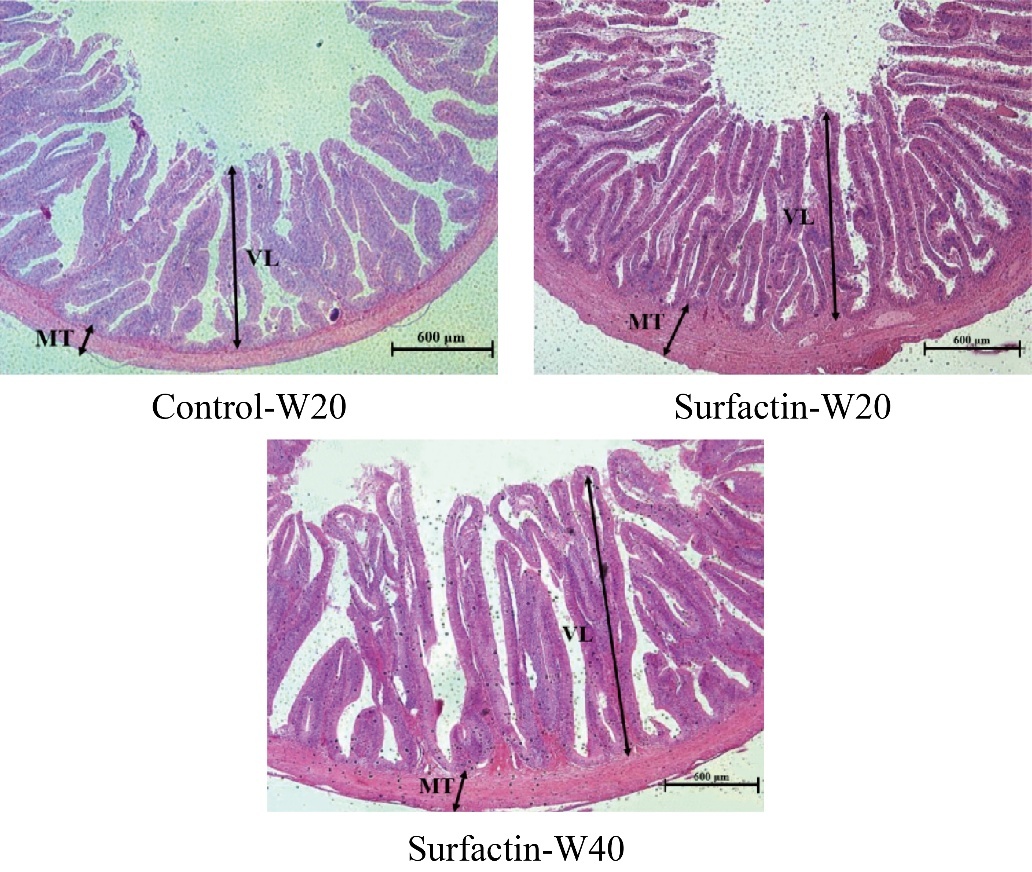
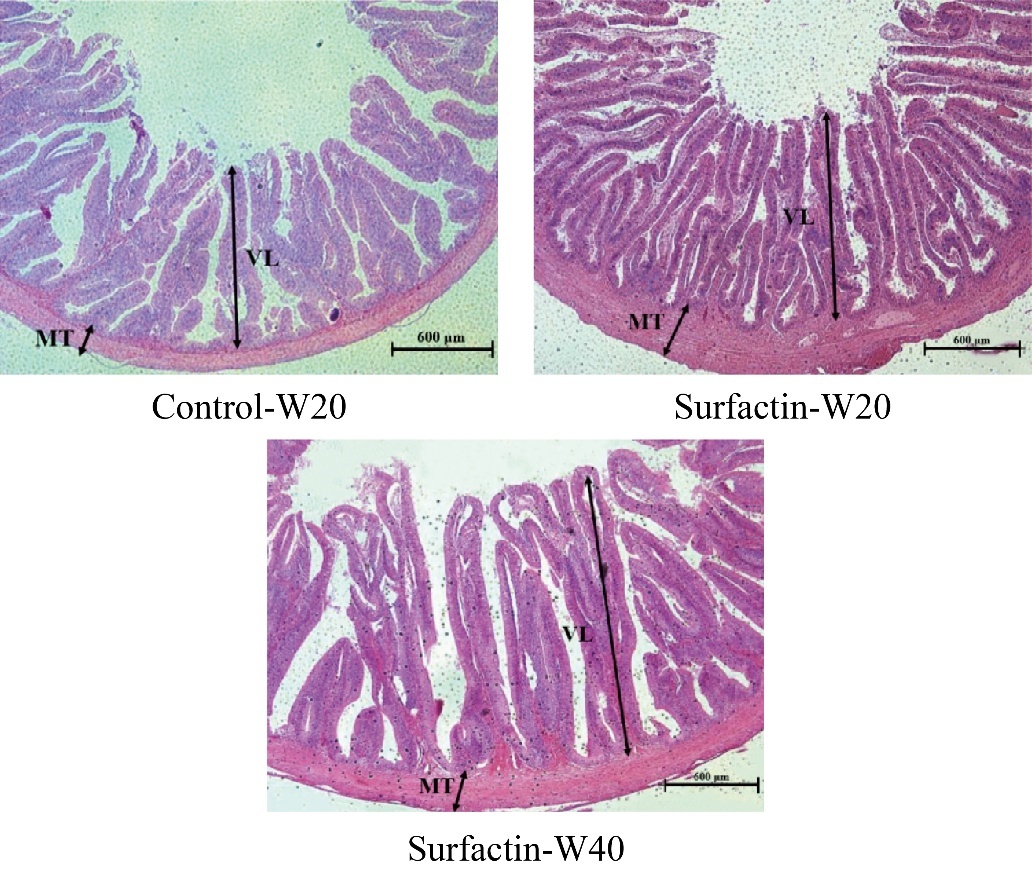
The effects of dietary surfactin supplementation on the intestinal morphology of American eels are shown in Table 4 and Figure 1. The values of VL and MT of surfactin groups were significantly higher than those of the Control-W20 group (P<0.05), the MT of Surfactin-W40 group was significantly higher than that of Surfactin-W20 group (P<0.05). As shown in Figure 1, the density and the quantity of intestinal villi in surfactin groups were higher than those in the Control-W20 group, and the thickness of muscle layer can be observed to be thicker.
3.5. Changes in Intestinal microbiota
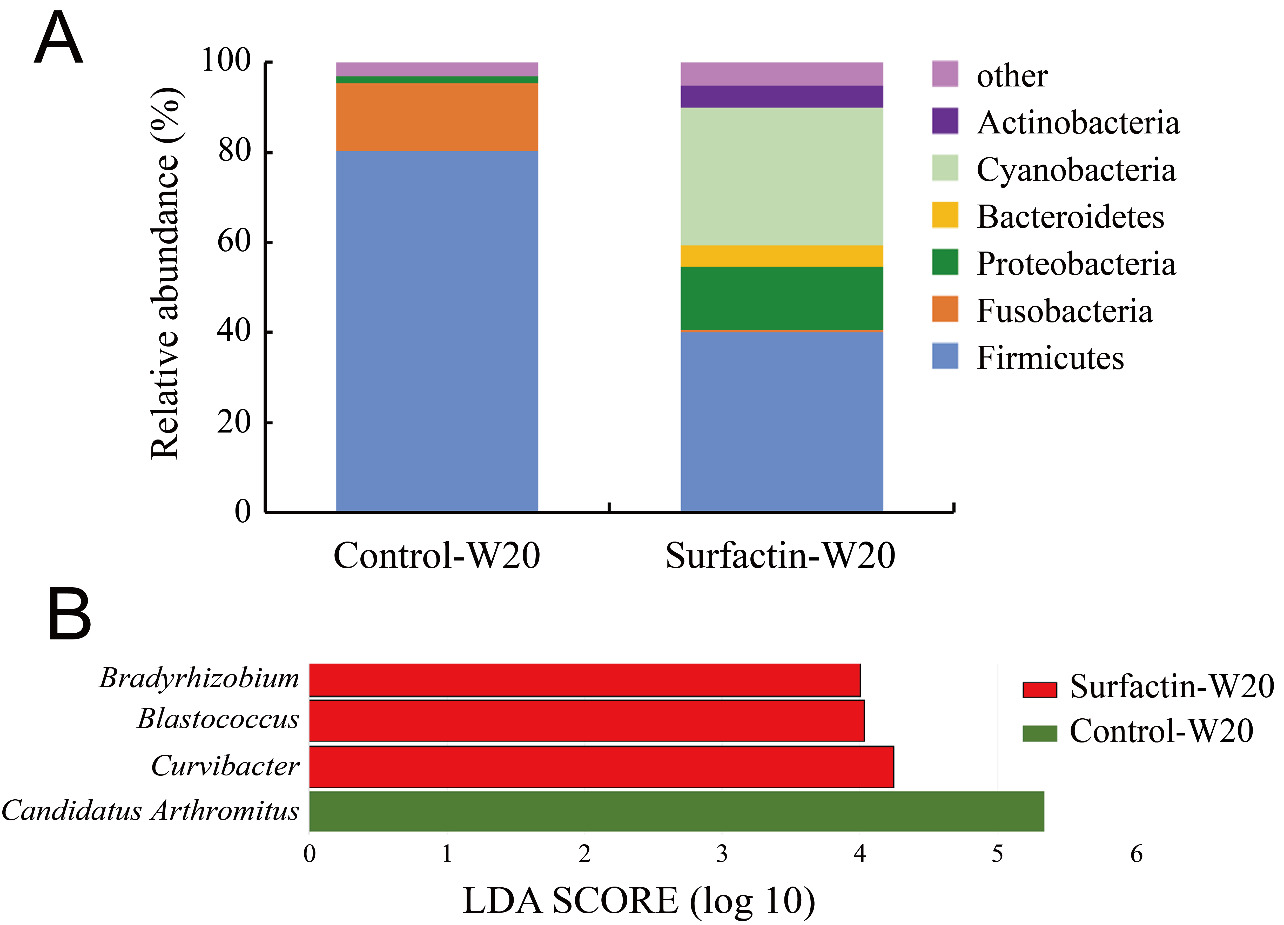
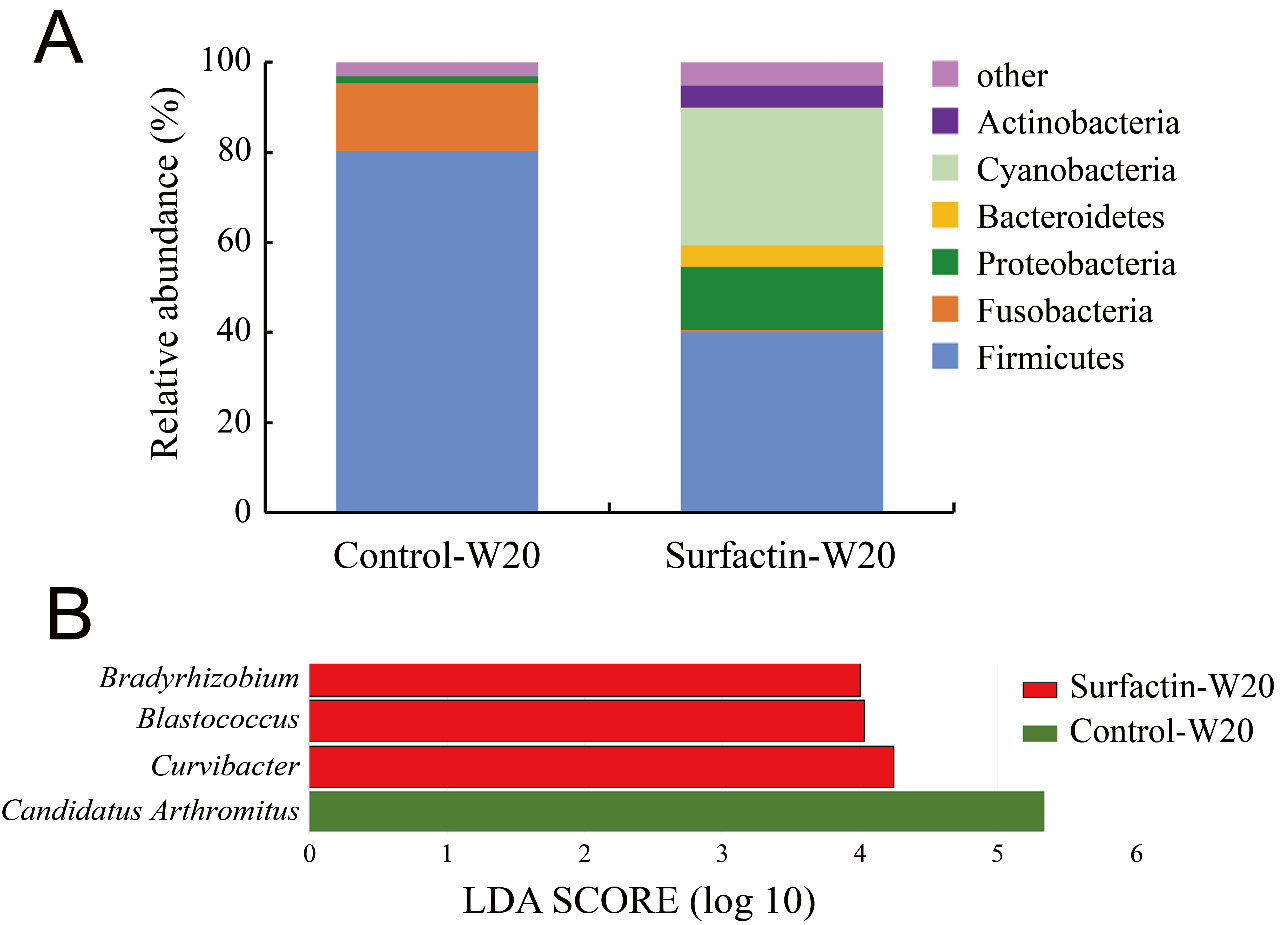
The changes in intestinal microbiota at the phylum level and genus level were shown in Figure 2, respectively. Compared with the Control-W20 group, the American eels in the Surfactin-W20 group have higher relative abundances of Proteobacteria and Cyanobacteria accompanied by lower relative abundances of Firmicutes and Fusobacteria. The LEfSe analysis showed the relative abundances of Candidatus Arthromitus were significantly higher in the Control-W20 group, and the relative abundances of Bradyrhizobium, Curvibacter, and Blastococcus were significantly higher in Surfactin-W20 group (P<0.05).
4. Discussion
In this study, dietary surfactin supplementation significantly enhanced the growth performance and feed utilization of American eels. The same phenomenon has been demonstrated in the feeding trials of marbled eel,9 juvenile largemouth bass,13 orange-spotted grouper,8 and American eel,7 which were conducted in the laboratory. Despite differences in species, feeding conditions, diet composition, and surfactin levels, our results confirm that appropriate surfactin supplementation improves growth and feed utilization.
Digestive enzyme activity is a key indicator of fish digestive and absorptive capacity, and is closely associated with intestinal health.25 In our study, dietary surfactin supplementation increased the lipase activity significantly compared with the Control-W20 group. Similarly, surfactin was found to enhance lipase and protease activities in American eel,7 orange-spotted grouper,8 marbled eel,9 and tilapia21 as well. Surfactin can promote digestive enzyme production through improving mucosal structure, stimulating cell proliferation, suppressing pathogenic bacteria to alleviate inflammation, and reinforcing intestinal morphology.26,27
CAT, SOD, GSH-Px are the primary enzymatic antioxidants, while GSH serves as the major endogenous non-enzymatic antioxidant, working collectively to protect cells against oxidative damage induced by free radical attacks.28,29 T-AOC reflects the total antioxidant capacity of the organism.30 MDA is a major lipid peroxidation product and a marker of oxidative stress.16 In the present study, dietary surfactin supplementation significantly elevated the activities of SOD and GSH-Px, as well as the GSH content in the intestine of juvenile American eels, while T-AOC and CAT activities showed increasing trends and MDA content tended to decrease, collectively indicating an enhanced antioxidant capacity. This is consistent with the findings that dietary surfactin supplementation enhanced antioxidant capacity in marbled eel and zebrafish.9,31 This is likely due to surfactin-activated Nrf2/Keap1 signaling, which may trigger Nrf2 nuclear translocation and antioxidant gene expression.32 In addition, surfactin reduces free radical generation through regulation of the intestinal microbial balance, promoting antioxidant enzyme-producing beneficial bacteria while suppressing endotoxin-producing harmful bacteria.33
Nutrients would be absorbed by the epithelial cells of the intestinal villi, which play a vital role in digestion and nutrient absorption.34 The higher values of intestinal VL and MT indicate that there might be a higher ability for the absorption and transportation of nutrients in the intestine of fish.11,16 In the current study, the midgut villus height and the muscle layer thickness of fish fed surfactin diets were significantly higher and thicker than those of fish fed the control diet. Similar findings were observed in growth-retarded marbled eel fed 25 mg/kg dietary surfactin.22 The increased VL and MT may be associated with the ability of surfactin to stimulate intestinal epithelial cell proliferation and promote the production of extracellular matrix proteins, thereby strengthening the intestinal barrier.13,26,27 Additionally, surfactin may improve intestinal morphology by promoting mucus synthesis, tight junction protein expression, and epithelial repair.35–37
In this study, surfactin supplementation significantly altered the intestinal microbial composition, with increases in Proteobacteria and Cyanobacteria and decreases in Firmicutes and Fusobacteria. Some Proteobacteria present in the gut of healthy fish are considered dominant protease producers in carnivorous fish, and they may also contribute substantially to host digestive function.17 Although some Cyanobacteria members were reported to be harmful to fish by synthesizing toxins, they have been considered as a promising source of antimicrobial molecules against aquatic pathogens.38 In individuals with poor growth and pathogenic infection, the relative abundance of Firmicutes is often higher.26 Fusobacteria are a potential intestinal pathogen associated with inflammation and abdominal infection.39 It seemed that dietary surfactin supplementation might beneficially regulate the intestinal microbiota by altering the ratio of potential probiotics and pathogenic bacteria at the phylum level.
At the genus level, Candidatus Arthromitus was significantly higher in the Control-W20 group. Candidatus Arthromitus, one of the gram-positive segmented filamentous bacteria, might be a possible pathogenic agent, since these bacteria have been frequently found in rainbow trout that present clinical signs of gastroenteritis.40–42 This suggests that eels in the Control-W20 group were at a higher risk of pathogenic infection. While the relative abundances of Bradyrhizobium, Curvibacter, and Blastococcus were significantly higher in Surfactin-W20 group. Bradyrhizobium is a gram-negative bacterium that has been shown to play a key role in nitrogen fixation. It has been reported in the intestinal tract of fish such as olive flounder (Paralichthys olivaceus),43 pirarucu (Arapaima gigas),44 nudibranch mollusk (Rostanga alisae),45 and wood-eating catfish (Panaque nigrolineatus).46 As a beneficial bacterium, Bradyrhizobium has been shown to form animal symbioses and promote growth and nutrient uptake.46,47 Curvibacter is not only positively associated with protein and energy digestibility in fish, but also possesses genes related to carbon metabolism, fatty acid degradation, and plays a role in biomineralization, as revealed by genomic studies.48,49 Blastococcus, together with other gut microbes, has been shown to participate in the regulation of intestinal permeability under certain conditions.50 Therefore, dietary surfactin supplementation could increase the relative abundances of some beneficial bacteria and decrease the proliferation of some potentially pathogenic bacteria. Similar modulatory effects of surfactin on intestinal microbiota and morphology have also been observed in other fish species, such as the marbled eel.22 Surfactin promotes beneficial bacteria while inhibiting pathogenic ones, largely due to the selective antimicrobial activity conferred by its amphiphilic cyclic lipopeptide structure.2,51 This selectivity arises from the structural differences in the cell envelope between Gram-positive and Gram-negative bacteria.2 Through this selective action, surfactin targets and suppresses the overgrowth of harmful bacteria, with its mechanism involving membrane disruption and inhibition of protein synthesis, thereby reducing their interference with the intestinal microecology and creating competitive advantages for beneficial bacteria.2,33,35 Beneficial bacteria may produce short-chain fatty acids and other metabolites, which could improve gut health and create a positive feedback loop.26
Constrained by the practical conditions of the commercial eel farm, there were not enough cement tanks with trial fish in the desirable body sizes. This study lacked a control group with fish weighing about 40g/fish to evaluate the effects of dietary surfactin supplementation on growth and intestinal health in the Surfactin-W40 group. There were only three replicates in each group, and no more replicate tanks might be used in the present study. Besides, this study only investigated the supplementation effects of 100 mg/kg surfactin, which was achieved under laboratory conditions. Whether this concentration is optimal for eel farm application remains unclear. Further studies with improved trial conditions are needed to validate the present findings under commercial farming scenarios.
5. Conclusion
In conclusion, our study demonstrated that dietary surfactin could promote growth performance, improve intestinal lipase activity, antioxidant capacity, and morphology, and modulate the intestinal microbiota of juvenile American eels. The beneficial effects of surfactin were similar across the two body sizes. Collectively, our findings offer valuable insights into the practical use of surfactin in juvenile American eels cultured in cement tanks and serve as a technical reference for large-scale commercial farming.
Acknowledgments
The authors gratefully acknowledge financial support from the earmarked fund for China Agriculture Research System (CARS-45).
CRediT Authorship Contribution Statement
Data curation: Xinyu Hu (Equal), Yitong Guo (Equal). Formal Analysis: Xinyu Hu (Equal), Yitong Guo (Equal). Investigation: Xinyu Hu (Equal), Yitong Guo (Equal). Methodology: Xinyu Hu (Equal), Yitong Guo (Equal), Yichuang Xu (Equal), Shaowei Zhai (Equal). Validation: Xinyu Hu (Equal), Yitong Guo (Equal). Visualization: Xinyu Hu (Lead). Writing – original draft: Xinyu Hu (Equal), Yitong Guo (Equal). Resources: Yichuang Xu (Equal), Shaowei Zhai (Equal). Supervision: Yichuang Xu (Equal), Shaowei Zhai (Equal). Writing – review & editing: Yichuang Xu (Equal), Shaowei Zhai (Equal). Conceptualization: Shaowei Zhai (Lead). Funding acquisition: Shaowei Zhai (Lead). Project administration: Shaowei Zhai (Lead).
Conflict of Interest Statement
No competing interests were disclosed.
Ethical Conduct Approval – IACUC
The animal study was reviewed and approved by the Animal Care and Use Committee of Jimei University (approval no. 2018-0912-001). This committee is the institutional ethics body responsible for reviewing and approving animal research protocols at our university.
Informed Consent Statement
All authors and institutions have confirmed this manuscript for publication.
Attestation Statements
Data related to any of the subjects in the study has not been published previously.
All study and manuscript data will be made available to the journal editors upon request before and/or after manuscript publication for review or query.
Data Availability Statement
Data can be obtained from the corresponding author.