
1. Introduction
Oncorhynchus mykiss, a cold-water salmonid belonging to Osteichthyes, Salmoniformes, and Salmonidae, comprises both landlocked and anadromous ecotypes.1 Owing to its high flesh quality, rapid growth, and strong salinity tolerance, O. mykiss is commercially cultured worldwide as a key salmonid species. It was first introduced to the Ili River (Xinjiang, China) in the 1960s, with China’s annual cultured output reaching 35,000 tons at present.2 In global fishery trade statistics, O. mykiss, salmon, and smelt accounted for 21% of the total value of aquatic product trade in 2023.3
Freshwater O. mykiss farming has been increasingly constrained by water pollution, excessive groundwater extraction, and degradation of broodstock germplasm in recent decades. Therefore, extending O. mykiss cultivation from freshwater to brackish and seawater habitats has become an essential developmental pathway for industrial upgrading. Mounting evidence demonstrates that appropriate salinity acclimation enhances disease resistance and growth performance in O. mykiss after transitioning to brackish/seawater culture.4 Salinity acclimation is a pivotal prerequisite for O. mykiss mariculture, whose success is strongly influenced by multiple environmental parameters.
Salinity acclimation is defined as the artificial domestication process with stepwise salinity elevation to help cultured organisms adapt to high-salinity aquatic environments. O. mykiss subjected to seawater acclimation exhibits improved growth performance, stronger disease resistance, and superior edible quality relative to freshwater-cultured conspecifics. However, O. mykiss has a finite salinity tolerance threshold; abrupt exposure to full-strength seawater induces osmotic dysregulation, metabolic disturbance, and markedly elevated mortality.5,6 Earlier studies subjected ~20 g juvenile O. mykiss to daily salinity increments of 2, 4, 6, and 8 ppt and demonstrated that rapid salinity elevation compromised survival and growth, thereby preventing the successful seawater culture of the tested fish.7 Another trial adopting O. mykiss fry with graded body sizes found that the adaptive range of salinity variation narrowed gradually with increasing individual body weight.8
To satisfy industrial requirements for fry adaptable to different marine zones, recent research has highlighted thermal influences on O. mykiss performance during salinity domestication. Fish are ectotherms whose biochemical and metabolic activities require adaptive regulation in response to ambient temperature fluctuations.9 The optimal thermal range for O. mykiss growth is 12-18 ℃; deviations from this range markedly affect feeding activity, somatic growth, and anti-stress capacity. Factorial experiments combining temperature and salinity revealed that O. mykiss cultured at 16 ℃ and 8 ppt salinity exhibited superior growth compared with freshwater groups.10 Within suitable thermal conditions, O. mykiss growth and feed digestibility of dry matter, gross energy, and nitrogen positively correlated with water temperature.11 As water temperature increased, weight gain and net energy deposition of O. mykiss rose initially and subsequently decreased, while oxygen consumption and basal metabolic rate kept increasing persistently.12 Additional research compared the differential utilization of carbohydrate, protein, and lipid by O. mykiss under two distinct thermal regimes.13
Current published studies predominantly focus on single- or two-factor interactions on O. mykiss growth, whereas the integrated effects of body size, water temperature, and ambient salinity on growth performance during salinity acclimation have not been systematically reported. Accordingly, this study adopted a three-factor three-level orthogonal experimental design with three body sizes (100 g, 250 g, 500 g), three temperature levels (10 ℃, 15 ℃, 20 ℃), and three salinity gradients (10 ppt, 20 ppt, 30 ppt) to quantify individual and interactive effects of tested variables and determine the optimal culture combination. This work aims to provide theoretical foundations and practical parameters for seawater domestication and to promote the sustainable development of brackish-water O. mykiss culture.
2. Materials and Methods
2.1. Pre-experiment Rearing of Experimental Fish
Prior to formal experimentation, juveniles of three distinct body sizes were acclimated in indoor flow-through concrete tanks under a 12 L:12 D photoperiod at 15 ± 1 ℃ for 15 days. The triploid rainbow trout used in the experiment was purchased from the breeding and rearing base in Weifang City, Shandong Province. Continuous aeration was maintained throughout temporary rearing, with dissolved oxygen ranging from 7.8 to 10.0 mg/L and pH value stabilized at 7.1-7.5. Fish were fed commercial formulated feed daily at 2% of body weight (Shandong Hanye Biotechnology Co., Ltd., crude protein ≥ 45%), and were feed-deprived for 24 h before the trial commenced. Healthy and injury-free O. mykiss with initial body weights of (100.00 ± 10) g, (250.00 ± 10) g, and (500.00 ± 20) g were selected for subsequent orthogonal trials.
2.2. Experimental Design
Three experimental variables, including O. mykiss body size (g), water temperature (℃), and ambient salinity (ppt), were set with three gradient levels for each factor (Table 1). A total of nine experimental combinations were set up, using the orthogonal array design (Table 2). For each treatment, three replicate test tanks were set up and placed in 600L breeding tanks for the experiments. The entire salinity acclimation trial lasted for 60 days under a constant water volume of 600 L per tank. Salinity was modulated using refined marine salt crystals, and cultivation temperature was controlled by circulating heating and cooling devices, with a temperature fluctuation of less than ± 0.2 ℃. At the beginning of the experiment, the water temperature was adjusted at a rate of 1 ℃ per day to reach the target temperature. After 24 hours of stabilization, salinity was increased at a rate of 2‰ per day to reach the target values for each group. Cumulative mortality was recorded daily during the experimental period. Body length and wet body weight of all experimental fish were measured at the initiation and termination of trials. Feeding management was consistent with temporary rearing protocols. Commercial feed was provided twice daily until the animals reached apparent satiation. The dissolved oxygen level was maintained above 8 mg/L, and the pH was within the range of 7-8. The number of Vibrio bacteria in the water was tested every Monday, and the concentrations of ammonia nitrogen, nitrite, and hydrogen sulfide were measured every three days to ensure that the O. mykiss were always in an appropriate environment. Every day, uneaten feed, mortalities and fecal waste were siphoned from each tank to keep the water clean.
2.3. Determination of Growth Parameters
All fish were subjected to 24 h feed deprivation prior to final sampling for growth measurement. The total number of fish and body weight per tank were recorded and weighed individually to calculate the survival rate and weight gain rate.
Survival rate(\%)=NtN0×100\%
where N0= initial fish number at test initiation, Nt= surviving fish number at termination.
Weight gain rate(\%)=Wt-W0W0×100\%
where W0= initial body weight (g), Wt= final body weight (g).
2.4. Statistical Analysis
All measured data were processed using IBM SPSS Statistics 22. Data were subjected to three-way ANOVA, with post-hoc Duncan’s multiple range test applied. Range analysis was further performed for parameters with significant intergroup differences after preliminary ANOVA.
3. Results
3.1. Effects of Three Factors on the Survival Rate of O. mykiss
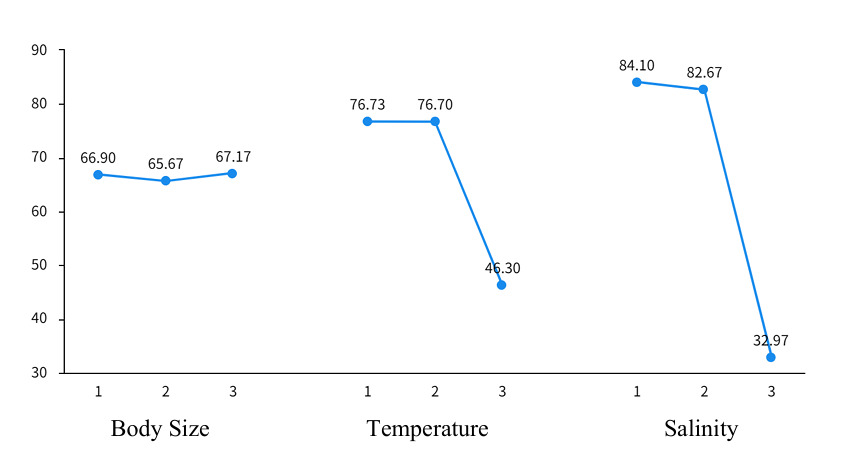
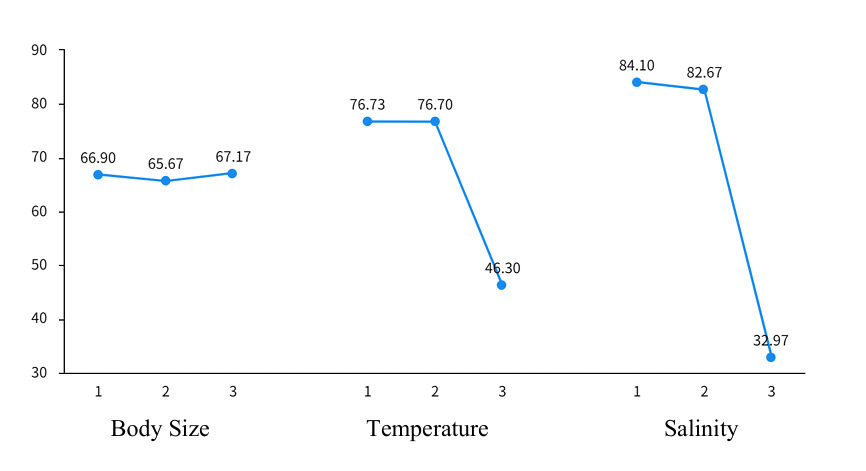
Survival rates differed substantially among the nine experimental treatments (Table 3; Fig. 1). For small-sized O. mykiss (100 g), the maximum survival rate (96.7%) was observed under 100 g-10 ℃-10 ppt, whereas the lowest survival (18.2%) occurred at 100 g-20 ℃-30 ppt. For medium-sized individuals (250 g), the highest survival rate was 97.1% at 250 g-10 ℃-20 ppt, while the lowest was 44.3% at 250 g-15 ℃-30 ppt. Large-sized O. mykiss (500 g) achieved 100% survival under 500 g-15 ℃-10 ppt and the lowest survival of 36.4% at 500 g-10 ℃-30 ppt.
ANOVA results of the survival rate were listed in Table 4. Body size (P = 0.985) and water temperature (P = 0.121) had no significant effect on survival rate (P > 0.05), whereas ambient salinity significantly affected O. mykiss survival (P = 0.048 < 0.05).
Range value (R) reflects the relative contribution of each tested factor, whereby a larger R denotes a stronger regulatory effect on the target indicator. Range analysis showed that the range values for survival rate across salinity, temperature, and body size were 51.13, 30.43, and 1.50, respectively, suggesting that the factors affecting survival rate in order of priority were Salinity > Temperature > Body Size (Table 5). The optimal level of each factor was screened according to average K value (K avg): K3 > K1 > K2 for body size (optimal: 500 g), K1 > K2 > K3 for temperature (optimal:10 ℃), K1 > K2 > K3 for salinity (optimal:10 ppt). The range analysis indicated 10 ℃ as the optimal temperature level. The experimental combination of 500 g at 15 ℃ and 10 ppt (Treatment 9) achieved 100% survival. Given that the K avg values for 10 ℃ and 15 ℃ were nearly identical, the combination 500 g-15 ℃-10 ppt was selected as the optimal for survival. Collectively, the optimal combination maximizing survival rate was 500 g-15 ℃-10 ppt.
3.2. Effects of Three Factors on the Weight Gain Rate of O. mykiss
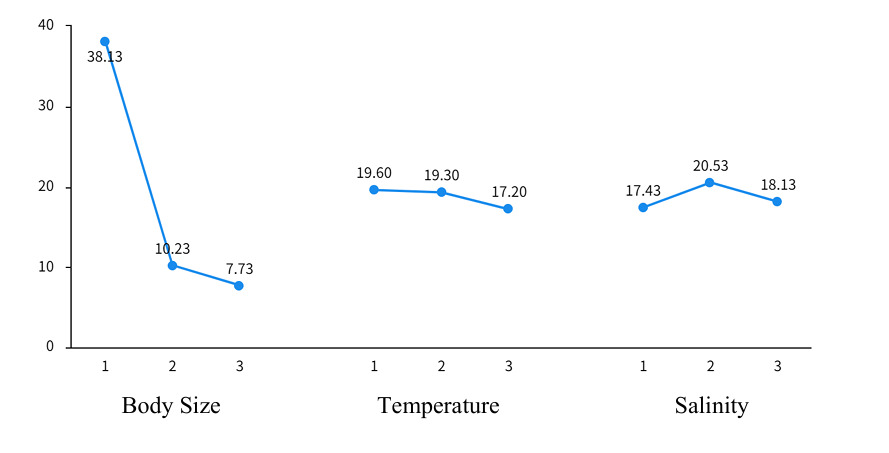
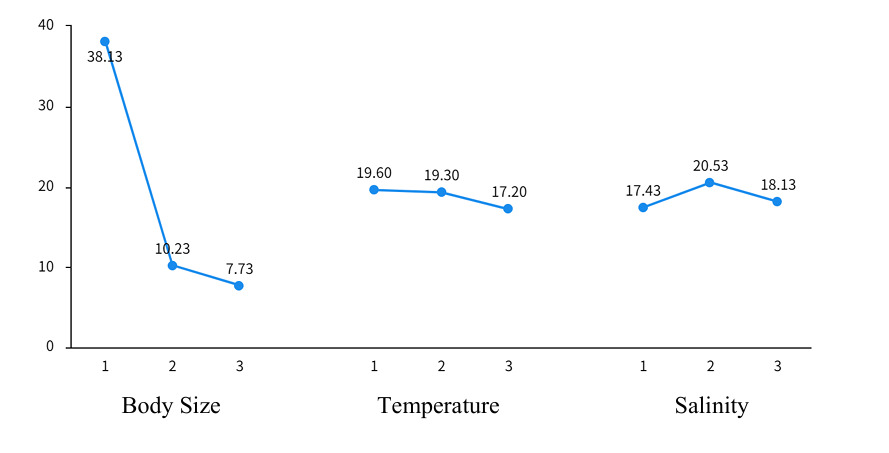
Weight gain varied significantly across different culture combinations (Table 6; Fig. 2). For 100 g small-sized fish, the highest weight gain (43.5%) was detected at 100 g-15 ℃-20 ppt, and the minimum value (32.7%) was under 100 g-10 ℃-10 ppt. Medium-sized (250 g) O. mykiss obtained maximum weight gain of 15.1% at 250 g-10 ℃-20 ppt and the lowest value of 5.2% at 250 g-15 ℃-30 ppt. For large-sized (500 g) individuals, weight gain peaked at 11.0% (500 g-10 ℃-30 ppt) and bottomed at 3.0% (500 g-20 ℃-20 ppt).
ANOVA results indicated body size (P = 0.064), temperature (P = 0.919) and salinity (P = 0.880) imposed non-significant effects on weight gain rate (P > 0.05, Table 7).
Range analysis showed the R values for body size, salinity and temperature were 30.40, 3.10, and 2.40, respectively, meaning the contribution sequence for weight gain was Body Size > Salinity > Temperature (Table 8). Based on K avg values, the optimal single levels were 100 g (body size, K1 > K2 > K3), 10 ℃ (temperature, K1 > K2 > K3), and 20 ppt (salinity, K2 > K3 > K1). Accordingly, the optimal combination to maximize weight gain was determined to be 100 g-10 ℃-20 ppt.
4. Discussion
4.1. Comprehensive Effects of Three Experimental Variables on Survival and Growth Performance
Orthogonal experimental design is an efficient statistical tool for identifying key influencing variables, greatly reducing experimental workload while yielding reliable results comparable to full-factorial tests.14 The current three-factor orthogonal trial systematically evaluated how body size, water temperature, and ambient salinity modulate survival rate and weight gain of O. mykiss during salinity acclimation. ANOVA demonstrated that only salinity had a statistically significant effect on survival rate (P < 0.05), whereas all three tested factors had non-significant effects on weight gain (P > 0.05).
Range analysis quantified the relative contribution of each variable: salinity possessed the highest R value (51.13) for survival rate, followed by temperature (30.43) and body size (1.50), confirming salinity as the dominant factor determining survival performance and body size as a negligible factor. In terms of weight gain rate, body size showed the highest R value (30.40), far exceeding salinity (3.10) and temperature (2.40), indicating that body size is the primary regulatory factor for somatic growth, with temperature and salinity as secondary limiting factors.
The magnitude of the average index value (K avg) can serve as a basis for determining the optimal level of a given factor. By comparing the K avg values of different levels of each factor, the optimal level of each factor can be determined.15 Usually, the level with the largest K avg value is selected as the optimal level.16,17 Overall, the combination of 500 g, 15 ℃, and 10 ppt achieved the highest survival potential. In orthogonal experiments, determining an optimal combination is based on comparing response values across factor levels rather than solely on statistical significance testing. Therefore, a factor may contribute to selecting the optimal combination even when its individual effect is not significant in ANOVA. In this study, range analysis indicated that the combination of 100 g, 10 ℃, and 20 ppt provided the highest weight-gain performance under the tested conditions.
4.2. Dominant Regulatory Role of Salinity on O. mykiss Survival
Salinity was confirmed as the predominant factor affecting survival rate in both variance and range analyses, and was closely associated with the osmoregulatory physiological characteristics of O. mykiss. As an anadromous salmonid, O. mykiss maintains blood plasma osmolality equivalent to about 11 ppt environmental salinity.18 When external salinity is lower than the plasma isosmotic point, fish maintain osmotic homeostasis via active ion absorption and urinary excretion; under hyperosmotic conditions, O. mykiss rely on active water ingestion, renal excretion, and branchial ion extrusion to balance internal osmotic pressure.19–21
In this experiment, all size classes maintained high survival at 10 ppt salinity, close to the isosmotic point, because limited energy was required for osmotic adjustment and physiological stress was minimized. Survival moderately declined at 20 ppt due to moderate hyperosmotic stress, while severe survival depression was universally detected at 30 ppt, with the minimum survival of only 18.2% for 100 g fish at 20 ℃-30 ppt. Excessively high ambient salinity exceeds the upper limit of O. mykiss osmoregulatory capacity, inducing body water loss, ionic disorder, organ dysfunction and eventual mortality.22 Previous salinity-gradient domestication trials reported that O. mykiss could activate endocrine-mediated osmoregulation, with elevated cortisol and thyroid hormone levels under high salinity, yet individuals still experienced severe osmotic stress at 32 ppt.23,24 Other published data indicated mass mortality occurs for O. mykiss above 30-40 ppt, with 20 ppt regarded as the upper safe salinity threshold for sustainable mariculture.25 Consistent with our findings, mortality increased with salinity, from zero mortality under freshwater to 10 ppt and up to 13% at 32 ppt.26 Moreover, an interactive relationship was observed between temperature and salinity: fish cultured at 10 ℃ obtained better survival than counterparts at 20 ℃ under 30 ppt hyperosmotic stress, indicating low temperature alleviates energetic cost for osmotic adjustment and mitigates adverse impacts of high salinity, whereas high temperature aggravates hyperosmotic damage during salinity acclimation.
4.3. Dominant Regulatory Role of Initial Body Size on O. mykiss Weight Gain
Body size was the primary determinant of weight-gain performance according to the range analysis, despite non-significant statistical differences among the three tested factors in the ANOVA results. Small-sized O. mykiss (100 g) achieved substantially higher weight gain (32.7%-43.5%) than medium- and large-sized conspecifics, consistent with the universal allometric growth law in teleost fish, in which specific growth rate is negatively correlated with body size. Juveniles exhibit intensive anabolism and high feed efficiency, while larger fish partition most metabolic energy for basal metabolism instead of somatic growth, which has been well verified in previous O. mykiss studies.27 Although the correlation between specific growth rate and body weight can be modulated by ambient temperature and genetic background, their intrinsic negative association remains unchanged.28–31 Juvenile O. mykiss had higher relative metabolic rates and active feeding behavior to ensure sufficient nutrient intake for biomass deposition; additionally, branchial and renal osmoregulatory organs exhibited higher unit-weight functional efficiency in juveniles, reducing extra energy costs for salinity adaptation and conserving more nutrients for growth. By contrast, large O. mykiss requires substantial energy expenditure to maintain osmotic homeostasis under salinity stress, thereby reducing nutrient availability for somatic growth and resulting in slower weight gain. Water temperature had a limited influence on weight gain within the tested 10-20 ℃ range, as reflected by minor discrepancies in K avg across the three thermal gradients. As a typical cold-water fish species, O. mykiss has a narrow optimal thermal window; the experimental temperature range in this study did not exceed the adaptive metabolic threshold, resulting in weak thermal regulation on individual growth performance.
In practical aquaculture applications, the two optimal culture combinations identified in this study may correspond to different production scenarios rather than representing interchangeable strategies. The combination of 100 g initial body weight, 10 °C, and 20 ppt salinity may be more applicable to the early seawater adaptation stage of juvenile rainbow trout, where maintaining growth potential and facilitating successful acclimation are the primary objectives. Smaller fish generally exhibit greater metabolic plasticity but may also be more sensitive to environmental fluctuations; therefore, appropriate salinity adjustments combined with relatively low temperatures may help balance energy allocation between adaptation and growth. In contrast, the combination of an initial body weight of 500 g, 15 °C, and 10 ppt salinity may represent a more suitable culture strategy for medium-sized rainbow trout during subsequent seawater growth. At this stage, fish have developed stronger osmoregulatory capacity and may benefit from moderate temperature conditions that support feed utilization and biomass accumulation.
5. Conclusion
In this study, a three-factor, three-level orthogonal trial was conducted to quantify individual and interactive impacts of initial body size, water temperature, and ambient salinity on survival and weight gain of O. mykiss during salinity acclimation. Salinity was the leading factor modulating survival rate, with optimal survival achieved under near-isosmotic 10 ppt across all body sizes; initial body size exhibited the strongest trend associated with weight-gain performance, and small-sized (100 g) O. mykiss exhibited significantly faster growth than medium- and large-sized fish. Range analysis indicated that 500 g-15 ℃-10 ppt was the preferred condition for survival-oriented salinity acclimation of larger individuals, whereas 100 g-10 ℃-20 ppt was a growth-oriented strategy for juvenile production aimed at rapid biomass accumulation.
Although this study identified optimal culture combinations for survival and growth performance of rainbow trout during salinity acclimation using an orthogonal experimental design, several limitations should be acknowledged. First, the present experiment evaluated only three environmental factors, including body size, temperature, and salinity, while other important variables, such as dietary composition, dissolved oxygen fluctuations, and genetic background, may also influence growth performance and salinity adaptation. Secondly, although the orthogonal design efficiently screened for optimal conditions, the number of replicates per treatment was relatively limited, which may have reduced the statistical power to detect subtle effects among experimental factors. Therefore, further studies with increased replication are required to validate the observed response trends. Finally, this study mainly focused on survival and weight gain as performance indicators. Future investigations combining physiological measurements, endocrine responses, transcriptomic analyses, and metabolomic approaches could provide deeper insights into the molecular mechanisms underlying salinity acclimation and growth regulation in rainbow trout.
Acknowledgements
This study was supported by Central Public-interest Scientific Institution Basal Research Fund, ECSFR, CAFS (NO. 2024TD08); Central Public-interest Scientific Institution Basal Research Fund, ECSFR, CAFS (NO. 2025QT04); Central Public-interest Scientific Institution Basal Research Fund, CAFS(NO.2025ZX03);Central Public-interest Scientific Institution Basal Research Fund (2026ZL02);Screening, Breeding, Integrated Aquaculture Technology, Demonstration and Promotion of Marine-adapted High-quality Germplasm of Rainbow Trout in Jiangsu JCTG (2025) 26;Lianyungang Key Research and Development Program (Social Development) under Grant No. SF2407; Postgraduate Research & Practice Innovation Program of Yancheng Institute of Technology, CXJH26054; Postgraduate Research & Practice Innovation Program of Yancheng Institute of Technology, CXJH26064; The authors wish to express their sincere gratitude to the anonymous reviewers whose valuable suggestions greatly improved this paper.
Author Contributions
Conceptualization: Yuanhao Ren (Equal), Yanming Sui (Equal). Writing – review & editing: Yihao Chen (Equal), Lei Li (Equal). Writing – original draft: Yiyun Zhang (Equal), Changjian Li (Equal). Resources: Jiahe Guo (Equal), Hanfeng Zheng (Equal). Supervision: Zhongquan Jiang (Equal), Na Ying (Equal), Siping Li (Equal). Methodology: Bo Qin (Equal), Tingting Lin (Equal).
Ethical Conduct Approval – IACUC
The material of this paper does not involve ethical conflicts. Authors got permission to take this sample. All experimental protocols and methods in this study were approved by the Chinese Academy of Fishery Sciences East China Sea Fisheries Research Institute (ECSFRI 13).
Conflicts of Interest
The authors declare that they have no known competing financial interests or personal relationships that could have appeared to influence the work reported in this paper.
Informed Consent Statement
All authors and institutions have confirmed this manuscript for publication.
Data Availability
The data that has been used is confidential.