

1. INTRODUCTION
The PAX (paired box) gene family consists of highly conserved transcription factors, first identified in Drosophila melanogaster, and plays crucial regulatory roles in vertebrate embryonic development. The family comprises nine members, Pax1 to Pax9, each exhibiting distinct functions and expression patterns.1 Pax9 regulates early organ development by controlling downstream target genes, and its loss of function often leads to congenital defects. For example, Pax9 is expressed in mesenchymal tissues in mice, where it is involved in the development of somites, pharyngeal pouches, craniofacial structures, teeth, and limbs.2 In fish, the functional roles of Pax9 have been primarily investigated in the context of skeletal and craniofacial development; however, direct evidence linking Pax9 to growth or body-weight traits remains scarce. Chen et al. showed that knockdown of Pax9 leads to tail defects, indicating its requirement for axial skeleton development.3 Meanwhile, Paudel et al. demonstrated that mutation of Pax9 in zebrafish causes midfacial retrusion and loss of facial appendages.4 In medaka, knockdown of Pax9 similarly leads to abnormal morphology in the tail hypural skeletal element, further supporting a conserved role for Pax9 in teleost skeletal development.5
Fish growth traits are regulated by both genetic and environmental factors. Understanding the genetic basis is a prerequisite for precision breeding. Traditional selective breeding, which relies solely on phenotypic data, is time-consuming and inefficient. In contrast, marker-assisted selection significantly enhances breeding efficiency by linking genotypes to phenotypes. Recent genome-wide association studies (GWAS) and candidate gene approaches have identified molecular markers associated with growth, disease resistance, and other traits in fish.6 For instance, the insulin-like growth factor (IGF) gene family plays well-established roles in muscle development and growth regulation.7 Notably, single nucleotide polymorphisms (SNPs) in the Pax9 gene are significantly associated with skull size in mice and dental abnormalities in humans, suggesting a conserved role in vertebrate craniofacial and growth regulation.8 However, the role of Pax9 in growth traits of economically important freshwater fish has remained largely unknown until recently. Previous studies in bighead carp have begun to address this gap: Zhou et al. demonstrated that head length is highly correlated with head weight (r=0.712, P<0.01) and that the head accounts for approximately 34% of total body weight, suggesting that genes affecting head development may indirectly influence whole-body weight.9 Chen et al. further provided genetic evidence for a shared architecture between growth and body shape, showing that multiple candidate genes are associated with both body weight and body length traits.10 Most importantly, using bulked segregation analysis (BSA), Chen et al. identified Pax9 as one of 14 candidate genes associated with growth traits in this species.11 Despite these genetic discoveries, the systematic molecular characterization, comprehensive tissue-specific expression profile, and detailed sequence features of Pax9 in bighead carp have not been investigated.
Bighead carp (Hypophthalmichthys nobilis) is a typical planktivorous fish with a large head that constitutes a major portion of its body weight and holds significant commercial value. Recent transcriptomic studies on head-related tissues have provided valuable insights into the molecular basis of growth and development in this species.12 Notably, the availability of a high-quality reference genome for this species has further facilitated gene discovery and functional studies. Given the established role of Pax9 in craniofacial development in model vertebrates, this gene may be particularly relevant for bighead carp. Head size is an economically important trait in bighead carp, as it accounts for a substantial proportion of total body weight and is the primary edible portion. Although head morphology and overall body weight are distinct traits, they may be connected through functional mechanisms: the craniofacial skeleton-particularly the gill-raker apparatus-determines filter-feeding efficiency, which in turn influences nutrient acquisition and somatic growth. Genome-wide association studies (GWAS) have demonstrated that head-related traits (head length, head width, head height) and growth-related traits (body weight, body length, body height) share common quantitative trait loci (QTLs) and candidate genes in this species,9,10 indicating that head morphology and somatic growth are governed, at least in part, by overlapping genetic architectures. This genetic correlation underscores the importance of examining craniofacial-associated genes, such as Pax9, in the context of growth variation. Previous studies in zebrafish have demonstrated that Pax9 is essential for upper jaw formation and craniofacial skeletal development,4 highlighting the conserved function of this gene in teleost craniofacial morphogenesis. Taken together with the genetic evidence from bighead carp GWAS and BSA studies,9–11 these observations provide a rationale for examining whether Pax9 expression is associated with growth variation in this species.
In this study, we characterized the Pax9 gene in bighead carp-designated as HynPax9-by determining its full-length cDNA and genomic structure, analyzing its phylogenetic relationships, and profiling its tissue-specific expression across five tissues. We then compared its expression levels between fast-growing and slow-growing individuals to assess whether HynPax9 expression is associated with growth variation. Building on previous genetic evidence identifying Pax9 as a growth-associated candidate in this species,11 this study provides the first systematic molecular characterization and expression profiling of Pax9 in bighead carp.
2. MATERIALS AND METHODS
2.1. Experimental Materials
All experimental bighead carp (Hypophthalmichthys nobilis) used in this study were derived from the same artificially induced spawning cohort at a commercial hatchery and reared in a common earthen pond at the Chushandian experimental farm, Xinyang, China, under identical management conditions. Throughout the six-month rearing period, fish were fed a commercial extruded floating pellet diet (Tongwei, China; crude protein ≥ 32%) twice daily (08:00 and 17:00) at a daily rate of approximately 3% of the estimated total biomass, with the ration adjusted weekly based on water temperature and observed feeding activity. The pond also contained natural planktonic organisms that served as supplementary forage. Water quality parameters were monitored weekly and maintained within suitable ranges for bighead carp (temperature 26–28°C, dissolved oxygen > 5.0 mg/L, pH 7.0–7.8). At six months of age, a total of 1,000 individuals were randomly captured from the pond using a seine net, individually weighed, and ranked by body weight. To maximize the detection of potential expression differences associated with divergent growth, five heaviest individuals (heavy group: 544 ± 14 g) and five lightest individuals (light group: 117 ± 8 g) were selected as representatives of the extreme growth phenotypes. This tail-extreme sampling approach is intended as a screening strategy for candidate gene discovery rather than for estimating population parameters. Tissues (brain, heart, liver, intestine, and muscle) were collected, immediately frozen in liquid nitrogen, and stored at −80°C for subsequent analysis. Every effort was made to alleviate the suffering of the experimental fish. All fish were deeply anesthetized with MS-222 prior to tissue sampling, and all dissections were performed on ice to minimize distress.
2.2. Total RNA Extraction and cDNA Synthesis
Total RNA was extracted from each tissue using TRIzol reagent (Invitrogen, USA) following the manufacturer’s protocol. RNA concentration and integrity were assessed using a NanoDrop 2000 spectrophotometer (Thermo Fisher Scientific, USA) and 1% agarose gel electrophoresis. All RNA samples were diluted to 500 ng/μL, and first-strand cDNA was synthesized using a reverse transcription kit (Takara, Japan) according to the manufacturer’s instructions. The cDNA was stored at –20°C for subsequent use.
2.3. Identification of the HynPax9 Gene Sequence
The Danio rerio Pax9 protein sequence (NP_571373.1) was used as a query to perform TBLASTN searches against the publicly available bighead carp genome assembly (NCBI Assembly accession: GCA_037950665.1). Candidate genomic regions were retrieved, and the exon-intron structure was predicted using GENSCAN.13 The coding sequence was identified by comparing the predicted exons with the TBLASTN hits (Table 1). The full-length cDNA sequence and its deduced protein sequence have been deposited in the China National GeneBank (CNGB) under accession numbers C_AA136411.1 (nucleotide) and C_AA136412.1 (protein).
2.4. Bioinformatics Analysis
The open reading frame and deduced amino acid sequence were predicted using ORF Finder. Physicochemical properties, including molecular mass and theoretical isoelectric point, were analyzed using ProtParam. Multiple sequence alignment was performed using DNAMAN. A phylogenetic tree was constructed using MEGA7 with the neighbor-joining method based on 1,000 bootstrap replicates.14 The exon-intron structure was determined by comparing the cDNA sequence with the genomic DNA sequence. The presence of signal peptide and transmembrane domains was predicted using SignalP-6.0 (https://services.healthtech.dtu.dk/services/SignalP-6.0/) and TMHMM-2.0 (https://services.healthtech.dtu.dk/services/TMHMM-2.0/), respectively. Nuclear localization signals were predicted using cNLS Mapper (http://nls-mapper.iab.keio.ac.jp/cgi-bin/NLS_Mapper_form.cgi).
2.5. Quantitative Real-Time PCR
Quantitative real-time PCR (qRT-PCR) was performed to measure HynPax9 mRNA expression levels using gene-specific primers: HynPax9-F, 5′-GACTGCTTGCGGACGGTGT-3′, and HynPax9-R, 5′-GGTGGGTTGAGGCTGAGGAT-3′. The endogenous reference gene was β-actin, with forward primer Hyn-β-actin-F (5′-TATCCTATTGAGCACGGGT-3′) and reverse primer Hyn-β-actin-R (5′-CCTGTTGGCTTTGGGATTC-3′). The stability of β-actin expression across tissues and between groups was confirmed by preliminary experiments. qRT-PCR was performed on an ABI StepOne™ real-time PCR system using Power SYBR Green PCR Master Mix. The thermal cycling protocol was as follows: 95°C for 10 min, followed by 40 cycles of 95°C for 15 s, 62°C for 30 s, and 72°C for 45 s. Primer amplification efficiency was validated using standard curves generated from 5-point 10-fold serial dilutions of pooled cDNA. The amplification efficiencies were 101.7% for HynPax9 (slope = –3.28, R² = 0.999) and 98.9% for β-actin (slope = –3.35, R² = 0.998). Melt-curve analysis confirmed a single specific product for each primer pair (Supplementary Fig. S1). Relative expression levels were calculated using the 2−ΔΔCT method with β-actin as the internal control. Due to the limited sample size (n = 5 per group), non-parametric Mann–Whitney U tests were used to compare HynPax9 expression levels between the heavy and light groups for each tissue. The Benjamini–Hochberg false discovery rate (FDR) procedure was applied to the five pairwise comparisons, and FDR-adjusted P < 0.05 was considered statistically significant. All data are presented as mean ± standard error of the mean (SEM).
3. Results
3.1. Gene Structure of HynPax9
The genomic DNA sequence of HynPax9 spans 7841 bp and consists of four exons and three introns (Figure 1). The full length of cDNA is 2018 bp, containing a 165 bp 5′ untranslated region (UTR), a 1032 bp ORF encoding a 343 amino acid protein, and an 821 bp 3′ UTR. Exon 1 includes the 5′ UTR and the first three nucleotides of the coding sequence (CDS); Exon 2 is entirely CDS; Exon 3 is entirely CDS; and Exon 4 contains the remaining CDS and the complete 3′ UTR. The three introns are located between Exon 1–2, Exon 2–3, and Exon 3–4, respectively (exact splice junctions are indicated in Figure 1).

3.2 Amino Acid Sequence Alignment of HynPax9
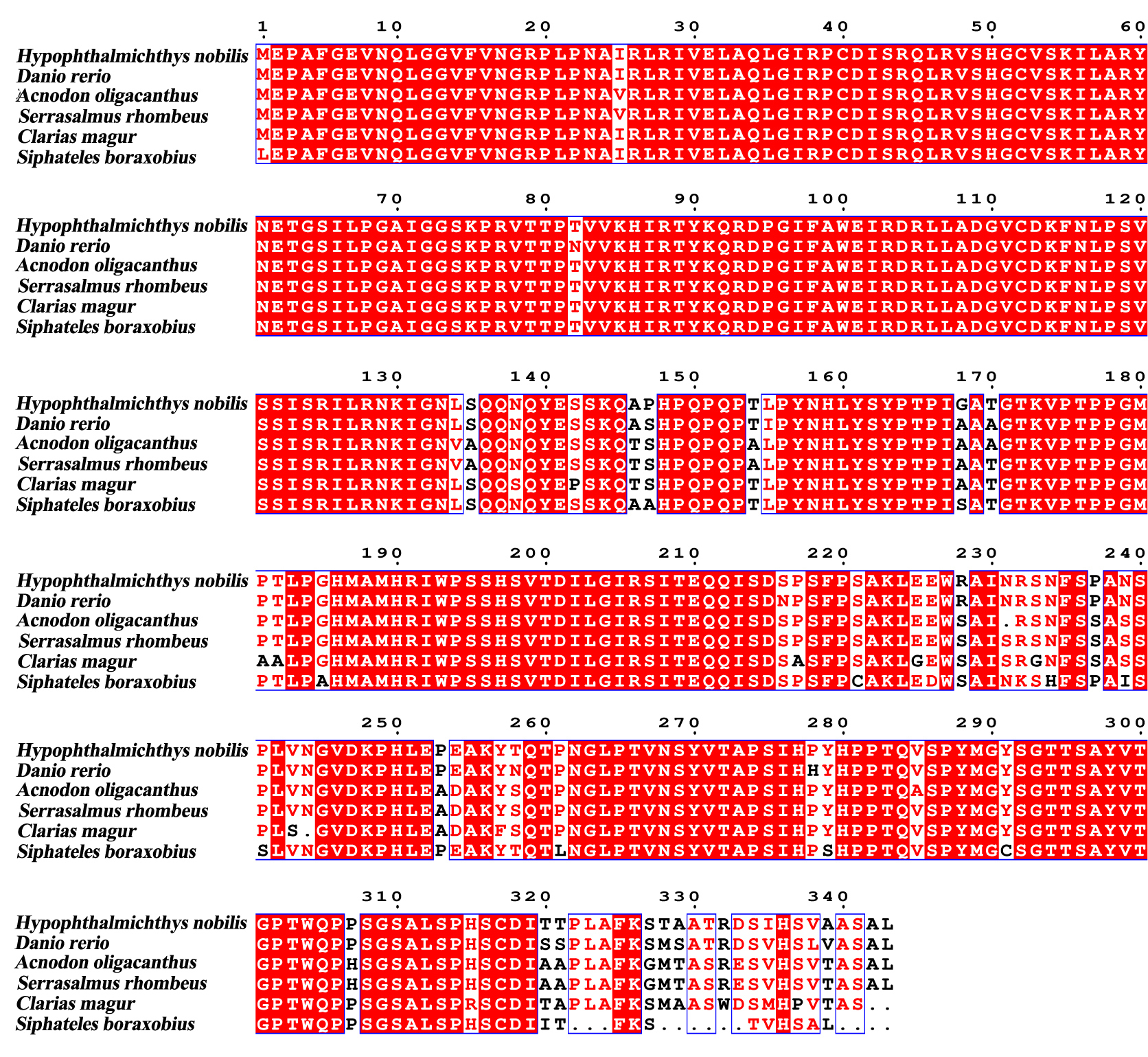
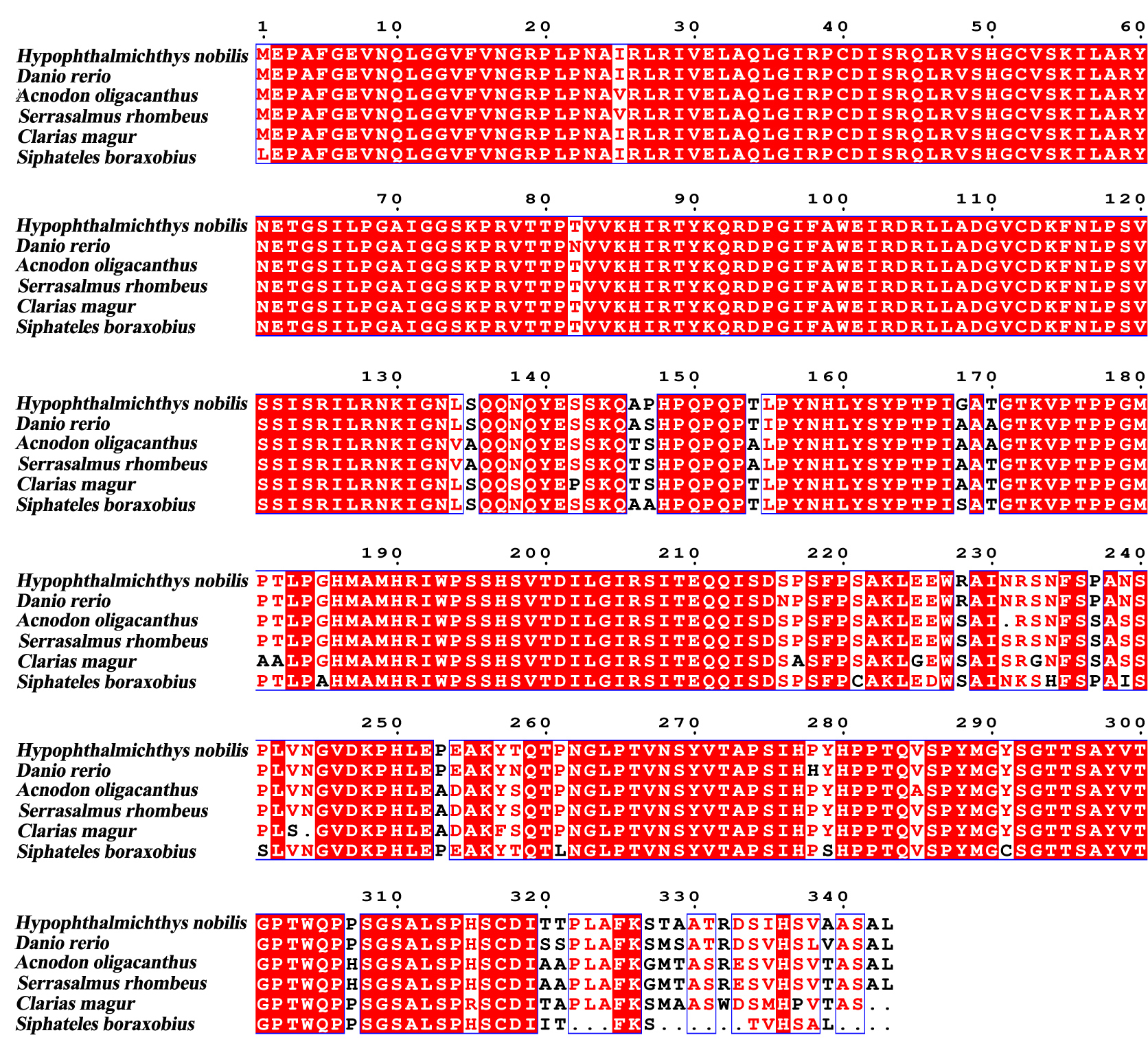
Multiple sequence alignment of Pax9 orthologs from representative vertebrates revealed a highly conserved N-terminal region corresponding to the paired box domain. Within this domain, the deduced HynPax9 sequence showed high identity with other cyprinid fishes including Danio rerio, Siphateles boraxobius, Acnodon oligacanthus, Serrasalmus rhombeus, and Clarias magur. The conserved core motif suggests an essential function in transcriptional regulation. The alignment is shown in Figure 2.
3.3. Phylogenetic Analysis
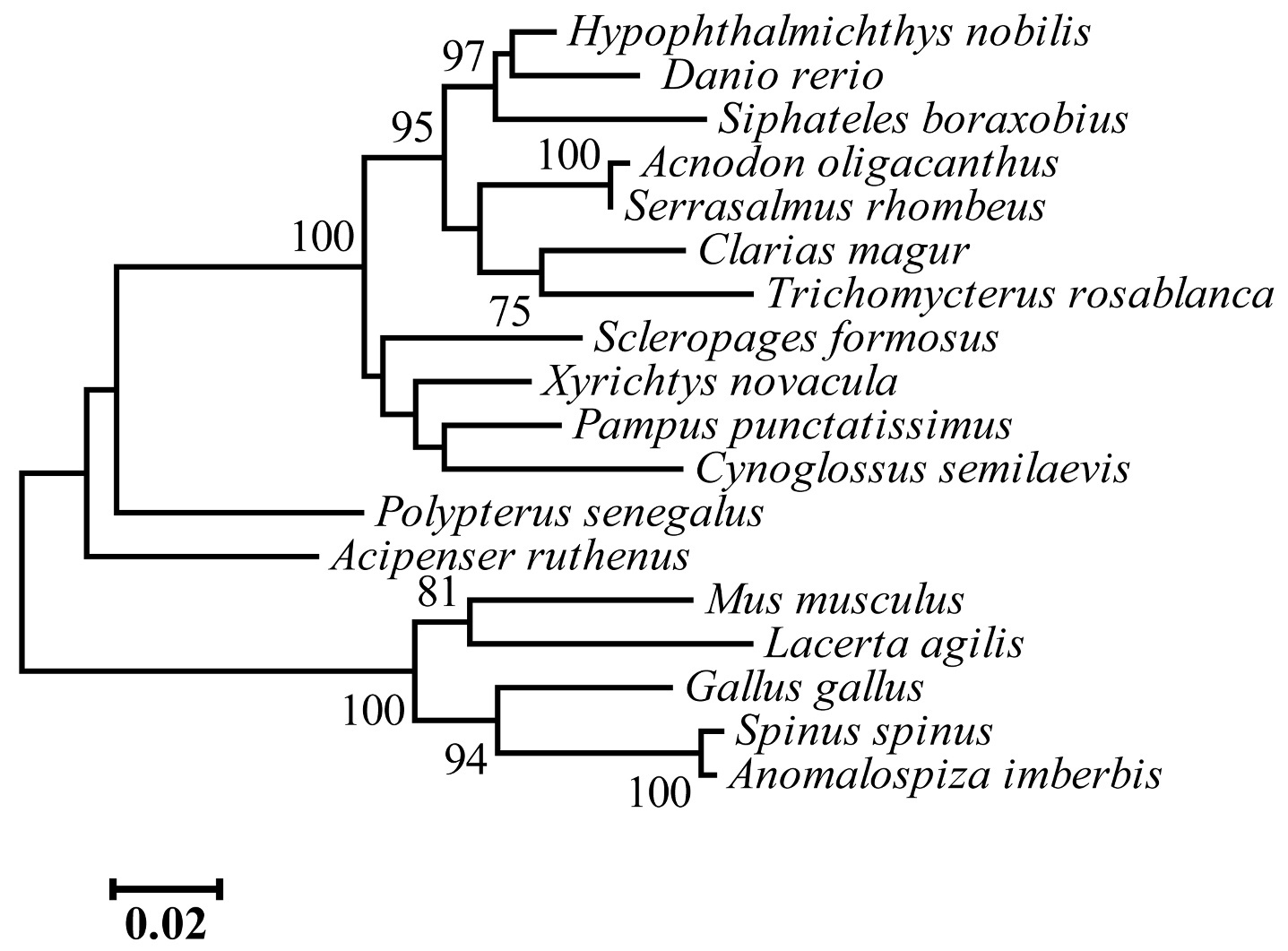
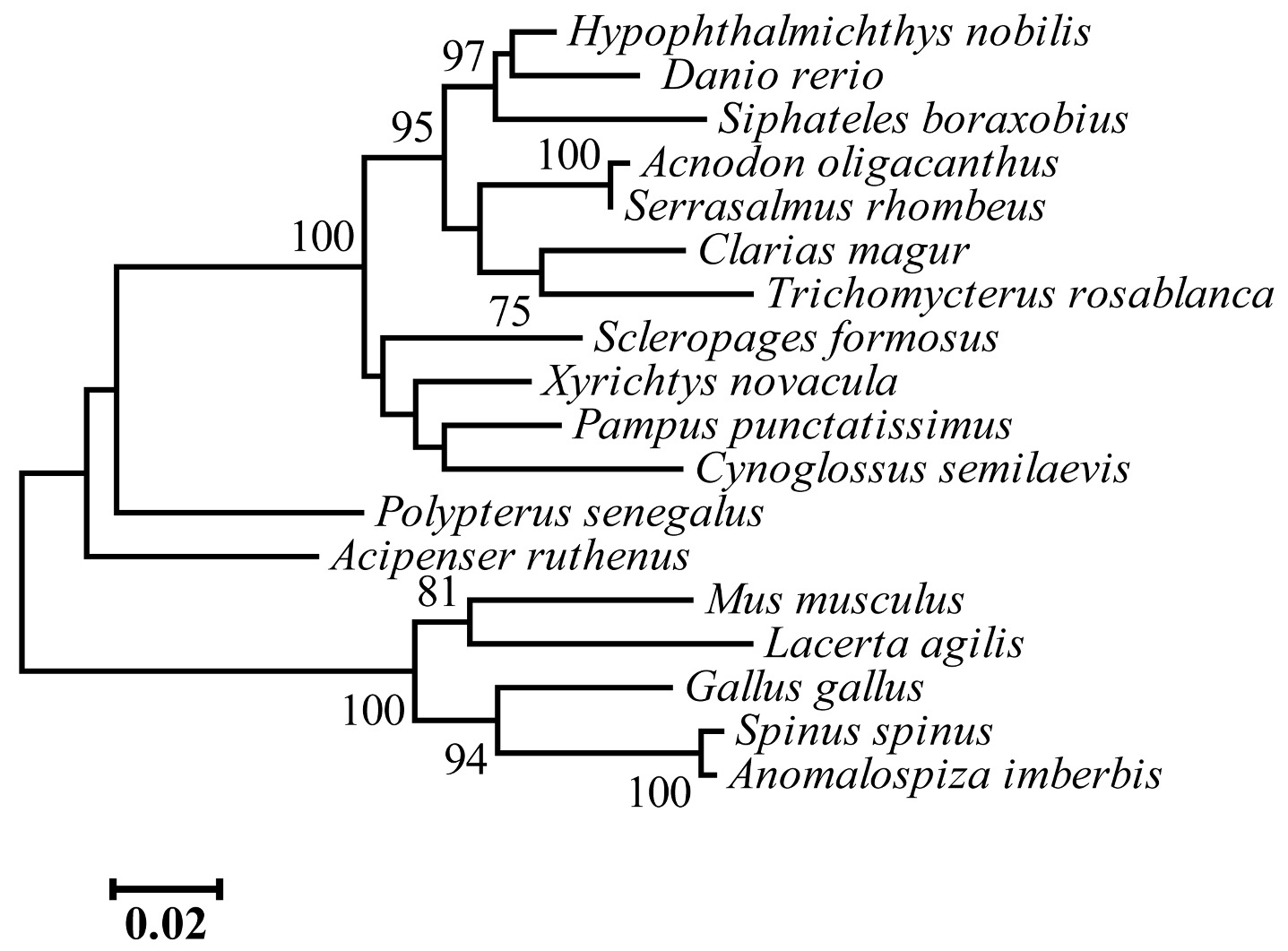
A phylogenetic tree was reconstructed using the neighbor-joining method based on full-length Pax9 amino acid sequences from representative vertebrates. As presented in Figure 3, HynPax9 was placed within the cyprinid clade and exhibited the highest sequence similarity with zebrafish Pax9, with strong bootstrap support of 97%. Other teleost Pax9 sequences formed separate branches, and all tetrapod Pax9 sequences including those from Mus musculus, Lacerta agilis, Gallus gallus, and finches clustered together, as expected based on their evolutionary relationships. This topology reflects the conserved evolutionary history of the Pax9 gene across vertebrates.
3.4. Tissue Distribution and Growth-Related Expression of HynPax9
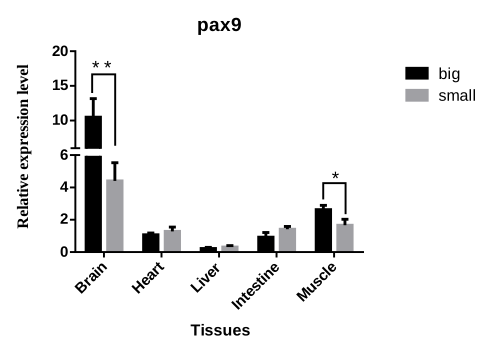
qRT-PCR analysis was performed to examine the tissue distribution of HynPax9 in bighead carp. The results showed that HynPax9 was expressed in all five tissues tested, including brain, heart, liver, intestine, and muscle. The highest expression level was observed in the brain, as shown in Figure 4.
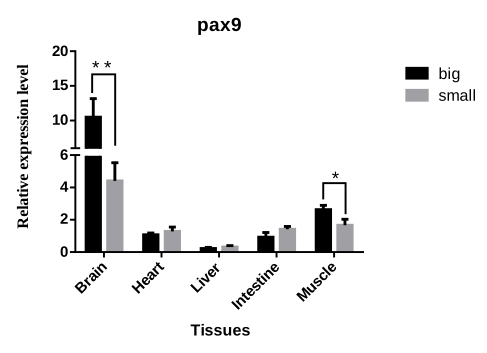
To explore the association between HynPax9 expression and body weight, we compared its expression levels in bighead carp individuals with extreme body-weight phenotypes. The heavy group consisted of the largest individuals with an average body weight of 544 ± 14 g, while the light group comprised the smallest individuals with an average body weight of 117 ± 8 g. In the brain, HynPax9 expression was significantly higher in the heavy group than in the light group (P < 0.01). In muscle tissue, expression was also significantly higher in the heavy group (P < 0.05). No significant differences in expression were observed between the two groups in heart, liver, or intestinal tissues.
4. Discussion
This study systematically characterized the Pax9 gene in bighead carp and compared its expression between individuals with extreme growth phenotypes. As a core member of the Pax gene family, Pax9 belongs to the Pax1/9 subfamily, which plays crucial roles in gill arch formation and thymus development.15 As a transcription factor, Pax9 primarily functions through interactions with DNA or protein interactions. The absence of a signal peptide and transmembrane domains suggests that Pax9 likely acts within the nucleus, directly participating in transcriptional regulation, aligning with the known functional role of Pax family proteins as nuclear transcription factors.16
Multiple sequence alignment revealed that HynPax9 shares high sequence identity with other teleost Pax9 orthologs, particularly within the paired box domain. This high degree of conservation suggests that Pax9 maintains essential functions throughout vertebrate evolution. For instance, the paired box domain and octapeptide sequence of Pax1 and Pax9 are strikingly conserved in Xenopus laevis, with the ancestral Pax1/9 gene having remained almost invariable for more than 500 million years since the divergence between hemichordates and vertebrates.17 The phylogenetic tree further supported this notion by placing HynPax9 within the cyprinid clade, with the closest relationship to zebrafish Pax9 and strong bootstrap support of 97%. The tree topology reflected the expected evolutionary relationships, with teleost sequences forming a distinct clade separate from tetrapod sequences, including Mus musculus, Lacerta agilis, and Gallus gallus. The close clustering of HynPax9 with zebrafish Pax9 is consistent with their phylogenetic positions within the Cyprinidae family.
Previous studies have demonstrated that Pax9 plays indispensable roles in craniofacial development. In zebrafish, Chen et al. found that Pax9 is involved in chondrocyte differentiation and bone maturation, further confirming its role in skeletal development.3 Neural crest cells play a critical role in craniofacial development, and PAX1-9 functions are largely conserved throughout vertebrate evolution, in particular during central nervous system and neural crest development.18 Pax9 knockout mice exhibit hypoplasia or absence of parathyroid glands and tooth agenesis.19,20 In zebrafish, Paudel et al. demonstrated that homozygous Pax9 mutants develop pharyngeal teeth normally but completely lack the premaxilla and most of the maxilla, and also fail to form nasal and maxillary barbels, indicating that Pax9 is essential for upper jaw formation rather than tooth development.4 These findings in zebrafish are particularly relevant for bighead carp, given the shared teleost craniofacial architecture and the commercial importance of head size in this species. However, it is important to note that the present study did not directly measure head morphology traits; rather, we examined HynPax9 expression in relation to body weight extremes. While the established role of Pax9 in craniofacial development, together with its recent identification as a growth-associated candidate gene in bighead carp, provides a rationale for examining this gene in the context of growth, any connection between HynPax9 expression and head development remains speculative at this stage.11 We hypothesize that HynPax9 may be functionally linked to growth-related processes, potentially through pathways involved in chondrocyte proliferation and differentiation; however, this hypothesis requires direct functional testing and morphometric validation in future studies.
qRT-PCR analysis revealed that HynPax9 was expressed in all five examined tissues, with the highest expression in the brain. Notably, its expression in the brain and muscle was significantly higher in heavy individuals than in light individuals, while no significant differences were observed in other tissues. The preferential expression in the brain and its up-regulation in fast-growing individuals suggest a potential association with central growth-related processes. The concurrent elevation in muscle tissue might reflect a peripheral effect, possibly mediated by systemic growth factors or neuroendocrine signaling. Similar growth-related expression patterns have been reported for other genes in bighead carp. For instance, slc5a6a, a gene associated with head size and shape in genome-wide association studies, is highly expressed in the liver, pituitary, and muscle, with significantly higher expression in fast-growing individuals than in slow-growing individuals.21 This parallels our findings for HynPax9 and strengthens the notion that transcriptional regulation in key metabolic and neuroendocrine tissues is a common feature associated with growth variation in this species. Given the large head proportion and high edible value of bighead carp heads, we speculate that HynPax9 expression may be relevant to head-related skeletal development; however, as noted above, this hypothesis requires direct morphometric validation. The differential expression in muscle tissue further suggests that HynPax9 may be associated with muscle growth-related processes, although this interpretation requires confirmation with larger sample sizes. Although the precise mechanism remains unclear, its nuclear localization and transcription factor characteristics are consistent with a potential role in modulating downstream genes involved in cellular proliferation and differentiation—processes fundamental to both skeletal and muscle growth. Our findings are consistent with the genetic evidence reported by Chen et al., who identified Pax9 as a growth-associated candidate gene in bighead carp through BSA analysis.11
Several limitations of this study should be acknowledged. The sample size (n = 5 per group) is modest, which limits statistical power and increases the risk of type I and type II errors. Although an FDR correction was applied and non-parametric tests were used for confirmation, the observed effect sizes should be interpreted with caution. Additionally, all fish originated from a single pond and a single cohort, which does not allow us to separate genetic effects from microenvironmental factors, such as social hierarchy or local feed competition, that may have contributed to the observed differences. Moreover, the extreme-tail sampling strategy may overestimate effect sizes relative to the full population range, so the magnitude of the observed expression differences should be viewed as upper-bound estimates that require validation in unselected populations. Furthermore, the expression data are correlational, and without functional experiments, we cannot establish a causal relationship between HynPax9 expression and growth regulation. Despite these limitations, our study provides the first molecular characterization and tissue-specific expression profiling of Pax9 in bighead carp, establishing a foundation for future functional studies and independent validation in larger populations.
In summary, our findings demonstrate that HynPax9 exhibits a tissue-specific expression pattern with the highest expression in the brain, and its expression levels in the brain and muscle are significantly correlated with body weight in bighead carp. These results provide preliminary evidence that warrants further functional studies and independent validation before HynPax9 can be considered as a marker for breeding programs.
Acknowledgments
This work was supported by the Doctoral Research Start-up Grant of Xinyang Agriculture and Forestry University (grant No. 203130) and the Natural Science Foundation of Henan (grant No. 262300422163). The authors thank the staff at the pond farm in Chushandian for their assistance with fish sampling.
AUTHORS’ CONTRIBUTION - CREDIT Conceptualization
Conceptualization: Junru Wang (Equal), Jun Liu (Equal), Kunjie Wu (Equal). Methodology: Junru Wang (Equal), Qi Lei (Equal). Formal Analysis: Junru Wang (Equal), Bangmiao Liu (Equal). Investigation: Junru Wang (Equal), Qi Lei (Equal), Zhihang Yang (Equal). Writing – original draft: Junru Wang (Lead). Data curation: Qi Lei (Equal), Zihua Yan (Equal). Validation: Qi Lei (Equal), Zhihang Yang (Equal). Resources: Ting Wei (Lead). Project administration: Ting Wei (Equal), Jun Liu (Equal). Visualization: Bangmiao Liu (Lead). Software: Zihua Yan (Lead). Writing – review & editing: Jun Liu (Equal), Kunjie Wu (Equal). Funding acquisition: Jun Liu (Lead). Supervision: Jun Liu (Equal), Kunjie Wu (Equal).
ETHICAL CONDUCT APPROVAL – IACUC
All experimental procedures involving bighead carp were conducted in accordance with the guidelines approved by the Animal Ethics Committee of Xinyang Agriculture and Forestry University.
DATA AVAILABILITY STATEMENT
All are available upon reasonable request.
COMPETING OF INTEREST - COPE
No competing interests were disclosed.
INFORMED CONSENT STATEMENT
All authors have read and agreed to the published version of the manuscript.